01/03/2021

House Of Confusion

We’re a nation that’s gone so far up its own arse it can’t move from the crap everywhere
(Peter Boyd, Waking The Dead: Anger Management, 2004)

© Tony Banks, Phil Collins, Michael Rutherford, 1986

You can’t understand the picture if you’re inside the frame
(Peter Boyd, Waking The Dead: Final Cut, 2003)

There is an interesting paradox in current voting trends, and one that is quite counter-intuitive even for me. It might well prove easier for Labour to form a government in a hung Parliament than for the Conservatives. Bear in mind that, whatever the exact voting intentions and with Sinn Féin excluded for the usual reason, there will always be a bloc of 80-85 MPs who would be neither Labour nor Conservatives, and could exert massive influence on the post-election events. Of these only the DUP could be expected to support a Tory government, or perhaps not. So the likely scenario is that the Conservatives would indeed need an outright majority, or else they might face a Coalition Of The Unwilling ready to vote down each and every bill. While Labour could count on support from the SDLP and some sort of agreement with Plaid Cymru, the Greens, the LibDems and the Alliance Party, who have de facto become the local branch of the LibDems in Northern Ireland. Meaning Labour could count on an additional 15-20 votes and form a viable minority government with as few as 280-290 MPs of their own, as in this case the Conservatives would be down to 275-285. Of course, all these scenarios can happen only if Labour and the Conservatives are really close in the popular vote, somewhere between a tie and Labour leading by a couple of points. Which has happened at the end of last year in many polls, so let's just see first what the trends look like now, two months into the Year Of The Snoek, shall we?


What the 2021 polls tell us is that we're back to the situation we had in midsummer, which is definitely more of a trogglehumper than a night's dream for Labour. Personal image matters too and people seem to have forgotten what a flushbunking blatherskite Boris has been over the last twelve months. Next thing you know, we're gonna have a statue of Saint Boris Slaying The Virus in the middle of Parliament Square. Just the kind of narrative that definitely works in Leafy Eastern Surrey, though admittedly less so in the Red-To-Blue-To-Red Wall counties. But even there, you can see signs that lingering doubt has given way to benefit of the doubt. Interestingly The Guardian, never short on contradictions, now advise Labour to devote more efforts to South England, pretty much repeating my earlier arguments that New New Labour will win the next election if they crawl back to the same level of support New Labour enjoyed in the Home Counties, even at their low point in 2005. Which is definitely not what the last batch of polls predict, as Labour is left bopmuggered by the number of voters who have whiffswiddled back to the Tories since the world-beating Snoek Deal, and even more so since the First Minister of England is rollicking in his deepfreeze-ready Pfizer Honeymoon. And that's the moment Keir Starmer chooses to go natterboxing rommytot about how giganticus weapons of mass destruction are, which will probably not really help either in Hampstead or Glasgow. If he was really paying attention, Sly Keir should feel scrotty over where public opinion stands now, based on the weighted average of the last four published polls, conducted between 19 and 26 February. Super-sample size is 6,307 with a highly theoretical 1.23% margin of error.


Before we proceed any further, there's a necessary and long-overdue caveat, about the SNP's vote share in GB-wide or UK-wide polls. Which is, believe it or not, overestimated, or rather represented above its actual level because of the pollsters' weighting mechanisms. According to ONS data, Scotland accounts for 8.2% of the UK's population, or 8.4% of Great Britain's. But higher voter registration means Scotland accounts for 8.5% of the UK's electorate, or 8.7% of Great Britain's. Then higher turnout at the 2019 election meant that Scotland accounted for 8.6% of all votes cast in the UK, or 8.8% of all those cast in Great Britain. And now our problems start. Based on the four main pollsters' published data for their most recent survey, here is the share of Scotland in their original sample, and then after excluding undecideds and weighting by likelihood to vote. I included only each's last poll here, but you can trust me it's all the same in past polls, and sometimes even worse, depending on the relative weight of undecideds that are scratched from the final 'headline result'.


YouGov publish only one set of numbers, which I assume represent the original makeup of their sample, without any hint on how weighting might alter that. So the makeup of the original samples is something of a mixed bag, but more or less accurate or inaccurate depending on your mood. But the post-weighting share of Scotland is definitely and conclusively overestimated by three of our main pollsters, and quite possibly also by the fourth one even if we don't have the smoking gun here. Which is why you see the SNP vote skyrocket from 3.98% in 2019 to fantastically implausible levels like 5-6%, while low-to-mid 50ish% of Scottish vote is more like 4.2-4.4% of the GB-wide vote. And this also gets you biffsquiggled and wondering why the SNP don't systematically bag all 59 fucking seats when their vote share is so razztwizzlery high. Fortunately, real Scotland-only polls are here to remind us that the SNP really do better than in 2019, though it might not always be such a landslide as you might think at first glance. For example, this week's full Scottish poll from Survation has the SNP on 48% of Commons voting intentions, which would be something like 4.1% GB-wide, and yet my current Poll'O'Polls says 4.2%, which would be some 51% of the Scottish vote. Just saying, so that you don't get your hopes too wildly high, especially when the trend sees the SNP slowly losing votes.

If you want the high life, you have to embrace some serious lowlife
(Claudia Baxter, Silent Witness: River's Edge, 2016) 

© Tony Banks, Phil Collins, Steve Hackett, Michael Rutherford, 1976

It strikes me that the human race is supposed to be more evolved
If you look at all this, you've gotta ask yourself if, as a species, we are on the right track
(Peter Boyd, Waking The Dead: The Hardest Word, 2004)

What polls tell us now is that the Conservative lead over Labour would be cut by almost half compared to 2019 and back to a 2015ish level. My model says it would take Boris just a few seats shy of a majority, but far from what is needed to pull a bonking stonker this time. Such an outcome would definitely not mean that Britain's Got Less Talent, as most of the fatalities here would be pibbling notmuchers from the 2019 intake, whose main contribution to the political debate has been the perfect triangulation of arse-licking incompetence. The only really noticeable Tory fatality here would be Graham Brady, Chair of the 1922 Committee of unruly backbenchers and a born-again Covidiot trying to outfox Nigel Farage on his turf. As it stands, Conservatives would gain only four seats: Alyn and Deeside, Dagenham and Rainham, Canterbury from Labour; Westmoreland and Lonsdale from the LibDems. The latter if they find a candidate who can outbigot Tim Farron on Christian values and homophobia, which shouldn't be too difficult when you think of it. Of course there are also even odds on Tories snatching Ayr, Carrick and Cumnock from the SNP. Just don't tell Douglas Ross and Andrew Bowie as they would drool at the prospect of a three-seat gain.


Odds are Bozo could even bribe the DUP back into some shade of supportivish neutrality, if he has enough pocket change left after spaffing so much on contracts awarded unlawfully to cronies and the publican next door. All it would take is reneging on the world-beating Christmas Gift To Britain Deal, which wouldn't matter anyway as nobody remembers what was in it, and most Ministers never even knew. Or he could try and convince Arlene Foster that duplicating the Swindon Roundabout under the Isle of Man is not such a plexicated idea as it looks, and could even be quite a ringbeller as long as it totally squishes Irish Reunification by not having any subaquatic connection to Dublin. The alternate scenarios, once I reallocate the marginals to the runner-up, are again quite interesting. The Conservatives' best case scenario would still see them lose two dozen seats, which proves that duplicating the 2019 upset is not that easy, even with some help from Astra-Zeneca. Labour's best case scenario would again trigger lots of speculation in the few days before Not-So-Hardy Keir decides not to extend an olive branch to the SNP after all. This is far from the 'get the popcorn out' scenario I mentioned earlier, where Keir could gamble a minority government without the Pesky Jocks. On these numbers, Keir would have to show his baws, and listen to Clive Lewis instead of Ian Murray and Anas Sarwar. But of course we already know Keir will never go that far, don't we? Better to never be First Minister of England that to make any concession to the Nats. Aye, right.


For your complete information, I have now re-engineered all my models, not just the Scottish one, to accommodate regional crosstabs when the pollsters provide them. When we have them, they're based on the Senedd and Holyrood electoral regions in Wales and Scotland. London is split between Outer and Inner, which has some taste of Middlesex vs Labourgravia, by Redfield and Wilton, who happen to be the only ones conducting London-specific polls since the 2019 election. Redfield and Wilton also crosstab their polling data from the rest of England with the eight ONS regions, while other pollsters stick to the cruder North-Midlands-South divide. I won't claim this is perfect and faultless, but is does look like an interesting approach to different changes in voting patterns all over the UK since the last election. As I mentioned earlier, factoring in the regional crosstabs helps the Conservatives against the SNP in Scotland, which could help SNP HQ realise that not all landslides do happen. It's fairly neutral in Wales, though in can help Plaid Cymru in some cases. In London, the Middlesex Effect helps the Conservatives against Labour. There's a strong opposite pattern in the rest of England, with the Conservatives only getting entrenched deeper in the Leafy South, while Labour come back with a meaner vengeance in the North and part of the Midlands. You can see below how my tweaked model compares with the untweaked version, and also with what my competitors predict with the same current set of voting intentions data.


What we have this time is the unlikely and seldom seen alignment of the polls, when all projections more or less based on uniform swing deliver a very similar number of seats, give or take la handful. I know from several other simulations that it is way more likely that my three competitors will deliver results quite different from mine, and then the regional tweaks make the gap even bigger, sometimes up to 25ish seats mostly switching from the Conservatives to Labour. The differences in algorithms and underlying data might not make a massive difference with some aggregates of polls, but it is not always true when relying on individual polls. As I said earlier about my Scottish seat projections, larger samples tend to level out the outliers. All you need is one outlier in one direction and another one going the opposite way, and it all folds back neatly into regression to the mean. On top of that I still need to assess more precisely whether the differences in the algorithms (using a mix of proportional swing and uniform swing instead of just uniform swing) matter more that the tweaks to the underlying data. Might make for some interesting case studies with various combinations of polls, though I have a hunch this might be conclusive only if we have a murder of polls going in the same direction, rather that the often contradictory results we have had so often in the past.  

If you're a lion with a degree of moral sensitivity, then you just stopped being a lion
(Doctor Greta Simpson, Waking The Dead: The Hardest Word, 2004)

© Steve Hackett, Phil Collins, 1977
Enjoy Gary O'Toole doing something Phil Collins never ever did
Singing and drumming at the same time, which is quite a feat

So, making mistakes can make you popular? Who knew?
(Clarissa Mullery, Silent Witness: Betrayal, 2019)

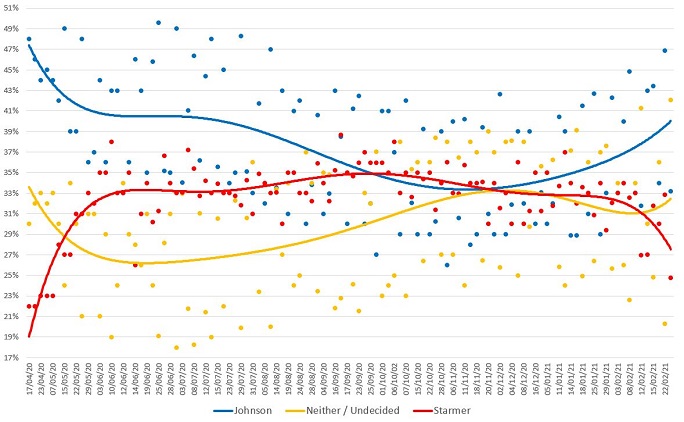
Polls don't only show better electoral prospects for the Conservatives as a whole. Boris Johnson's personal ratings have also improved over the last two months, as well as his standing in Preferred Prime Minister polling. It's like people are sending the message that they don't mind eating snoek and no longer buying books from France for the next three years, as long as they all get their jags and then can go to the game and sling tins at the linesman again. Which might be uncomfortably closer to the truth than you might want to believe, for Englanders at least. According to the aggregate of all polls, the First Minister of England's net approval rating has improved from -11% in November, -8% in December when we had some of the first hints of 'Fucking Brexit Getting Fucking Done', -7% in January after the not-so-convincing Bozo Deal with the EU, -1% in February after twelve weeks of vaccine rollout. Boris Johnson has also skyrocketed back to a convincing lead over Keir Starmer in the Preferred Prime Minister polls, which definitely look bad for Sly Keir. There's a double whammy in there, with both a number of Starmeristas switching to undecided, and a number of undecideds rallying around Boris. I won't even lecture you on the importance of cuddling undecideds, in England just as in Scotland, as I have made that point repeatedly already, haven't I?

The next question is whether there will be a Very Tory Coup against Boris Johnson, something along the lines of November 1990 déjà vu all over again. Though you have to understand most Tory MPs would think twice before becoming part of that. They all know that Boris is an evil ruthless vindictive bastard. If you staged a coup against him, you'd have to win or be relegated to the Ninth Circle, so standing orders would have to be "shoot to kill and take no prisoners". A number of Tory MPs from the 2019 intake never thought they would be elected, even in their wettest dreams. They think they owe it to Bozo, so they're ready to be his cannon fodder, and wouldn't even try and explain their support by anything more intellectual than "because it's Boris". Never mind this lot are mostly complete shitwanks like Ben Bradley, and pretty much the Trashcan Men to Johnson's Randall Flagg. Numbers matter here, not brains, and these and other Boris Cultists probably make up about a third of the Conservative Parliamentary Party. Then another third have already challenged Boris from the right, broadly on the basis of libertarian and traditional English values, including painting the closing of the pubs as an unacceptable breach of civil liberties. This lot, hardly more intellectual than the first one, would probably have supported Michael Gove before he got his wings and claws clipped, though they probably dispunge Sleekit in private, but now they know better than to fuck with Boris. And finally, the last third are more like traditional One-Nationers still believing that conservatism has a compassionate side, but are also business-friendly. Since their natural leader, who would be Theresa May, has pretty much burnt herself out already, they would be the logical fanbase for PR-savvy Rishi Sunak. Though a divided Tory party might have some more surprises in store, including the unlikely return of Jeremy-In-The-Box Hunt. Or the much more likely scenario where the Covidiots dump the burnt-out vermicious Gove and switch allegiance to Rishi "Let's Open Everything Wide" Sunak, which would be one fucking fuck of a problem for Boris.


Now there is also a lot of ambiguity and contradictions in Rishi's levels of approval in recent polls. The most recent favourability survey by YouGov has him on a +13% net rating, which makes him the only Cabinet member with a net positive and a shitload of leagues ahead of the others: Priti Patel on -37%, Dominic Raab on -19%, Matt Hancock on -23% and even Boris himself on -12%. But YouGov is definitely the least Boris-friendly of all pollsters, so don't read too much into that one poll. Rishi is also doing a lot better here than Keir Starmer, who is on a net -10%. Oddly this 23-point lead does not translate into a massive advantage in Prime Minister polling, though there are multiple caveats here. You can't compare these directly with the Johnson-Starmer chart above as only one pollster, Redfield and Wilton, has tested the Sunak-Starmer option. While six pollsters test the Johnson-Starmer option regularly with somewhat different results, so the signal from Redfield tends to be lost in all the noise. Redfield and Wilton are also the most consistently Johnson-friendly in this niche polling, so I wouldn't rule out Starmer actually doing better than Sunak if any other pollster asked the same question, which would indeed be quite counter-intuitive if you take the favourability ratings at face value. But then Rishi hasn't had the same wealth of opportunities as Boris to outfox Keir in Commons, has he? Perhaps Lindsay Hoyle should now make Chancellor's Questions a regular feature, like every other week instead of the highly predictable and borderline boring PMQs, and we would see what happens.


You probably remember I said two months ago that Boris wouldn't last till the end of this year. Which was based on polls predicting a hung Parliament where Labour would be tied with the Conservatives on the number of seats, and might even end up as the first party. Now the last batch of polls says we are very far from that, because hopscotchy Boris is basking in the spotlights of a world-beating Covid vaccination scheme, and people have pretty much immunised themselves against all his poppyrot. So Oor Feisty Bozo has got himself a stay of execution, and he'd better make the most of it while it lasts, like awarding the next English school meals contract to Wetherspoons while everyone is watching the squirrels who survived Jo Swinson. Then the litmus test might come sooner that Boris wants or expects, when he has to take a principled stand and say something intelligible in the incoming debate about 'Covid passports', and I definitely can't think of any answer that wouldn't leave him crodsquinkled and at odds with one half of his own party or the other. Then Boris might try and make the point moot by sending Matt Hancock on a fact-finding mission about Gwyneth Paltrow's vagina-scented cure for Long Covid. Not available in Northern Ireland. Terms and conditions apply. Or he might take a leaf from Theresa May's playbook and kick that can of worms down the road, until the vaccine rollout is completed and public opinion agrees that segregation is the right thing to do. Which might not be as far-fetched as we would like to think. Never underestimate the genetically-inherited propensity of Englanders for discrimination and erecting barriers where none exist. Sunlit uplands are great as long as you don't let everybody in, aren't they?

These our actors, as I foretold you, were all spirits and are melted into air, into thin air.
And, like the baseless fabric of this vision, the cloud-capp’d towers, the gorgeous palaces,
The solemn temples, the great globe itself, yea, all which it inherit, shall dissolve,
And, like this insubstantial pageant faded, leave not a rack behind. 
We are such stuff as dreams are made on, and our little life is rounded with a sleep.
(Prospero, The Tempest, Act IV, Scene I)

© Tony Banks, Phil Collins, Peter Gabriel, Steve Hackett, Michael Rutherford, 1974

09/02/2021

The Year Of The Nats

It was the year of fire
The year of destruction
The year we took back what was ours
It was the year of rebirth
The year of great sadness
The year of pain
And a year of joy
It was a new age
It was the end of history
It was the year everything changed
The year is 2021
The place... Scotland
(Babylon 5, Season Four opening sequence, almost....)

© Al Stewart, Peter Wood, 1976

Keep your mind open too wide and your brains will fall out
(Detective Superintendent Colin Osbourne, Silent Witness: Beyond Guilty, 2003)

I have a feeling '21 is gonna be a good year. For Scotland if not for England. Because I can't honestly give a rat's fuck about what will happen to or in England. They wanted Brexit and the First Minister of England they elected got it done. More or less. Now it's their mess and they have to own it and sort it out. And don't even try that "we're all in it together" cooshite, because we're not. You have painted yourselves into a corner without exit, but we have the motive, means and opportunity to get ourselves out of this. So keep calm and eat your Brexit snoek, and let us go our own way. Just wait and see. Scottish Independence is the next logical step after the First Minister of England surrendered Northern Ireland to the Republic of Ireland and Gibraltar to Spain, isn't it? And you all should be so happy to see those pesky thrifty Jocks go, who can't even manage themselves and you subsidise to the tune of £15bn a year. Oor Doogie Ross, Baroness Ruth Davidson and Nigel Farage said it, so it has to be true. It's £289mil a week, so I guess all we have to do is paint that on the side of a bus and tour it from Carlisle to Truro, and you will instantly vote us out of your Precious Union, so you can take back control of all that dosh. But don't come whining and blaming us when you realise there is no dosh at all, and it was all a lie that you were just too happy to believe. 

© Rebecca Hendin, The Guardian, 2020

2020 was the Year Of The Nyaffs in so many ways that anything 2021 becomes can only be an improvement. Then I would be at a loss choosing the Nyaff Of The Year, as they are so many who deserve it. Boris Johnson and Jacob Rees-Mogg would definitely deserve a Lifetime Achievement Award, which clears the field for other worthy contenders. Of course Dominic Cummings would get an award, you'd just have to pick for which of his many feats over last year, and getting himself sacked for being too much of a nyaff, even by Johnsonian standards, doesn't count. I guess we could also have an Ensemble Cast Award for Priti Patel, Matt Hancock, Robert Jenrick, Dominic Raab, Gavin Williamson and Oliver Dowden as The Worst Cabinet in Living Memory. North Of The Wall, I definitely nominate Oor Doogie Ross for his successive U-turns on the Internal Market Bill, which had him ending up exactly where he started from. Kirsty Blackman for her asinine whining over Woko Haram taking one fuck of a shellacking at the SNP's NEC election. Wee Andy Bowie for his attempt to spin the Bozo Deal as a great success and England's Christmas present to Scottish fishermen. Rev Stu Campbell, though technically he's way Doon Sooth, for relaying the Tory lie that 'voting against the deal is voting for no deal' in another attempt to smear and undermine the SNP . And finally another Ensemble Cast Award for all the Genderist Cultists who left the SNP and joined the Scottish Greens, after the SNP were forced by their own rebels to let Scottish Parliament pass Johann Lamont's 'sex not gender' amendment to the Forensic Medical Services Bill. Then of course that was last year, and since then we've seen some new outpour of madness. More on that later when discussing this year's polls.


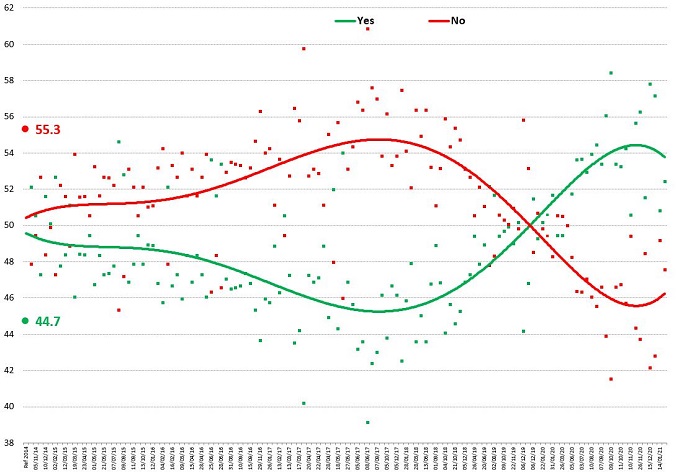
Now Scottish politicians of all shades are getting ready for this year's election, and there is no doubt the Brexit fallout will play a huge part in the campaign. It would indeed be a dereliction of duty if the SNP did not use it to massively make the case for Independence. Because, no matter what SNP HQ have in mind, the Scottish Parliament election has to be, and will be for millions of voters, a 'pseudo-referendum' on Independence. I don't think the SNP desperately trying to shoot themselves in both feet and both hands simultaneously will have much impact here. I am quite sure voters have their priorities straighter than the governing party, and that support for Independence will continue to be the default option for the foreseeable future. Of course The Cause will benefit greatly from Labour rebranding themselves as the party of English Nationalism, a move that even the Starmer-friendly Guardian thinks is a massive blunder that could derail Sly Keir's attempts to make his party attractive again, and is fought by the true progressives within Labour. Sly Keir has also come up with what he probably thinks is the Magic Wand against Independence: Radical Federalism, or Double Devo Max, or The Vow 2.0. Of course you are welcome to unbelieve everything that Labour, or a think tank close to Labour, has ever said about it being a viable alternative. Because it's not, but could be a massive Squirrel In The Room, the distraction Unionists need to keep our eyes off the proverbial ball. Only Panelbase have tested a three-way vote so far, in their latest survey for The Sunday Times. They found that only 20% of Scots support this Third Way being on the ballot, and just 17% would actually vote for it. But it would snatch 5% off Yes and 12% off No, so Yes would not get an outright majority. You can bet the English Establishment would use that as evidence the referendum was inconclusive and we don't get Independence after all. So let's stick to the classic Yes-Or-No question, and here's what the updated trends of voting intentions say, once undecideds are counted out.


I think that the situation is not as bad as the recent downward trend of the Yes vote would make you believe. First of all, you should not consider just the raw results, bot also how they compare with previous answers to the same question. Here the Survation and SavantaComres polls show no change from the previous surveys by the same firms, that were both fielded in December. Only the Panelbase poll is a bit worrying as it shows the Yes lead down by 6% on their previous poll conducted in November. But this earlier poll was one of those showing an unexpectedly high level of support for Yes, so part of the explanation might just be random differences in sampling. Or not. Then the reassuring part is that the weighted average of the three January polls is not significantly different from what we had the last time I wrote about this in November, as the chart further down shows. Just notice that undecideds still make up about 10% of the electorate, and potentially still hold the key to success. As I have said multiple times already, the path to victory is converting undecideds, and I'm delighted to see The National has now endorsed this strategy and launched a new campaign that looks quite successful so far. Let's just hope this will not fall flat after the SNP announced their Eleven Points Roadmap, that quite muddied the waters by being released after hearings were concluded in Martin Keatings's People's Action On Section 30, which has now been sent to the Inner House of the Court of Session. It was quite puzzling to see Pete Wishart claiming the first ruling was a final blow for the case, when it obviously was not, as it was not dismissed on its merits but pretty much on technicalities. But Pipe'n'Slippers Pete had probably not read the SNP's document in full, as its Article 10 clearly states that court action to circumvent Section 30 will be on the table after Holyrood passes a Referendum Bill. Always fun to see Wishy making an arse of himself trying to out-sturgeon Sturgeon on gradualism. But then who still really cares about what Pete has to say?


There's a widespread theory in social sciences that human primates are naturally resistant to change, even when they affirm they support it, because they are unsure what the consequences will be. In many cases too, a lot of people who want change to happen don't expect it to happen, because they don't believe there will be a majority for it, even when polls say otherwise. So there is a double element of doubt, which seems to be currently absent from the Scottish collective mind. First factor is certainly that Independence has been the center of the political debate for more than eight years now, since the Edinburgh Agreement paved the way for the first referendum. All the pros and cons, even the wildly hypothetical, have been debated at some point from all possible perspectives, so people certainly think they have all they need to know to make an educated choice. In this context, I definitively think that any reincarnation of Project Fear will fail, because the people know better and the lies have already been debunked time and again, and all the phony reports in the world won't make a fucking difference. There is conclusive evidence in recent polls than more people want IndyRef2 to happen within the next five years than would vote Yes, and also that more expect Yes to win than would vote Yes or want the referendum to happen. Which is quite far from the double whammy of doubt you could expect when faced with the prospect of such radical change. And if you think Independence is screwed by the SNP reopening the Pandora's can of worms of identity politics, and prioritising pandering to an obstreperous extremist fringe over the proverbial top prize, bear in mind that all that was left at the bottom of the box was Hope, or so the saying goes. Not that Hope, of course. 

Our relationship is based on mutual loathing but it’s a living thing
It needs nurturing, it has to be sustained by continual conflict and abuse
(Charlie Gimbert, Lovejoy: The Sting, 1986)

© Al Stewart, 1976

Instead of scuppering the Scottish nationalists, a Scottish Parliament has made them more popular
Now, that might only be a blip but, with her own politics, her own news,
Today’s Scotland feels a lot more than 400 miles away from Westminster
No constitutional chopper has come down between Scotland and England
But it feels as if a slow, gentle separation is taking place
Like two pieces of pizza pulled apart, still connected, but only by strings of molten cheese
(Andrew Marr, History Of Modern Britain, broadcast on BBC on 19 June 2007)

Of course everyone expects the pandemic to have an impact on our May election. Which is why the Scottish Government tabled the Scottish General Election (Coronavirus) Bill, that the Scottish Parliament passed unanimously on 23 December. This was Stage 3 of the process, so the Bill is now law. It postpones dissolution to 5 May, the day before the election, so that any contingency plans can be debated and voted on until the last moment. It also increases the Presiding Officer's power to postpone the election, from one month to six months. Holding the election over several days has been ruled out, unless the Electoral Management Board propose it at a later date, which right now looks unlikely. Finally the most important, and possibly most controversial part, addresses postal voting. Tory MSP Oliver Mundell has recently been warned by the Electoral Commission over 'postal vote fishing', that is asking constituents to send their application to his constituency office instead of the Electoral Registration Officer. There is also circumstantial evidence that Liberal Democrat leader Willie Rennie did the same, which sounds definitely fishy. The Bill now brings the deadline to apply for a postal vote forward to 6 April. This is considered necessary to deal with an increased workload for election officers, as postal votes are expected to rise from 18% in 2016 to 40-50% this year. But the Scottish Government also made it clear they are not encouraging postal vote, as every precaution will be taken to make in-person voting safe. Let's just hope it will work and we won't have any nasty surprises in the next three months. The Bill nevertheless includes provisions for an all-postal vote, clearly as a last resort measure that would involve postponing the election by a yet unspecified delay. We have pretty much all bases covered and all parties in agreement, so let's roll.


This bill not only provides a base plan to hold the election as scheduled, it also provides a backup to the base plan, a backup to the backup and a last resort scenario. Scotland is more prepared to hold a safe election than any other country worldwide, and Unionists who say otherwise now are only talking through their arse in shameless bad faith, because poll after poll points to a 2011ish SNP landslide. Just remind them that Portugal held a presidential election in January, and the Netherlands will hold a parliamentary election in March, and nobody in either country claimed it would be unsafe and asked for a postponement. The Welsh government too has never raised the possibility of postponing the Senedd election, due to be held the same day as the Holyrood election. What might, or might not, happen with the English local elections is also totally irrelevant here. Some have suggested they should be postponed, but stress the rationale is a world-beating state of unpreparedness and the total lack of contingency plans, which means everything Doon Sooth will be left to last minute improvisation, with councils receiving fuck all support or advice from the English government. The polar opposite of the Scottish situation, and now the point is moot anyway after England and Wales decided to hold their locals no matter what. Anyway we've had three Holyrood polls in January, from SavantaComres, Survation and Panelbase. Oddly they basically agree on the constituency vote, but show different results for the list vote that are beyond the margin of error or a plausible sampling variation. Just below is the weighted average of voting intentions and how my model translates that into seats. We again have an outright majority for the SNP, which they would 'as usual' bag on the constituencies alone, and a sizeable pro-Independence majority. Though we have drifted now from earlier "much better than 2011" results to "just as good as 2011" for the SNP. More reasons to not be complacent and avoid obvious own goals, though it might be too late for the latter advice. We will have a better assessment of the shockwaves from recent SNP bar brawls soon enough, probably with the next Scottish Political Tracker from SavantaComres, which is quite probably being conducted right now. 


For the first time, I am using here a re-engineered version of my model, which relies now on the regional crosstabs for both the constituency vote and the list vote, when pollsters publish them. This is the case here for SavantaComres and Survation, so only the Panelbase poll injects a minority component of uniform swing. The regional crosstabs say the the SNP would do better than their national average in Central Scotland, Glasgow, Highlands and Islands, but significantly worse in South Scotland. Labour would do better just in Glasgow and West Scotland, the Liberal Democrats in Highlands and Islands, the Conservatives in North East and South, the Greens in Glasgow and Lothian. But the odd workings of AMS mean the projection based on regional crosstabs would have a significant impact in one region only: South Scotland. Here my revamped model says the SNP would fail to gain any of the four Conservative constituencies, but would swap that for two list seats. The SNP would lose one list seat because they are projected to gain East Lothian from Labour, which AMS would automatically compensate. Which would create a tricky situation for the SNP as their three MSPs from the South were all elected on the list in 2016. The last shenanigans of the SNP's NEC mean this would most probably cost Joan McAlpine her seat, definitely bad news for those who advocate a return to sanity within the SNP. Then the Conservatives would find themselves in quite a conundrum in Highlands and Islands, where they would bag only two list seats. Since one is already reserved for the return of Oor Doogie Ross to Holyrood, two of their incumbents would have to be kicked out, probably by a coin toss. The comparison of my results with those from two other sources, that both rely on uniform swing, shows that the different algorithms make little difference in the end. Different predicted outcomes in the constituencies are erased by the leveling effect of the allocation of lists seats. And if one party misses a list seat in a region where they underperform, it is likely to be compensated in another region where they overperform. So the conclusions you can draw from your projections remain the same.


It would definitely be good strategy for the SNP to stress how Scottish Labour, no matter how 'independent' they want to rebrand themselves, are more than ever subservient to the decisions taken in London by Keir Starmer's Ninth Circle. The leader who has made himself sound so bland that even The Guardian find him uninspiring, and hold his chestnuts to the fire for his many inconsistencies. Scottish voters will never buy the crap, reminiscent of the Iraq War era, that the Liberal Democrats can be something of a progressive alternative to a confused Labour. Not when they have the SNP on the ballot, who would benefit mightily from distancing themselves from their social-liberal policies, and embracing again the social-democratic values that made them successful in the past. And that also happened after a fiercely fought civil war, with Alex Salmond first expelled and then coming back with a vengeance and taking over the party, as John Curtice reminds us in The National, though he then rambles on again about the obvious. A strong push against a still possible Labour rebirth has the potential to deliver what the SNP need: a handful of list seats that would prove all the alt-Yes naysayers wrong. if you keep whispering "Vote Labour, Get Tories" in their ears. The freak scenario now would be to see the SNP nose-diving in polls, a clear and present danger former SNP PR lad Kevin Pringle was right to point out in The National. It's quite clear that some at the highest levels of the SNP food chain are genuinely worried about Nicola needlessly re-igniting the internal feuds. Of course there will be a price to pay for the infighting against an imaginary 'enemy within' leaking into the public domain. This is not what SNP voters expect, they want the party to concentrate its broadsides on the real enemy: the Conservatives who have repeatedly betrayed and insulted Scotland over the last five years and beyond. And of course nobody should refrain from the pleasure of exposing Oor Doogie Ross for the abysmal failure he is, even compared to his lacklustre predecessor.


The SNP's NEC once again bending the rules to shoehorn some of Woko Haram's Lost Boys into Holyrood despite their massive earlier defeats, and the unexpected sacking of Joanna Cherry from the Commons' frontbench dominated the news for a couple of cycles. But I suspect there was some Squirrel Effect here again as the most important item, in the long run, didn't make headlines: Humza Yousaf withdrawing the amendments to his Thought Police Bill that would have protected freedom of speech from the Genderist Inquisition, and delegating 'a broader definition of freedom of expression' to two prominent members of that clique, without involving the SNP's women groups or human rights lawyers. The various daily twists and turns of the Holyrood probe into the Alex Salmond case are also good clickbait. So now I guess we will never see Big Eck's Book Of Revelations on the shelves, as the revelations, and then some, are all over the press and social media day after day. So all Alex could do of all that is a scrapbook, and I don't think he will ever need one in the foreseeable future. But all the fracas could lead to Nicola Sturgeon being impeached at some point, which I think can still be delayed until after the election. Which totally explains retrospectively, for those who did not get it when it happened, the plot to keep Joanna Cherry away from Holyrood and install Angus Robertson as the heir apparent. But the best laid plans.... and an unexpected credible contender for Bute House has been mentioned: Kate Forbes, who unexpectedly became the instant target of some genderists. I totally admit the SNP's social-democratic wing would find themselves in quite a paradoxical situation if they ended up supporting Kate as First Minister against Angus, as she is not the most progressive voice about women's rights and gay rights. But we have resolved worst contradictions in the past, haven't we? Bottom line anyway is that I fear that SNP HQ should now abandon all hope of a 'peaceful and orderly transition' within their Ninth Circle and brace themselves for something quite more brutal.

An evil enemy will burn his own nation to the ground, to rule over the ashes
(Sun Tzu)

© Al Stewart, 1976

It's OK to panic, as long as you do it according to procedure
(Commander Karen Sommerville, Silent Witness: Shadows, 2010)

With all these encouraging prospects in mind, unless the next batch of polls totally contradicts them, the next general election might seem somewhat irrelevant, or inconsequential. Last year concluded with a massive survey conducted by Focaldata, relayed first by The Times and then by The Guardian (the only one not behind a paywall) and The National. With a 22,186 sample GB-wide, it delivers an outcome similar to what I described in my last post of last year: a tie in seats between Labour and Conservatives, with the SNP surging back to 2015 level. Their Scottish subsample must have been around 2,000, but Focaldata haven't published the size of their subsamples, and predict the SNP would bag 57 seats. According to the data file Focaldata have released, with individual projections by constituency, the two 'missing' seats would be Labour holding Edinburgh South and the Conservatives holding Berwickshire, Roxburgh and Selkirk, their safest Scottish seat in 2019. This year we have just one poll, from Survation on behalf of Scot Goes Pop, conducted between and January. It shows a surprisingly low level of support for the SNP, both in comparison to previous Commons polls or to the Holyrood polls conducted simultaneously. Here is what we have, with the SNP uncomfortably close to their 2019 result, and what my model makes of that. Here too, I have re-engineered my model to factor in the regional crosstabs, when the pollster provides them. Which Survation does, with result quite similar to their Holyrood crosstabs, but with some differences coming from the different nature of the votes and possibly the personal stature of incumbent MPs.


Unsurprisingly the Conservatives do better than their national average in the North East and the South. This would allow them to hold all three Border seats, plus Banff and Buchan. On a bad day for the SNP, the Tories would also save Wee Andy Bowie in West Aberdeenshire and Kincardine, though they might not all be happy at the prospect. And more unexpectedly they could also gain Ayr, Carrick and Cumnock by a rabbit's ass' hair. But Oor Doogie Ross would be kicked out of Moray even if the SNP underperformed. The Liberal Democrats would do better than average in Highlands and Islands, but the SNP also would, so that wouldn't help Jamie Stone, who would lose his seat whichever way the wind blows. But LibDems would also overperform in Lothian and Mid Scotland and Fife, which would allow them to hold Edinburgh West and possibly the ultra-marginal North East Fife. Labour would overperform in Glasgow and West Scotland, which wouldn't help them much at first glance because the SNP are so far ahead in most seats there. But, on a bad day for the SNP, Labour would snatch back Glasgow North East, ironically Anne McLaughlin's seat, whose partner is Graham Campbell, SNP councillor for the Springburn-Robroyston ward of Glasgow and one of most prominent conspirators in Joanna Cherry's demise. And not so surprisingly also East Lothian, which has changed hands twice since the 2015 SNP landslide. I guess some within the SNP would love that, as it would get Chief Maverick Kenny MacAskill out. On a very bad day, Labour could also have a decent shot at Rutherglen and Hamilton West, which also changed hands twice since 2015, and even Inverclyde, which has been in the SNP's hands ever since the 2015 landslide. At the far end on the swingometer and on a good day, the SNP would snatch back Edinburgh West from the LibDems. Plus Banff & Buchan and Dumfries & Galloway from the Conservatives. Which would make Alister Jack the first ever sitting Secretary of State for Scotland to lose his seat to the SNP. Bear in mind that Douglas Alexander, Jim Murphy, Danny Alexander and Michael Moore were no longer Scottish Secretary when they lost their seats to the SNP, though they had been earlier in their career. And Alistair Darling technically never lost his seat as he had stood down before the 2015 election where Joann Cherry gained it, and was anyway also no longer Scottish Secretary at that time.


Finally, just above is the comparison between what my upgraded model delivers from the Survation poll, and what the two other projectors readily available online make of the same polling data. Oddly, Electoral Calculus predicts Labour would gain back Kirkcaldy and Cowdenbeath, which might be mathematically correct based on the 2019 results, which were a political outlier, and uniform swing. But neither Election Polling nor me see it happening, that is unless somebody close to the Stirling University Mafia manages to pull a dirty trick on Neale Hanvey in the name of ideological purity going back seven generations, and I certainly wouldn't put this past that mischievous clique. Then the differences between my revamped model and others are not that big and just stress a situation we already knew existed. The Conservatives being strong in the South, and Labour still doing well in parts of Auld Strathclyde, will come as no surprise to anyone who paid attention. That it could be more damaging to the SNP than generally thought is no real news either. Just a timely reminder that, when you say that no vote should be taken for granted, you have to mean it and act accordingly. I honestly have no idea right now which modeling is the best. I guess we will have to wait until the next election to know if my idea of including regional crosstabs, with the risk involved in smaller samples, was a genuine lightbulb moment or just completely fucking daft. But this next election will possibly never happen, or will it after all?

In Edinburgh, they have salt and sauce
In Glasgow, we have salt and vinegar because we’re classy
(Susan Calman, on QI: Revolutions, 2020)

© Al Stewart, 1973

23/01/2021

The House That Ate People

The man is a lout, of course. A lout, a lecher, an anti-Semite, a racist and a bully
He is however more intelligent than he seems
We mustn't make the mistake of underestimating him
(Francis Urquhart, House Of Cards, 1990)

© Peter Gabriel, 2000

I know that you think your policies are the best for the whole nation
Not just the rich, the strong and the greedy
And I don't believe the people is still behind you
The nation is desperate for a change of heart
You have already abandoned Wales and Scotland
Thousands of Englishmen live in cardboard boxes under bridges
I cannot believe the people are still behind such brutally uncompromising hard-right policies
(The King, House Of Cards: To Play The King, 1993)

2021 did not start really well for Boris Johnson. Any positive impact the Brexit Deal might have had soon disappeared amidst the chaos caused by the influx of red tape that most businesses were unprepared for, with distrust also fueled by scientists casting doubt on the First Minister of England's long term ability to properly fight Covid, and economists predicting a double-dip recession in 2021. In the first week alone, we had a YouGov poll showing a tie in voting intentions between Labour and the Conservatives, and another one from Opinium showing Labour 1% ahead. Which was admittedly a wee smitch better than the massive survey conducted by Focaldata all along December, that had Labour 2% ahead. But massively worse than the very last poll of 2020 from Deltapoll, that had the Conservatives 5% ahead. Of course you're going to object that different pollsters, different methodologies, different house effects and all that. And you will be right, but the general public mostly overlook that, just see the proverbial 'headline voting intentions', and go Ouch For Boris. And it did not really get better for Boris after this, as the trends of voting intentions show. But Labour surging back ahead in a few recent polls is obviously not a prediction of the shape of things to come. It has happened already and then Tories bounced up again, the last time quite oddly before the Bozo Deal was announced.


The most surprising result in recent polls is that Boris Johnson still manages to end up ahead of Keir Starmer in 'Preferred Prime Minister' questions. But polls here are as contradictory as ever, with Opinium and YouGov steadily showing Starmer leading, while other pollsters have Johnson ahead. Things become more interesting when Rishi Sunak enters the competition, which only Redfield and Wilton have tested so far, and pitting just Johnson and Sunak against each other, not Starmer and Sunak. Conservative voters choose Johnson by a wide margin, but Labour voters would prefer Sunak at Number Ten. Which is definitely odd as Sunak's policies are definitely in line with the parts of the Tory manifesto Labour objects to the most. And also hints that Labour voters have missed the part where Sunak is more popular with the general public than both Johnson and Starmer, and would certainly prove a tougher adversary if he was to lead the Conservatives at the next election. Which might happen, or not. See my previous remarks on how Southeastern Surrey Tories might miss that opportunity and instead choose.... errr.... Michael Gove? Then I have said many times why I think Starmer is not doing better, so it does not need repeating. I think the core issue, and one that covers pretty much all of these reasons, is that the public tend to like men with principles and who stick to them. Like Sly Keir supporting Remain and sticking to it no matter what, without pandering to public opinion, or what he imagines public opinion to be. Not Sly Keir endorsing Lexit and supporting the poisonous Bozo Deal. Not Sly Keir giving in to the fallacious 'voting against the deal is voting for no deal' Tory propaganda, which he obviously knew, as a lawyer, had fuck all legal or constitutional standing, as has been repeatedly and conclusively demonstrated even before the vote. Have to up your game now, Keir.


Already speculations appear in the press about an hypothetical snap election in the near future. I agree that it is a distinct possibility but I don't think Boris Johnson will call it. Because he now has the Tory libertarian far-right going after him, the MPs Formerly Known As The European Research Group, who have now rebranded themselves the Covid Research Group. A very appropriate name indeed in both cases because they have never done anything like actual research into either issue, but are solely guided by their deeply and strongly held beliefs. A perfect fit for the dystopian Trumpo-Johnsonian Post-Truth Age, where "I don't believe you" is deemed an acceptable counter to rational thought. My best educated guess is that the snap election will happen after the next 1990ish Very Tory Coup, and will be called by the next First Minister of England (Rishi Sunak, anyone?) wanting to secure a personal mandate. Because it worked really well for Theresa May, didn't it? The Next Chosen One wouldn't even have to bother with repealing the Fixed Term Parliaments Act. It has been circumvented already, thanks to friendly tips from the Liberal Democrats and the SNP, so it can be circumvented again. Just make sure the SNP agrees on the date.

All political leaders should recognise that they have a sell-by date
And they should leave the stage while people are still clapping
(Chris Patten)

© Peter Gabriel, 1980

Loyalty is supposed to be the Conservative Party’s secret weapon
Well, that’s an illusion, quite frankly
People in politics should determine their exit as well as their entrance
Most politicians don’t, they hang on to the bitter end and regret it
(Kenneth Baker)

The mid-January instant snapshot of voting intentions is based on three polls, the last ones for which we have the full reports and crosstabs: one from YouGov has Labour 1% ahead, one from Opinium has Labour 3.4% ahead, and the final one from Redfield and Wilton has the Conservatives 2% ahead. Here we have a supersample of 5,705 with a theoretical margin of error of 1.3%. These three polls cover the period from 13 to 18 January, the best approximation of the current state of public opinion. All three pollsters see a swing from the Conservatives to Labour, compared to the very first 2021 polls that were conducted in the immediate aftermath of the Bozo Deal. Comparison with the December polls, conducted before the Bozo Deal, is trickier as the three pollsters see different patterns of change here, though none is really good for the Conservatives. On average, projections deliver a 15-seat lead for the Tories, instead of the tie we had just before the Bozo Deal. Still a hung Parliament with again some sort of "damned if you don't, damned if you do" situation for the English parties, and even more so for Labour. Just as usual, we have this massive Tartan Elephant in the room, that the Labour leadership wouldn't quite know how to handle. On current numbers, Sly Keir would have to ride the yellow tiger to get into Number Ten, but he could lose enough MPs in doing so that he would never reach further than the gate on Whitehall. A catch-22 of intergalactic magnitude if there ever was one, with or without the mixed animal metaphors. The circus would be fun to watch, wouldn't it?


The seat projections are a wee smitch better for the Conservatives than what I had just before Christmas, or what the massive Focaldata survey predicted. Which is quite predictable when the weighted average of the supersample shifts from a 2.2% Labour lead to a 0.8% Labour lead. But that doesn't mean the situation after an hypothetical general election would be better than last month for the Conservatives, or even for Labour. Of course, if the general election was fought on managerial competence only, as the Scottish Tories advocate for the next Holyrood election, it would deliver vastly different results. Or wouldn't it? Anyway, a number of Conservative big or biggish names, in an out of government, would lose their seats: Iain Duncan Smith, Theresa Villiers, Graham Brady, Amanda Solloway, Chloe Smith, Alok Sharma, Robert Buckland, Steve Baker, etc... Plus of course the Scottish Supine Six, the whole lot of them. And Boris Johnson himself would see his majority in Uxbridge cut by half. Ironically, former LibDem leader Tim Farron would also lose his seat, the only Conservative gain  on current polling, and would probably take that as an act of God. But with this Poll'O'Polls, we also have 42 ultra-marginal seats that could radically change the post-election landscape, depending on which way they go, and here's what the range of seats would look like. 


All the alternate scenarios suggest that the two main English parties should actually wish for Scottish Independence to happen soon. Of course a Rump Commons for a Rump UK would not offer the same range of hypothetical post-election possibilities, as it would lack a powerful third party pursuing their own course firmly in opposition to the Tories. But it would remove the thorn in the English Establishment's side that the SNP have proved to be over the years, even when they did nothing serious to earn that distinction. And would make England's domination of the 'British' Parliament even more obvious than it already is. Remember what I showed you a long time ago: the party who comes first with Scotland in the UK is always the one who would benefit the most if the election was held without Scotland. Basic maths, which only illustrates a self-evident truth: the battleground is England, that's were elections are lost or won. Which of course was mostly false when Labour bagged 40ish or 50ish Scottish seats, and is reason enough to never let them bag them ever again. Labour. Seats. For 'them' and 'them'. Then, as I said already, the majority in Rump Commons would be 296 seats, or just 293 if Sinn Féin still wouldn't take their seats. The Conservatives would have easily reached it at all elections since 2010, and wouldn't have needed the Coalition that year. But it is clearly not out of reach for Labour as they achieved it and better thrice under Tony Blair. So the remedy that might save Labour in England is the same one that will kill them in Scotland: become Blairite again to seduce the Home Counties' middle class. Ironic, isn't it?

No man ever steps in the same river twice
For it's not the same river and he's not the same man
Everything changes and nothing stands still
(Heraclitus)

© Peter Gabriel, Jill Gabriel, 1978

The mob is primarily a group in which the residue of all classes are represented
This makes it so easy to mistake the mob for the people, which also comprises all strata of society
While the people in all great revolutions fight for true representation
The mob always will shout for the "strong man", the "great leader"
(Hannah Arendt, The Origins Of Totalitarianism) 

And now a short aside and a kind of conclusion, about the post-mortem of the American elections. Not a comment about the most recent events, but just a comparison between what prognosticators predicted and what actually happened. And it's not a pretty sight. All overestimated the Democratic wins, and sometimes by a wide margin. Though a few underestimated Joe Biden's performance in the presidential election, which is why the average of the last day predictions is so close to the actual result. Though, to be honest, the majority opinion was that most of the tossups would go to Biden, so the average is a wee smitch misleading. Same applies for the Senate, where the majority trend was 52 Democrats to 48 Republicans. Oddly, most predicted that both Georgia seats would switch to the Democrats, a funny case of being right while being wrong. The House of Representatives projections were the worst, as they were based on a mix of generic nationwide polls and specific district polls, all of which proved to be massively wrong. The district-by-district polls, which I included in my own projection, were the worst. The bulk of them predicted that marginal Republican seats would switch to the Democrats, and the exact opposite happened, with Republicans neatly culling a dozen Democrats in marginal seats. The least wrong prediction was for a status-quo, each party bagging the same number of seats as in 2018, end even that was not even close to the actual result. Note that, as unbelievable as it sounds, one seat (New York's 22nd District) is still officially undeclared. Both candidates have requested recounts that delivered different results, and the seat is now the subject of a court case that is expected to drag on for some time.


My own predictions were not far different from what others said, though they were not quite as bad. I predicted Biden would get 320 electoral votes, which is indeed better than American pundits Nate Silver and Larry Sabato predicted on the last day. But I still got three states wrong: Florida and North Carolina that I allocated to Biden, Georgia that I allocated to Trump. My Senate prediction was 52 Democrats to 48 Democrats, which is also not that bad compared to other prognosticators. But here too I got three seats wrong: Iowa and North Carolina that I predicted switching to the Democrats, the Georgia regular election that I predicted as a Republican hold. My prediction for the House of Representatives was also quite a long way off: 244 Democrats (with a possible range of 214-258) to 191 Republicans (with a possible range of 177-221). So the actual result is really close to my worst case scenario for the Democrats, and there is massive irony here. If I had relied solely on my usual algorithm mixing uniform swing and proportional swing, based on nationwide generic polls, and totally disregarded the district-by-district polls, the result would have been 228 Democrats to 207 Republicans. Which would have been closer to the actual result than any American pundit predicted, and shows how badly wrong the district-level polls were. Guess I will have to take that into account for the 2022 midterms. Which promise to be quite tricky as they will be fought on new boundaries, after the mandatory redistricting cycle based on the 2020 census. The tricky part here is that US media do not publish notional results of the previous election, as UK media do. So there is a massive amount of wild guesses in any predictions for the first election after redistricting. Might be fun to try though.

And the moral of the story is: don’t go looking for morals in stories
If you want a message, fuck off down the post office
(Ian Dury)

© Peter Gabriel, 1986

Riding Shotgun In The Sky

The poetry of the Earth is never dead. When all the birds are faint with the hot sun and hide in cooling trees, a voice will run from hedge ...