Showing posts with label 2020 elections. Show all posts

02/11/2020

America Votes And Goes Home - One Day To Lift-Off

I want a world without the hypocrisy, with the kind of people
Who wouldn't just eat from the fruit of the forbidden tree
But who'd cut the fucking tree down and burn it for firewood

(Michael Langdon, American Horror Story: Apocalypse, 2018)

© Kerry Livgren, 1975

Technically we're one day away for Election Day in the USA, but 'tomorrow' doesn't have the exact same meaning here and there, as do so many words in English. Polling places will actually open tomorrow at 11am Edinburgh Standard Time on the East Coast, and close at 7am on Wednesday morning in Hawaii. I won't even mention the US Territories that are on the far side of the International Date Line and will vote on 2 November, or is it 4 November? Never got that one quite right, and it will be 3 November local time for them too anyway. Nuff said. And of course polling places are bound by law to stay open until the last person in the queue at closing time has voted, which might require an extra hour or two in some cases, despite the huge number of postal votes already cast. So don't expect anything close to a clear picture until Wednesday lunchtime at best, and probably even later, over the week-end or so. Only hours away from in-person voting, most major headlines deal with the nationwide polling for the Presidential election, even though it is just an indication of a general trend, as the outcome of the election depends on state-level results. Some might have expected that Donald Trump's wee bout of Covid would boost him in the polls. After all this was The Man who had just world-beaten serial world-beater Boris Johnson for the shortest Covid-related hospital stay in living memory. But it did not, as previous events seem to have influenced voting intentions in a more decisive way. More specifically the first Presidential debate, where a shouty and incoherent Trump made a complete arse of himself. This debate between Trump and Biden did little to enlighten the public. The next morning, media described it as 'a shitshow' and 'a hot mess inside a dumpster fire inside a trainwreck'. And it was followed by a Biden surge in polls, which then died down. For some unfathomable reasons, the trend of polls has recently become more Trump-friendly, though not enough to drag Biden down into a major danger zone. 


And then the American public were deprived of the second 'town hall' debate that Trump reportedly turned down because only weaklings need extra protection from a contagious disease. But I can reveal The Donald actually never turned down the second debate, his spads did. And then injected him with enough of his experimental Covid Specials to make him believe he had. They had everything to fear from a debate involving a real audience of real Americans who had not been 'prepared' by the White House PR team. Finally the formerly-third-and-now-second debate was a definite letdown as it failed to deal with foreign policy. So we missed Trump being asked about his offer to buy Denmark from Greenland, or it might have been the other way round, his spads don't quite remember which tweet had the correct version. Or Trump reiterating his opposition to Scottish Independence because his golf tournament couldn't be called the British Open anymore. Not that it mattered anyway as Americans are not known to be fluent in foreign policy and are more likely to focus on domestic issues, like their constitutional right to one school shooting per week. The whole sequence of events definitely had an impact on voting intentions though, as the weighted average of the last six published polls has Biden on a single digit lead, instead of the double digit lead he enjoyed in the immediate aftermath of the first debate.


State by state polling shows that Joe Biden's post-debate surge mostly translated into more votes in states he already had in the bag, and his later slump mostly translated into fewer votes in swing states, which is obviously not good at all. At one point after the first debate, polls even said Biden would gain Georgia by the weest of margins. Which would have been quite a feat as the last Democrat to win it was Bill Clinton in 1992, and he owed a lot to Ross Perot snatching a big chunk of the Republican vote. But now Georgia is back in Trump's column and Biden's lead in the Electoral College has shrunk by 14 votes compared to early September. Biden's supporters take comfort in the fact that no candidate with an 8% lead in the popular vote on Election Eve has ever lost the Presidency. Then, before 2016, no candidate with a 2.9 million votes' lead had ever lost the Presidency either, had they? Team Blue have reasons to be cautious as the trend of recent state-level polls has made Biden weaker in a specific and limited way, after a counter-intuitive Trump surge in a number of key swing states. Compared to my last projection eight weeks ago, Biden has gained one electoral vote in the 2nd Congressional District of Nebraska, one of two states that split their electoral votes instead of the classic winner-takes-all allocation, but lost 15 in North Carolina that is now projected to back Trump by less than 1%. Biden's base of Solid and Likely states has shrunk from 302 to 253 votes. Most notably, predicted gains in Pennsylvania, Florida and the 2nd Congressional District of Maine have now shifted from Likely to Weak, as well as a few East Coast states shifting from Strong to Likely. Meanwhile another key state, Ohio, remains in Trump's column, which Republicans see as a good omen as no Republican has ever won the Presidency without also winning Ohio. Which does not mean that all Republicans who won Ohio have also won the Presidency, Thomas Dewey in 1944 and Richard Nixon in 1960 are proof of this. Then the most encouraging sign for Team Blue has nothing to do with the campaign issues and serious politics, as it is Trump's latest soundbite, promising to unleash his lawyers all across the USA as soon as the last vote is cast. Not the words of a confident candidate expecting a fair win.
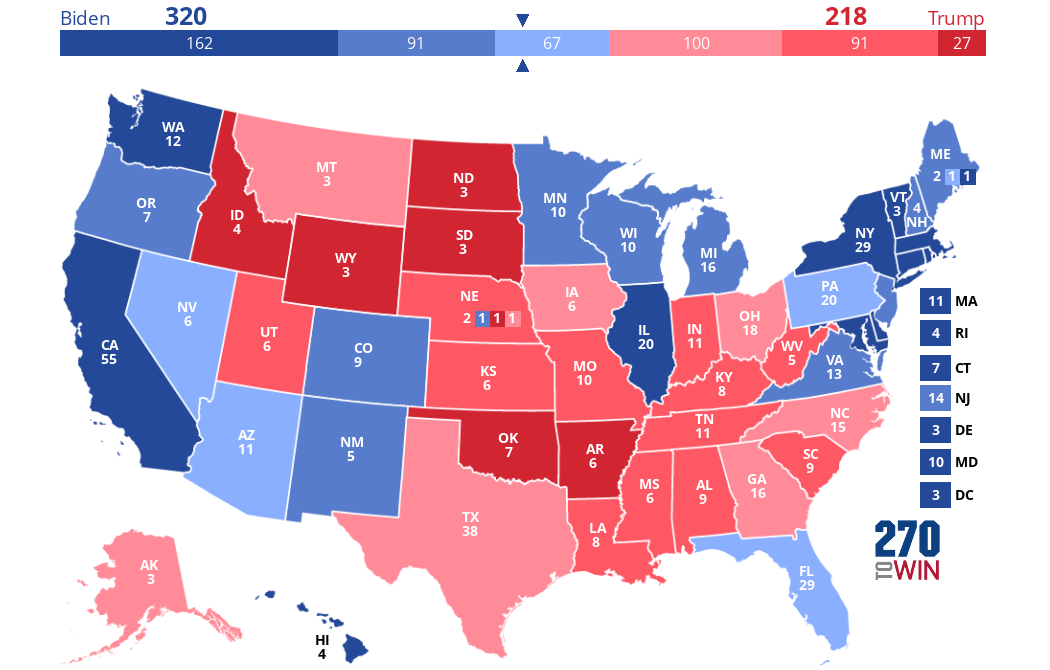


The now very unlikely scenario where we have a repeat 2016, with Biden winning the popular vote and losing the Electoral College, would again trigger calls for a reform of the presidential electoral process. Article II, Section 1, Clause 2 of the United States Constitution devolves it to the states, so a reform could proceed without the need to amend the Constitution. The only option that would require an amendment would be to abolish the Electoral College altogether and make the winner of the popular vote the President-elect, which has exactly fuck all chance of ever happening. More recently some Republicans came up with a proposal that would have allocated 435 votes by congressional district (as Maine and Nebraska already do), 100 (two per state reflecting the Senate seats) to each state's winner of the popular vote, and the three votes for the District of Columbia to the popular vote's winner. If this had been implemented in 2012, Mitt Romney would have won the presidency 282-256, instead of the actual Obama victory on 332-206, because of heavy gerrymandering in Republican states after the 2010 census. The idea has since been dropped as no state except Pennsylvania seriously considered switching to it. Another and more popular option is the National Popular Vote Interstate Compact, where states could individually decide to allocate their votes to the winner of the popular vote nationwide. It would effectively be 'nullification without suppression' of the Electoral College, and is unsurprisingly much more popular in Democratic states than in Republican states. It would reach the desired effect once states totalling 270 electoral votes joined it, which is far from a done deal right now, even if the 2016 result has given it some additional appeal. So the current process is likely to remain in effect for the foreseeable future, for better of for worse.

© Klaus Meine, 1991

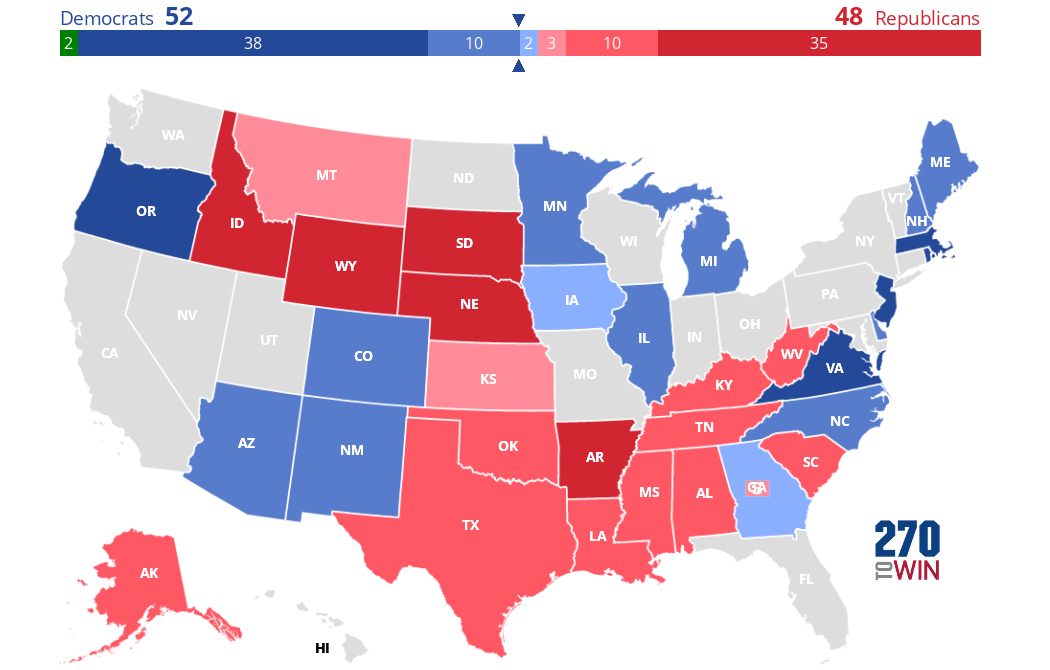
There is no such thing as nationwide polling for the Senate elections, but each competitive race has been surveyed independently many times during the campaign. State-level polls show the Democrats in a very favourable position even in states they're predicted to lose at Presidential level, such as Georgia and Iowa. Even hardcore Republicans admit that the Democrats have been better at campaigning and that Trump is more of a liability than an asset in close Senate races. Best estimate right now is that Democrats will end up with 50 seats and Republicans with 48. And the two Independents caucusing with the Democrats will allow them to take back control of the Senate with a four-seat majority. Polls here are often better for Democrats than the presidential polling, as they appear to have lost just one possible gain since September, the Georgia seat that is part of the regular election cycle. Which does not in fact change the overall projection, as Democrats are now predicted to gain the other Georgia seat, that will be decided at a by-election. I don't expect any further major upset here, though the Republicans appear to be weaker than expected in Georgia, Kansas, Montana and South Carolina. So Republican candidates definitely have to hope Trump does well in these four states and they can ride his coattails to re-election. Democrats also appear weaker than expected in just one seat: Minnesota, that they gained by a cat's whisker in 2008 on Obama's coattails, and then held with a 10% lead in 2014. The states labelled as 'Tilt' are those where a seat is predicted to change hands: six from Republicans to Democrats, one from Democrats to Republicans. The predicted Democratic gains (Arizona, Colorado, the Georgia by-election, Iowa, North Carolina and Maine) definitely qualify as 'Weak' and will probably be decided by tiny margins only. The Republican gain in Alabama looks much more solid as Democrats gained the seat only by serendipity at a by-election in 2017 and the state has a strong Republican leaning.


The situation in the Senate during the proverbial lame-duck session would draw attention to three states: California, Arizona and Georgia. If Joe Biden wins the presidency, as is highly likely, Kamala Harris will have to resign her Senate seat in California. Which would create only a very short suspense as California law does not require a by-election to fill a vacancy. The Governor has the power to appoint a new Senator for the balance of Harris's term ending in 2022. He would obviously do just that in a matter of hours and another Democrat would replace Harris. Things are more interesting in Arizona as the Senate election there is a by-election, not part of the regular cycle. In this case, Arizona law requires that the Senator-elect be seated immediately to avoid any long vacancy that would deprive citizens of representation. So, if Democrat Mark Kelly wins, as polls currently predict, he would be sworn in and seated on 30 November at the latest. The situation is even weirder in Georgia thanks to local election laws that require a jungle primary for by-elections. If none of the candidates bags an outright majority tomorrow, as is the hugely likely scenario, a runoff will be held on 5 January 2021 between the two top contenders. The combination of all this means that the Senate will be reduced to 99 seats and the balance of power altered to 51 R-48 D during the lame-duck session, opening the door to all sorts of surprises in any vote. This is why the Republicans fast-tracked the confirmation of Trump's Supreme Court nominee Amy Coney Barrett ahead of Election Day, to avoid any possible fuckup, and finally won it 52-48. Two Republican Senators had pledged they would not support the nomination in an election year, applying the same informal rule as in 2016 when another vacancy happened, that the Republican Senate majority then controversially reneged on. But only one (Susan Collins of Maine) kept her promise and voted with the Democrats against confirmation. The other one (Lisa Murkowski of Alaska) reneged on her commitment not to renege on the 2016 rule. I guess the Whip reminded Murkowski she had a rough re-election when standing against her party in 2010 and wouldn't want to risk another such gamble.

© Paul Kantner, Grace Slick, Marty Balin, 1975

Oddly, the House of Representatives polling is not as obviously good as the Presidential and Senate polls for the Democrats. There is even a very credible scenario where they could lose some marginal seats in swing states, while not gaining enough elsewhere to make up for the losses. The trends of nationwide polling for the House of Representatives still show Democrats ahead, but they have seen better days. More significantly, the weighted average of the last six generic House polls has Democrats on 52.6%, Republicans on 45.5% and Others on 1.9%. Which is as close as can be to duplicating the 2018 results, with Democrats a wee smitch down. Compared to the Presidential polls, both parties here snatch some 2% of the vote from 'Others'. Which probably does not count as a real pattern, but just reflects the fact that minor parties like the Greens and Libertarians are fielding just a minuscule number of House candidates, as they are not willing to spend shitloads of dosh on multiple local campaigns that will deliver fuck all seats.


The projections for the next House have to rely on a mix of generic nationwide polling and targeted polls in individual districts, which you surely remember is American for constituencies. Something we don't see often in the UK, unless Lord Ashcroft pays for it from his pension pot. But it's quite common in the United States where campaign spending is limited only by the depth of the donors' pockets. There has been quite a flurry of district-level polling over the last two weeks. Most of it has been concentrated on supposedly marginal seats that could possibly change hands, and has not always delivered the expected results. Many marginals are projected to remain in the same party's hands, which only confirms the weight of the incumbency factor in close elections. But polling of supposedly safe districts has also delivered some possible upsets, most of them in the Democrats' favour. A number of seats are now in the balance that were not expected to, in Republican-leaning states such as Georgia, Montana, Nebraska, Ohio, South Carolina and Texas. Which is of course in line with Joe Biden making inroads in states where the demographics favour the Democrats, most prominently in areas where Hispanics and African-Americans are expected to turn out in larger numbers than at earlier elections. 


The projection above, after the dust has settled, is obviously good news for the Democrats, though an unprecedented and unforeseen number of seats might prove too close to call on Election Night. What I have now is the Democrats gaining 17 seats and losing 8, thusly slightly consolidating their majority from the 2018 midterms. As you might expect, the American punditariat don't really have a consensus vision of the gory details here. Current estimates are 220-239 Democrats vs 181-188 Republicans, the rest being tossups, as in American for 'tie'. Of course the odds of Republicans taking back the House with a clean sweep of all 45ish marginal seats are somewhere to the south of fuck all. Some pundits even have a more optimistic vision of the Democrats' prospects than me, with predicted net gains somewhere between 10 and 15. Anyway, if I had to wage a tenner on the global outcome, I would go for a Democratic trifecta: Biden and Harris at the White House, House majority confirmed and strengthened, Senate back to a Democratic majority. Then the surest bet is that we won't know anything for sure on the day after Election Day and can expect a lot of court challenges from the Republicans. No doubt Trump and his cronies will prove to be the sorest losers since Dog domesticated Man, and nothing can be taken for granted until everyone duly elected tomorrow is sworn in. Fingers crossed.

© Jeannette Sears, Pete Sears, 1982

06/09/2020

A Tale Of Two Conventions. Almost.

Try not. Do. Or do not. There is no try.
(Master Yoda, Star Wars: Episode V – The Empire Strikes Back, 1980)

© Bob Weir, John Perry Barlow, 1987

There are only two seasons in Washington, lovers of liberty
Tax season, a shameful time when your nation’s leaders 
Rob you blind for their own amusement and unending sloth 
And election season, a shameful time when your nation’s leaders offer you
Empty platitudes in exchange for your votes and your hard-earned cash
I can smell the change in the air
It smells like hairspray and apple pie and fresh manure like America itself
So let’s rejoice, lovers of liberty, all the leaves are brown but the sun is out and the sky is blue
(Sally Langston, Scandal: Wild Card, 2016)

So it's this time of Election Year when American political parties have had their National Conventions. Or some version of them. As this year they have been mostly covided out and replaced by socially-distanced micro-events and Zoom sessions, which the punditariat will of course punditify about for days without end, just as they have done with the full-fledged conventions of years past. Of course the best moment of the Republican Convention was Donald Trump Junior telling his audience that Joe Biden is Nessie and Loch Ness is a swamp. Which would not have struck American audience as odd, as most of them probably think Loch Ness is an amusement park near London. Then we had the next news cycle totally hijacked by right-wingers outraged at Bette Midler's comments on Melania Trump's speech. Which were indeed unfair as Melania does speak better English than her husband.  Pundits will now keep a close watch on post-Convention polling, awaiting the proverbial Convention bounce that could benefit Trump. The last time the Republicans actually had a Convention bounce was in 2008. when they got Team Blue all sweaty for a few days as John McCain briefly overtook Barack Obama in national polls. Then Sarah Palin spoke and Obama cruised to victory. But this year Trump would need way more than a bouncelet to prevail, as the trend of national polls and the weighted average of the six most recent ones conclusively show Biden ahead by a safe margin, even with a few less good polls recently. And remember this is the USA, so Red is Blue and Blue is Red.


Now Biden's main problem will be to keep the momentum for the next two months and avoid any embarrassing gaffes. He still has a margin of progress in a few states if he wants to upgrade from 'convincing victory' to 'fucking Trump-woodchipping landslide', even if most of the South and Midwest look like lost causes. If you think Trump's core electorate in the backwaters of America, from Appalachia to Terrebonne Parish, are going to desert him because he went campaigning in 'Frorida' before discussing 'Yo-Semites' going on vacation (that's American for holiday) in 'Thighland', just bear in mind half of America can't even spell 'G8', and those who can think it's some sort of car engine. Never forget this is a country where a solid third of voters will never mind being ruled by an illiterate psychopathic moron because they are illiterate psychopathic morons themselves, who still think that Father Knows Best, there would be fewer deaths in school shootings if all the kids carried guns and universal publicly funded healthcare is a plot by Communist reptilian aliens hell-bent on removing God from the American Way Of Life. Or something like that involving France and North Korea. But right now even Trump calling Biden 'Joe Hiden' will misfire as most people are likely to conclude he was just mispronouncing and not trying to make a lame joke.

© Paul Kantner, Marty Balin, 1969

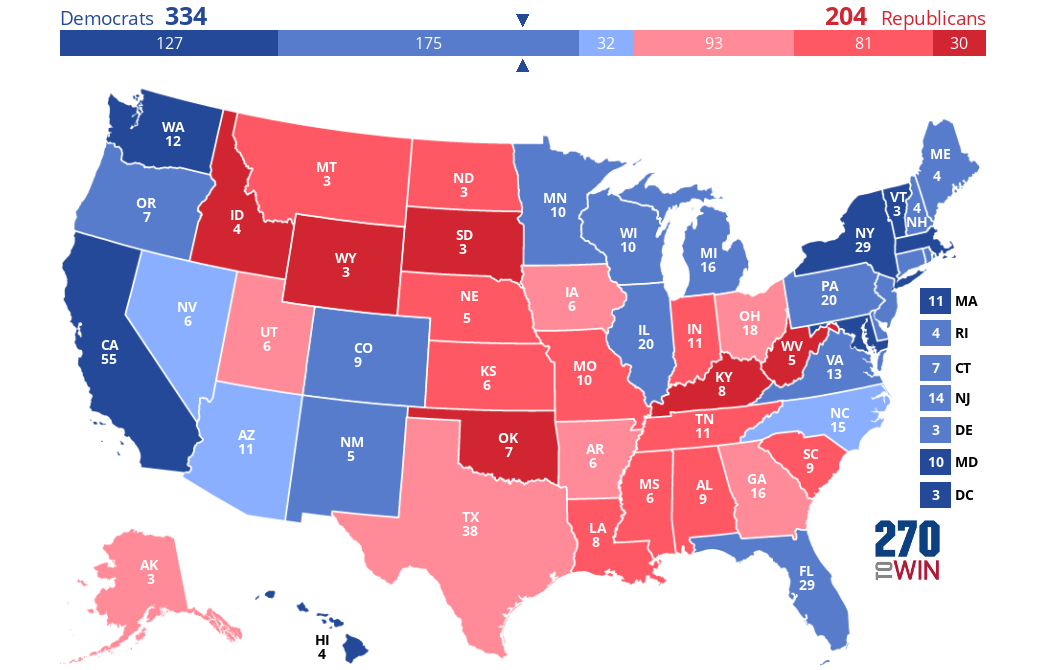
Of course what really matters is what state-level polls say, and how many Electoral Votes (EV) they predict for each candidate. The punditariat are as always punditifyingly cautious but sill lean Biden's way, with the most recent 'pundit consensus' predicting 278 EVs for Biden, 169 EVs for Trumps and 91 tossups (which, as you remember, is American for marginals). This is already enough to take Biden to the White House as 270 EVs are needed, but I think the situation is actually worse for Trump as my own calculations have Biden with a more solid base of 302 EVs to Trump's 111 EVs and 125 possibly going either way. The most likely outcome is Biden winning with a projected 334 EVs and possibly more. Biden still hasn't gained back Iowa and Ohio, two swing states won by Obama and then by Trump but both are extremely close. It says a lot too that several states supposedly safe for Republicans are now close to a tie like Arkansas, Georgia and Texas. So a pro-Biden upset in the last stages of the campaign appears now more likely than a pro-Trump upset, and the map below shows what my calculations say, with thanks to 270ToWin for this and other templates.


Compared to the 2016 result, Arizona, Florida, Michigan, Pennsylvania, North Carolina and Wisconsin are predicted to switch from Trump to Biden for a total of 101 EVs. No state this time is predicted to switch from Biden to Trump. Compared to Obama's winning map in 2012, Biden would add North Carolina (which Obama bagged just once in 2008) and Arizona (which Obama never won). But he would lose Iowa and Ohio, both of which Obama bagged in 2008 and 2012. That leaves out just one difference with Obama's 2008 map: Indiana, which Obama won then to everybody's surprise including his own as Democrats had not won it since Johnson in 1964, and before that Roosevelt in 1932 and 1936. The most interesting case here is Arizona, which voted for a Democratic candidate for the last time in 1996. Here the demographics have slowly changed the Democrats' way, with both the Latino population share and the Latino turnout increasing. These are the same trends that made New Mexico first and then Nevada and Southern California turn Blue, including Richard Nixon's home turf in Orange County, the affluent southern suburbs of Los Angeles. And might even switch Texas back to the Democrats for the first time since 1980, probably not at this election but quite possibly at the next one. The current projections have Biden in a very strong position anyway as even his worst case scenario would still have him winning by a convincing margin. What remains to be seen though is the impact of Trump's Project Fear, switching to a hawkish 'law and order' message and calling major unrest in a few cities the 'Biden riots'. It doesn't seem to have switched many voters so far, but of course the effect of deception and lies on swing voters should never be underestimated. 

© Chris Riddell, The Guardian, 2020

The main event since my last post has been of course Joe Biden choosing California Senator Kamala Harris as his running mate. Harris is a clever and yet safe choice for several reasons. The first and obvious one is that she is a woman, only the second time in US history a woman has an actual shot at becoming Vice-President. She is also of Indian and Jamaican ancestry, both her parents were immigrants to the USA in the 1960s and she self-identifies as African-American. Which ticks quite a number of boxes on the Democratic scorecard, though her background is definitely a privileged one, quite far away from the deprived inner cities. Then she has held elected office continuously since 2004, meaning she has been vetted often enough and under scrutiny for long enough to make any unpleasant surprise highly unlikely. In a country that loves nothing more than having all skeletons in the closets dusted off and lined up so they can have a good look at them, it's a safe bet that Republicans will not unearth any smoking turd from Harris's past. But paradoxically the main positive in selecting Harris is that she is ideologically ambiguous enough to be a difficult target for the Trump campaign. They will have a hard time making the 'radical left' label stick to either Biden or Harris (but bear in mind that, by American standards, the SNP would be radical left and Jeremy Corbyn totally off the chart), while the Democrats have plenty of ammunition to fire at Trump and his far-right nutcase of a Vice-President and running mate, Mike Pence (who, by British standards, would still be a far-right nutcase). Ironically the best weapons Trump would have come from disgruntled supporters of Bernie Sanders, but he can't use them as they hit at Biden-Harris for not being radical enough. So my best educated guess now is that Biden will win the Electoral College by at least the same margin Trump had in 2016, and probably by the same margin Obama had in 2012 when the Republican candidate was way saner and had a lot less baggage than Trump.

Hope is like the sun
If you only believe in it when you can see it, you’ll never make it through the night
(Leia Organa, Star Wars: Episode VIII – The Last Jedi, 2017)

© Seamus Jennings, The Guardian, 2020

The day we stop believing democracy can work is the day we lose it
(Queen Jamillia of Naboo, Star Wars: Episode II – Attack Of The Clones, 2002)

© Bob Dylan, 1974

The Senate is a gilded cage, a place of great comfort and wonderful perks
Where you think that you’re making a difference, but you’re not
It’s just you and 99 others grimly reminding yourselves every day
That the only way out of this, the only way to make your mark, is to be President
(Senate Majority Leader Edison Davis, Scandal: Pencils Down, 2016)

The second major battle is for control of the Senate, and the Democrats' prospects also look really good. 33 of the 35 seats up for re-election this year are the same that were up in 2014 when Democrats lost control of the Senate, so we have 23 Republican incumbents to only 12 Democrats. Republicans are clearly on the defence here and Democrats on the offence as several key seats are in states that are predicted to give a majority to Biden at the presidential election. Democrats now have 45 seats and need only 49 to take back control as the two Independent Senators (Angus King of Maine and Bernie Sanders of Vermont) caucus with them. Which could be translated into English English as 'take the Democratic whip' if there was anything like a formal whip in the US Senate. But there isn't and Senators have voted outside of party lines multiple times without any consequences, even during the more ideologically polarised last four years. And technically the Democrats actually need only 48 seats as it would lead to a clean 50-50 split. If Joe Biden is elected, Kamala Harris, as Vice-President and ex officio President of the Senate, would have the 101st and tie-breaking vote. There is a distinct possibility of this happening as the current spread of projected seats is 48-53 Democrats and 45-50 Republicans. But polls actually predict 50 Democrats and 48 Republicans when you sort out the marginals, which would avoid any heart-attack-inducing suspense on key votes. And this result has also a direct impact on the United Kingdom as the Senate is constitutionally empowered to ratify international treaties, or not. Including.... aye.... you got it.... a US-UK trade deal. Not that Democrats in charge would necessarily make a bad deal less likely or less threatening to the food industry or the NHS, but there is definitely a slightly-larger-than-fuck-all probability that the worst could be avoided. So here is what we have now, with the grey states indicating no Senate election this year. Projected Democratic gains: Arizona, Colorado, Georgia, Iowa, Maine, North Carolina. Projected Republican gain: Alabama which Democrats won by serendipity at a 2017 by-election and don't really expect to hold. 


Democrats are unlikely now to stage an upset in Kansas, though the Republicans' position remains surprisingly weak in a state that has been represented by two Republican senators continuously since 1938. But it says a lot that polls suggest Iowa could kick out their incumbent Republican Senator after just one term and bring back a Democrat, even with presidential polls predicting the state's EVs will go to Trump. Or that 'moderate' Republican Susan Collins, who has an ambiguous record on alternating between opposition and support to Trump, would fight the one election too many and lose her seat after 24 years in the Senate. Another significant gain for the Democrats would be Arizona, both politically and symbolically. The Democratic candidate there is Mark Kelly, a retired Captain in the US Navy and astronaut who flew four Space Shuttle missions, two as Pilot and two as Commander. Kelly is also the husband of Gabrielle Giffords, a former Democratic Representative for the city of Tucson, who retired from politics after being severely wounded in an assassination attempt in 2011 and has since become an icon for the supporters of stronger gun control, which Kelly has also fully embraced during his campaign. Less emotionally charged but probably more politically significant would be a Democratic gain in Georgia. Atlanta, the state capital and largest city, is home to a successful, affluent and well-organised Black community who massively supports the Democrats. While the rural areas, once part of the historic Cotton Belt, are mostly Republican strongholds. Remember this is where Gone With The Wind was set and it was not all fantasy, though of course the Democrats were the evil slaveowners and the Republicans the progressive abolitionists back then. So now we have the perfect mirror image of that, with demographics again vastly favourable to the Democrats. 

It is my experience that senators focus only on pleasing those who fund their campaigns
And they’re in no means scared of forgetting the niceties of democracy in order to get those funds
(Obi-Wan Kenobi, Star Wars: Episode II – Attack Of The Clones, 2002)

© Bob Dylan, 1978

There’s no such thing as a clean campaign, it’s an oxymoron
(Fitzgerald Thomas Grant II, Scandal: A Criminal, A Whore, An Idiot And A Liar, 2013)

Current polling for the House of Representatives is also very favourable to the Democrats, though it is not much different from the 2018 result which was already a very good year as they took back control of the House after eight years of Republican majority. So this year's polls predict Democrats cruising towards a second consecutive victory at the House elections, something that has not happened in twelve years. The trend and the weighted average of the three most recent polls both point to a higher Democratic vote share than in 2006, the midterms of George W. Bush's second term, when they took back the House on 52.3% of the popular vote and 233 seats. Or 2008 when they rode Obama's coattails to 53.2% of the vote and 257 seats. The discrepancies between past results and today's projections show the impact of heavy-handed gerrymandering in states controlled by the Republicans during the redistricting cycle that followed the 2010 census. A rough estimate is that Democrats need a 5% lead in the popular vote nationwide to achieve a tie in seats, and beyond that the dominoes will only fall slowly as Republicans post-2010 mostly avoided the post-2000 dummymandering that cost them dearly in some states in 2006 and 2008.


The weeish swing in the popular vote would only switch a few swing seats from Marginal Red to Marginal Blue. The punditariat's expert opinion says five to ten and my model says seven. Enough anyway to solidify the Democratic majority in the House and turn the elections into the Magic Trifecta result every party wishes and doesn't always get even when they win the White House. And even a Trifecta in a presidential year can be overturned at the next midterms. Clinton, Bush Junior, Obama and Trump have all known this, not to mention all earlier Presidents who suffered the same fate. Now the seat projection is an exact mirror image of the 2010 midterms, when Republican took back the House in the middle of Obama's first term. But at these elections, the last held before the last redistricting, the Republicans needed only 51.7% of the popular vote for their 242 seats, which again illustrates how the post-2010 gerrymandering in Republican states was used to make a victory more difficult for the Democrats. The next redistricting cycle (what would be called a boundary review in the UK) will probably be less controversial than the last two as about a third of the states have now taken it out of hands of the state legislatures and devolved it to an independent commission without political interference. For now we have Democrats cruising to a 50ish-seat majority, give or take. And we can expect a stronger party loyalty in the current ideologically polarised context, with 'centrist' Democrats (who, in British terms, would be the left wing of the Conservatives) much less likely to vote with Republicans to defeat 'progressive' legislation (which, in British terms, would be the Liberal Democrat manifesto, no shit).


What matters most for the Democrats is that even their worst case scenario has them holding their majority in the House. But the bigger the majority, the better it is for the progressive wing of the party as the House has the final say on the federal budget and a stronger Democratic majority makes 'compromise deals' with 'moderate' Republicans less likely here. Another challenge for the Democrats is to take back control of state legislatures they have lost over the last ten years, especially in the now Republican states where redistricting is still under political control and produced obvious gerrymandering in the last cycle. Which is definitely a square-the-circle thing as the states the Democrats need to gain back the most are also the ones most heavily gerrymandered by the Republicans like Ohio, Pennsylvania, Florida, North Carolina and South Carolina, so a string of uphill battles even if some are projected to turn blue at presidential or senatorial level. Finally the major key to all of this year's elections in how much PAC money (which would be dark money in British terms) each party can inject into their campaigns. The Democrats certainly have an advantage here as unfavourable polling will force the Republicans to divert resources to some states that were supposedly safe for them, and don't look like it now like Texas, Florida, Pennsylvania or Georgia. The larger the state, the more money you need to pour into it and the less you have for competitive states, something Democrats don't really have to worry about as their own safe states like New York, Illinois, most of New England and the Pacific West, definitely look immune to any sort of Republican offensive and could even prove safer than expected. There is even a double-whammy against Republicans here as political advertising is already more expensive in large states with large cities, and the more competitive the state gets, the more the prices rise again and again. Still two months to go before we know how the whole circus ends....

We need a system where the politicians sit down and discuss the problem
Agree what's in the best interest of all the people and then do it
If the people don't agree, well, then they should be made to by someone wise
Might sound an awful lot like a dictatorship but, well, if it works...
(Anakin Skywalker, Star Wars: Episode II – Attack Of The Clones, 2002)

© Bob Weir, Eric Andersen, John Perry Barlow, 1973

02/06/2020

America The Beautiful - An Election Update


The way I see it, if you want the rainbow, you gotta put up with the rain
(Dolly Parton)

© Katharine Lee Bates, Samuel A. Ward, 1895

Some people see things as they are and ask why
Others see things as they never were and claim mad cow

(Alan Shore, Boston Legal: Stick It, 2006)


The land of the free and the home of the brave, they say. This is the country where people are ready to accept a 60% pay cut because employers provide health insurance so you have to stay on the payroll at any cost or you lose all coverage in times of pandemic. The choice between poverty or death, that's the American Dream for you. Not that it could happen in the UK, or could it? And yet Donald Trump's electoral prospects have not sunk to the bottom of the Mariana Trench as the rally-around-the-flag Christo-fascist rhetoric still works with whole chunks of low-education Americans, and there are just enough of them to win an election. Biden has Silicon Valley, Martha's Vineyard and Bono. Trump has all the shiftless peckerwoods, so a winning hand in two dozen States as long as the Supreme Court upholds the ban on mandatory literacy tests to register to vote. Always bear in mind this is the country where Nazis are protected by the Constitution and anyone with enough dosh can buy themselves a seat in either House of Congress, or an acquittal at a multiple rape-murder trial, depending on which is most urgently needed. So the narrative some months ago was "don't believe what you see in the polls, Trump will pull a rabbit anyway" and it was pretty convincing during the primary season when the Generic Democrat's lead over Trump remained close to the 2016 result. Now, and one Covid crisis later, the picture has changed quite dramatically as the trendlines show.


The big dots on the left show the 2016 vote shares and the trendlines factor in only the polls fielded in 2020, which is why they don't connect with the big dots as this year's polling has steadily been better for Biden than the last election was for Clinton. There has also been speculation about Bernie's People, those who supported Sanders in the Democratic primary, only reluctantly supporting Biden, or even deserting him, after Sanders dropped out of the race. There is no real evidence one way or the other in polls, as the variations in Biden's voting intentions have remained within +/-1% of the trend, though individual polls have shown larger variations. One of the factors here is that the sample sizes for individual polls (shown by the tiny dots in the chart) vary widely from some 800 to more than 30,000. This leaves the door open to more random variations than in British polls, especially with a probable turnout of 130 to 140 million. So the weighted average of the last six polls is just as good a clue of where the election might go. Right now it shows Biden leading by 5.6%, or 3.5% higher than Clinton in 2016. Which is good news for Biden as four of Trump's 2016 states were decided by a smaller margin (Wisconsin, Michigan, Pennsylvania, Florida) and another two by a barely larger one (Arizona, North Carolina). These are just the battlegrounds where Biden needs a clean sweep for a convincing victory.


Then of course US-wide polls tell only part of the story, actually a rather minor one even if it makes for easy headlines. What truly matters is state-by-state polling and how it translates in the number of electoral votes (EVs) for each candidate when the Electoral College convenes in mid-December. The tables below shows what these polls predict this week. State names in bold red denote those predicted to switch from Trump to Biden. The resulting number of Biden's EVs would match Obama's in 2012 with a slightly different map. Compared to Obama's 2012 results, Biden would lose Iowa and Ohio but gain Arizona and North Carolina. Interestingly Obama had won North Carolina in 2008 but Arizona has a long history of supporting Republican candidates. The last time a Democrat won Arizona was Bill Clinton in 1996, and the last one before that Harry Truman in 1948. State-by-state polls also deliver some interesting results in supposedly strongly Republican states. A lot of pundits have a hard time admitting that Georgia and Texas, to name only two, could be too close to call on Election Night, as both have been solidly Republican for many years. But demographics in both are steadily moving the Democrats' way, just like in Arizona and Florida. Proof of this is that, two years ago, Democrats came within 1.4% of unseating Republican Governor Brian Kemp in Georgia, and 2.5% of unseating Republican Senator Ted Cruz in Texas. Though I wouldn't hold my breath for a presidential upset in either state this year.


It's interesting to see that American prognosticators and pundits have different views about this election. Roughly the split between a data-based approach (it can happen because the polls say so) and a precedent-based approach (it can't happen because it hasn't happened already). Of course the punditariat have something of a short-term tunnel vision here. After all they're the same who said Clinton would win in 2016 because Obama had won twice and are now doubting Biden because, ye ken, Trump won the last one. Right now prognosticators say it's Biden by 316 to 222, the only difference with my projection being that they allocate North Carolina to Trump. The punditariat have a more ultra-cautious approach with Biden on 222-268, Trump on 204-233 and a further 57-112 rated as 'tossups'. Their average now is Biden winning 290-248, which is my 'Biden Min' scenario with Florida and North Carolina staying in the Trump column. As usual, time will tell, but I have a hunch the changed context makes it more difficult for Trump to stage a Clintonian 'Comeback Kid' upset now.

If it is what it is, it ain't what it ain't. Don't make it what it isn't.
(Detective Sergeant Frank Tripp, CSI Miami: Sunblock, 2007)

© Martin Bell, The Guardian, 2020

When you fling enough crap into the universe, occasionally the breeze is going to blow your way.
(Captain Jim Brass, CSI: Torch Song, 2013)

This November's Senate elections might also deliver some upsets. Here only state-by-state polling matters and it is currently surprisingly favourable for Democrats. Below are the tables of projected results according to the most recent polls for each seat. Projected Democratic gains are in bold red and the lone projected Republican gain in bold blue. There is no doubt many Democratic candidates would be riding Biden's coattails as several of the predicted Democratic gains mirror their successes in the presidential polls. But polls also say that Democrats would harvest surprise gains beyond that, in complete reversal of the 2014 elections which saw Democrats lose the Senate when the same seats were last up for re-election. But the projected Senate map would be different from the pre-2014 one as Democrats would not recoup all their losses. Some of the seats lost in 2014 now look decisively out of reach (Arkansas, Louisiana, South Dakota, West Virginia). Only three of the Democratic losses of 2014 would turn blue again (Colorado, Montana, North Carolina) while the last two (Alaska, Iowa) would be weak Republican holds.


But there remains a certain amont of uncertainty as Senate elections tend to be highly personalized and skeletons in the closets have the nasty habit of surfacing late in the campaign. The Arizona seat looks like a sure gain for Democrats as they already gained the state's other seat in 2018 and demographics there favour them. But the predicted gains in Kansas and Maine definitely look more difficult to score, and some pundits even consider them quite far-fetched, as Democrats haven't held these seats since 1918 and 1978 respectively. But Democrats clearly hope that Trump cultist Kris Kobach will prove toxic even in Ruby Red Kansas as he was already decisively defeated at the gubernatorial election two years ago, and that this election will be the one too many for 'moderate' Republican four-term veteran Susan Collins in Maine. So the spread between the best case and the worst case scenarios for Democrats is quite large, and you can't rule out Republicans holding control of the Upper Chamber by the tiniest of margins.


American pundits are also quite divided about these elections. Their predictions credit Democrats with 45-50 seats (all including the two independents who caucus with the Democrats) and Republicans with 47-50 seats, with 2-6 seats rated as Tossups. Which covers pretty much all possible combinations between my 'Dem Max' and 'Rep Max' options and leaves nobody none the wiser, as they say. Then some among the punditariat are secretly dreaming these elections will deliver the rarely seen 50-50 split. In the current highly polarized climate, many votes would probably go 50-50, meaning the Vice-President would cast the tiebreaking vote. That would be Trump's Veep Mike Pence, himself quite a far-right fundamentalist, for the two weeks between the swearing-in of the new Senate and Inauguration Day, and then the next Veep, whoever that may be. I guess some pundits would love nothing more than Trump trying to pass some controversial legislation during that twilight zone session. Which would no doubt trigger a major uproar and just the kind of crisis that makes for juicy headlines.

Denny Crane: Say what you will about Republicans
We stick to our convictions even when we’re dead wrong
Alan Shore: Some might say especially then
(Boston Legal: Witches Of Mass Destruction
, 2005)

© Bruce Springsteen, 1970 

Denny Crane: You Democrat! Protesting wars, banning guns.
If you nancies had your way, nobody would ever shoot anybody.
And then where would we be?
Alan Shore (shaking head): Where would we be?
(Boston Legal: Smile
, 2006)


The House of Representatives elections are not predicted to deliver any stunning changes as Democrats have already scored a major success in 2018 when they took back control of the House with 10% of its seats changing hands. The general trend of recent polling has been less kind for Democrats than it was a few weeks back, without actually jeopardizing their dominant position. Even more caveats apply here though than for the presidential polls. Sample sizes here are routinely somewhere between 800 and 1,200 with the random one surveying about 2,000. So there is huge room for any kind of random variations, especially as American pollsters mix surveys of registered voters and likely voters, and their approach of 'likely voters' is generally less solid than the 'likelihood to vote' algorithms used by British pollsters. But that's all we have, so we have to live with it.


The current weighted average of voting intentions, based on the last six published polls, is also mildly worrying for Democrats as it shows basically the same vote shares as in 2018. It is nevertheless better than Biden's predicted presidential vote, probably because smaller left-leaning parties like the Greens are willing to field a presidential candidate even if they bag only 2% of the vote, but can't afford to stand for Congress except in a few select districts in the Pacific West or Atlantic Southeast. A lead of about 8% is anyway enough to preserve the current Democratic majority, even if it won't increase it. Then Democrats surely hope some downballot effect on Election Day will allow them to do better and bag some additional seats, mostly in Southern states. Main targets, consistent with evolving demographics and the presidential polling, are in heavily Hispanic districts in Texas as well as heavily African-American districts in Georgia and North Carolina. Republicans managed to hold some of these seats in 2018 only because minorities usually have a lower turnout, and Democrats hope to overcome this as they did successfully at previous elections in Nevada or Southern California, where they wiped out the last Republican stronghold in legendary Orange County two years ago.
 

Pundits are generally more optimistic for the Democrats than polls suggest, and agree that this election will deliver a wee batch of Democratic gains in marginal seats. But the absolute worstest case scenario for Democrats could be as close to a tie as an odd number of House seats will allow, something that has not happened since 1930. Oddly Democrats back then had won the popular vote 52.7% to 44.5%, almost the same as current polling predicts, and yet were outnumbered 218-217 by Republicans, though by-elections had turned this into 218-217 for Democrats by the end of 1931. But of course history exactly repeating itself after 90 years is quite a far-fetched prospect. Or isn't it? Then reaching a tie this year when Democrats would still get a majority of the popular vote, even in their worst case scenario, only highlights again the effects of aggressive gerrymandering in Republican states, which mean that Democrats need a 4% lead in the popular vote to bag just a tie in seats. This is obviously a strong incentive for Democrats to devote resources to the State Legislature elections that will be held in 44 states and the gubernatorial elections to be held in 11 states. The impact of these elections goes way beyond local, as who wins them in a majority of states will also have the upper hand in the next redistricting cycle, due to happen next year on the basis of the 2020 Census and be implemented for the 2022 mid-terms. A strong coattails effect from the expected good result in the presidential election could trigger just the sort of domino effect Democrats need in State Legislatures to deliver a less unbalanced playing field two years out. Time will tell.


The $64,000 question now if what impact, if any, current events will have on the campaign and the elections, and of course here I mean George Floyd's murder and the massive violent protests that followed. It is common knowledge that race is a key issue in American politics and even American everyday life, often in an obsessive way that Europeans can never fully comprehend, even in an ethnically diverse UK where we have our own issues with racism. It so happens that Democrats here are catch22ed between a rock and a hard place, as the events have already made Joe Biden's choice of a running mate more complicated, even if he doesn't have to make the final decision until August. On the one hand, Democrats can't afford to alienate minorities, specifically African-Americans, who are massively supporting them and whose turnout is a key to the elections in many states. On the other hand, they can't afford to look or sound weak on violence when major cities are rocked by riots and looting. From distant Europe, Trump might have sounded massively offensive when he tweeted that "when the looting starts, the shooting starts", or utterly ridiculous when he decided to treat Antifa as a terrorist organization, or ventured out of his bunker under live-ammunitioned guard for a Bible-thumping PR stunt. Yet all definitely struck a chord with his Christo-fascist gun-toting fanbase and might even have swayed some law-and-order cultists that might otherwise have ticked the Biden box. Remember this is America, where "shoot first, talk later" is a basic of social life and "go get 'em" is a valid foreign policy option. Things could definitely get much worse before they get marginally better, if ever.

I’m talking about the future, so what if I’m not up on recent history?
I’m prophetic, not infallible

(Morden, Babylon 5: Day Of The Dead, 2262)


© Jim Morrison, Robbie Krieger, Ray Manzarek, John Densmore, 1978

04/04/2020

Sing A Song Of America


© Paul Kantner, Marty Balin, 1986

If the primates that we came from had known
That some day politicians would come out of the gene pool
They'd have stayed up in the trees
And written off evolution as a bad idea
Hell, I always thought the opposable thumb was overrated
(John Sheridan, Babylon 5: A Distant Star, 2259)

There is not much happening on the polling front in the UK right now, and what little happens is pretty depressing anyway, so this is as good a time as any to take a look at the events in the Former Colonies Of The Crown. 'Tis this time again, like every leap year, when the world braces itself for the Big American Election Circus, the one where everyone's fate is at stake from the White House's tenant to Daly City's dogcatchers. This year's Election Day is Tuesday, November 3rd (that's American for 3 November). All 435 seats of the House of Representatives and 35 Senate seats so far are up for election, providing no more Senate special elections (that's American for by-elections) are triggered before Election Day. Gubernatorial elections will be held in 11 states and elections for the state legislature in 44 states. The latter are especially significant this year as the 2020 census is the start of the next redistricting cycle (that's American for Boundary Review). Redistricting is mandated by law to happen every ten years on the basis of census data and to be completed for the next elections, this time the 2022 midterms. All districts (that's American for constituencies) for the House of Representatives and state legislatures are to be redrawn, the sole obvious exception being the at-large seats for the six states that are entitled to only one Representative (and you already got it, that one is American for MP). In the USA this is a highly sensitive and politicized issue as redistricting is devolved to the states. In 36 states redistricting is processed by the state legislature and more often than not this results in heavy-handed gerrymandering. Two states use a 'political commission' outside the legislature and only six use a totally independent commission. So this year's elections will decide what the electoral maps for 2022-2030 look like.


There is no speculation in the USA about Covid-19 leading to rescheduling the elections, because it won't happen. Only the primaries and special elections due to be held before Election Day will possibly be impacted. Contrary to popular belief the date of the presidential election is not enshrined in the Constitution, only the process is. Article Two, Section 1, Clause 4 of the Constitution devolves the responsibility of setting the date for Election Day to Congress and the famous 'Tuesday next after the first Monday in the month of November' (in plainer English, that's first Tuesday of November unless it also happens to be 1 November, in which case Election Day is moved to 8 November) is stipulated by law only since 1845. Before that it was pretty much a free for all with each state choosing their own dates as the election was held over a long period of time like in Medieval England, pre-1918. This law (Title 3, Chapter 1, Section 1 of the United States Code) has never been amended since and has fuck all chances of being amended any time soon as Inauguration Day, the day the President-elect assumes power (20 January since 1937, was 4 March before), is enshrined in the Constitution and can be changed only by a constitutional amendment that typically takes a year or more to ratify. A classic American legal oddity. More importantly the Constitution also states that the outgoing President's powers cease to exist at noon on 20 January. So it's pretty much loophole-proof and if everything goes tits up they would most probably resort to mandatory postal vote, as setting up a secure nationwide electronic voting system would take more than the few months remaining between an hypothetical full lockdown and Election Day. Postal voting is already fairly common and three states have already made it the only legal way to vote, to avoid the cost and bother of having to set up proper polling stations.

Before I start with the heavy stuff and all the charts, remember that colours are reversed in the Former Colonies Of The Crown, which is one of the lesser quirks of a country that uses 'short' tons that are neither tonnes nor tons and would be more appropriately called 'light' tons, if that makes any sense at all. And it's also the country where not just streets have no names, but districts don't have any either but just numbers. Anyway Republicans are red and Democrats are blue. Libertarians are yellow and Greens are surprisingly green, though it does not matter as neither bag enough votes to deserve their own line items in my stats. So they and the myriad of fringe candidates will be bundled as 'Others' and grey, because, ye ken, there are fifty shades of it.

Intelligence has nothing to do with politics
(Londo Mollari, Babylon 5: Point Of No Return, 2260)

© Jim Morrison, 1971

You seek meaning? Then listen to the music, not the song
(Kosh Naranek, Babylon 5: Deathwalker, 2258)

The biggest headline material is of course the presidential election and at this moment the Democratic Party's primaries.  The Republican primaries were just a formality as Donald Trump faced only token opposition and has already secured 94% of the primary vote and enough delegates to clinch the nomination at the Presidential Convention due to be held 24-27 August, Covid-19 permitting. The Democratic Party primary was a much more crowded affair with 29 candidates initially though only 11 ended up actually running (which, as you know, is American for standing). Then they fell like flies as the primaries went by until only two were left on 19 March: Joe Biden and Bernie Sanders. A lot has been said about Sanders being a socialist, which in the USA is something akin to 'atheist communist traitor to be exorcised immediately', but remember this is the USofA where Nigel Farage is considered mainstream right-wing. The closest approximation to Bernie's actual platform (that's American for manifesto) would be the SNP. No shit, Sherlock, just compare the Political Compass charts behind the links. Sanders is not even as far to the left as Corbyn's Labour was. And Biden would be something like a past-sell-date Ed Davey, which is as far to the left as you can go to be deemed 'electable' by the American MSM. As a starter, here is where both candidates stand right now after 30 states have already held their primaries: 


Neither candidate has yet reached the 1,990 pledged delegates (those chosen in the primaries and committed to support a specific candidate) required to clinch the nomination on the Convention's first vote. But 1,677 pledged delegates remain to be chosen before primary season ends, so Biden needs less that half of these to get his majority. There is every indication he will get them and even more and will win the nomination on the Convention's first vote without any suspense. In the unlikely event of a massive Sanders surge that would deny Biden his majority, the Convention would go to a second vote where the pledged delegates for the other candidates are freed from their pledge and can switch to either of the finalists, and the superdelegates (the ex officio members selected from the Democratic Party's establishment) also get a vote. Both these categories would bring more support to Biden, so here it would end anyway. Forget what you saw in Season Six of The West Wing, you won't get a brokered convention as it would take at least three finalists anyway. So Biden will get to take on Trump head on, probably after also playing the 'Sanders unelectable' card during the last stages of the primary campaign. But nationwide polls paint a more nuanced picture, as the trends of the 2020 polling show:


Polls actually do show Biden doing better than Sanders but both still lead Trump by a significant enough margin, outside the polls' margin of error. But don't take that as a definitive prediction that Trump will bite the dust. Despite all what polls have to say now, the outcome of the election is a huge unknown. Will the divisive Democratic primary leave only some bruises or deep wounds? Will Biden's triangulation lead him to endorse some of Sanders's proposals? Will Trump's dismal handling of the Covid-19 emergency cost him votes in key states and key demographics? Knowing full well that the Christo-fascist demographic will support him no matter what because it's 'us and them' and 'them is unpatriotic'. Far-right propaganda blogs and Twitter trolls have already set the tone: Democrats are to blame for everything including Trump's U-turns and PR disasters. Won't end well. And even the current weighted average of the most recent polls is not that good for Democrats. Of course it shows both Biden and Sanders in the lead, but the projected results are definitely uncomfortably close to Clinton's performance in 2016, and anyway might move in unforeseen directions until early November.


Bear in mind too that nationwide presidential polls have to be taken with extreme caveats, even more than John Curtice can provide in his whole lifetime. The last batch of polls before the 2016 election credited Hillary Clinton with a 3%-4% lead over Donald Trump in the national popular vote and Democrats felt pretty confident she would win. In the end she won the popular vote by 2.1% and 2.9 million votes and lost the election. Because that's how this antique American invention known as the Electoral College works. Clinton actually lost the election by 77,744 votes out of nearly 137 million votes cast. That's Trump's total margin in three key states (Pennsylvania, Michigan and Wisconsin) that Barack Obama had won in 2012 and would have taken Clinton just clear of the 270-vote hurdle in the Electoral College. The aggregate of state-level polls in the last week before the election had predicted that Clinton would win all three. Current state-level polling says only Michigan is realistically within reach of the Democrats but with only a tiny lead, with Sanders doing slightly better in Michigan and Wisconsin, and Biden doing slightly better in Pennsylvania. The massive paradox with the Electoral College is that Democrats could win the popular vote by a higher margin and still lose the election. Just imagine they increase their already solid margins in California, Illinois and New York and somewhat close the gap in Texas, Florida and Georgia but still lose them. Thus they could bag something like an extra 1.5 million votes and all these would be wasted votes as they would change fuck all in the Electoral College. Which is what projections based on state-by-state polling hint at right now:


The best extrapolation from state-level polls says that Biden would win, but not that convincingly, and Sanders would lose by a hair. But as usual there is more here than meets the eye at first glance. Biden would possibly gain Arizona, Michigan, North Carolina and Ohio but lose New Hampshire. While Sanders would possibly gain only Michigan and Ohio and lose none. But all of Biden's possible gains definitely rate as Tossup (that's American for tied) so there is not yet a definitely clear path to victory for him. What Democrats actually need is to switch bigger key states like Florida and Pennsylvania, which Obama won twice and Clinton lost. But both now look like uphill battles and quite possibly totally out of reach. Even if Biden seems to have a stronger baseline and would destabilize Trump in more states than Sanders, odds still are he will fail in most if not all of the currently tied states and Trump will prevail pretty much the same way as four years ago.

The avalanche has already started
It is too late for the pebbles to vote
(Kosh Naranek, Babylon 5: Believers, 2258)

© Frank Zappa, 1977

Sometimes, before you deal with a problem, you have to redefine it
There's no need to embarrass our leaders by pointing out the flaws on our side
That they're aware of and dealing with in their own way
Some people just enjoy finding fault with pur leaders
They're anarchists, troublemakers, or they're simply just unpatriotic
(Political Officer Julie Musante, Babylon 5: Voices Of Authority, 2260)

This year's Big Thing, next to the presidential election, is the swarm of Senate elections. 35 seats are up (33 scheduled 'Class 2' seats and 2 special elections) with 23 Republican incumbents and 12 Democrats. These seats were last up in 2014 when the Democrats lost nine seats and control of the Senate. All this has led to wishful speculation that Democrats might retake the Senate this year. Of course there are limits to this line of reasoning. The most obvious one is that these same seats had been up for election earlier in 2008, the year of Obama's first election and an excellent one for Democrats down-ballot, even in notionally Republican-leaning states. So some sort of backlash was to be expected in 2014, though the actual results looked like overkill, and changes in voting patterns over the last six years make it likely that 2020 won't be another golden year for Democrats. Here is my current assessment of the 35 races, based in part on the punditry's views and in part on state-level polls. The nine seats lost by Democrats in 2014 are in bold italics:


It appears right now that only Colorado can realistically be gained back by Democrats, with North Carolina a more distant possibility. Democrats also have a few less obvious opportunities for pickups (that's American for gains, and also a variety of cars, but that's a different story). Arizona is the most likely, for the seat that was once held by the late John McCain. Here the evolving demographics favour Democrats but they will have to rely on a strong GOTV drive targeting Hispanic voters, usually a low-turnout category. Democrats are optimistic about this because that's how they already gained Arizona's other Senate seat in 2018, which had been in Republican hands since 1994. What will also help Democrats is that their candidate Mark Kelly has huge name recognition as a former astronaut and now a popular author, while Republican candidate and outgoing Senator Martha McSally was appointed to the seat after McCain's death, not elected, and has a history of losing elections more often than winning them. Four-term veteran Susan Collins of Maine is also in the danger zone in a Democrat-leaning state. Collins has a strong record as a 'moderate Republican', which is somewhat to the left of Gengis Khan, but her unwavering support for Trump during the impeachment proceedings might well seal her fate with a slightly left-of-center and independent-minded electorate. Another upset Democratic gain could happen in Kansas, allowing for a serious serendipity factor. Republicans lost the incumbency bonus here with four-term veteran Pat Roberts retiring. Republican candidate Kris Kobach is also kind of an extremist even by Trumpian standards and already lost the Governor's election to a Democrat in 2018. Moreover a Democrat-backed independent nearly caused an upset in this very same seat in 2014, cutting the Republican lead by more than half on the previous election in 2008. So here's my current take on the possible outcomes of these Senate elections:


The 'Democrats Max' option, though not the most likely outcome, would in fact mean Democrats taking back control of the Senate as the two Independent Senators caucus with the Democrats (that's 'take the Democratic whip' in Westminster English). Of course we also are on shifting ground here as Senate races are always highly personalized and a massive opportunity for candidates' past sins to come back and fuck them in the arse. There is also a massive downpour of corporate funding in these elections, especially as there is no such thing as dark money in American elections since the Supreme Court's Citizens United ruling. The 2018 Senate elections cost about 1.1 billion dollars, that's some 30.8 million dollars per seat or 24.9 million pounds at current exchange rate. The 2018 House of Representatives elections cost 1.7 billion dollars overall, 3.8 million dollars per seat or 3.1 million pounds. Just for comparison the full cost of the UK's 2019 general election was about 45 million pounds, or the equivalent of 1.8 US Senate seat or 14.4 US House seats. Also campaign spending in the UK is capped at £30k per candidate, and most candidates don't even use that much as actual spending is about £70k per constituency, while in the USA campaign money grows on magic corporate money trees and the floodgates are permanently open, you just have to ask. Quite mind boggling, isn't it? Finally there is one Senate race that isn't on the radars yet but could soon be: Texas. After all Biden-Democrat Beto O'Rourke came within 2.5% of unseating Christo-fascist Republican Ted Cruz for Texas's other Senate seat in 2018, and Texas's demographics are evolving in favour of Democrats just like Arizona's. So pundits will definitely be looking for advance warnings of a possible most unexpected upset there. Polls don't foresee it happening right now, but you never know....

With our basic freedoms at stake, no response can be too extreme
There may be some minor and temporary abridgments
In the traditionally protected areas of speech and association
But only until this crisis is over
It is going to take the efforts of every loyal citizen to keep us safe
Eternal vigilance is the price for freedom
(Political Officer Julie Musante, Babylon 5: Voices Of Authority, 2260)

© Paul Simon, 1968
Additional music: Tony Kaye, Chris Squire, 1971

The universe is run by the interweaving of three elements
Energy, matter and enlightened self-interest
(Ambassador G'Kar, Babylon 5: Survivors, 2258)

Last but not least, the House of Representatives elections for all 435 seats. Five seats are currently vacant and four special elections will be held in late April, May and June. Looks like a waste of taxpayers' money so close to the general election but, ye ken, no taxation without representation. And there has been worse some times in the past with both a special election and the regularly scheduled election for the same seat being held simultaneously on Election Day. Meaning the winner of the special election sat only on the proverbial lame-duck session between Election Day and the swearing in of the new Congress on 3 January, and the winner of the regular election sat on the next Congress. In most cases the same person won both elections but, believe it or not, it has happened, and not just once, that the two elections were won by different candidates. Last such case was in Michigan in 2018 when Democrats won both the special and the general in the 13th District, but oddly had selected different candidates for each election. But there also have been cases in the past were one party won the special and the other won the general in the same district. American logic. Right now, the trends of polls since the beginning of the year are definitely favourable to the Democrats, and the current weighted average of the six most recent polls confirms it.


Interestingly the current projection of voting intentions is strikingly similar to the result of the 2018 elections, pretty much the same situation we have with presidential polls. This is based on nationwide generic polls which have been criticized in some cases as unreliable because of regional discrepancies in voting patterns, but many pollsters rely on much larger samples that is usual in other countries, to account for the much larger electorate. Democrats might also benefit from a serendipity factor here as more Republican Congressmen-women (that's the other American wording for MPs) are standing down than Democratic ones, so Republicans lose the incumbency bonus in about three times as many seats as Democrats, many of them being fortuitously marginal seats in states where the demographics favour Democrats like Georgia or Texas. The seat projections, based on my usual mix of uniform and proportional swings, show very little change from the outgoing House. Democrats are predicted to gain four seats: one each in Georgia, Minnesota, New York and Texas. Republicans would gain only one seat, and this would be only a virtual gain, for a seat in Michigan currently held by an independent who was elected as a Republican and later left the party in opposition to Trump's policies. Even the lower end of the projections, which looks unlikely on the basis of current polling, would still deliver a Democratic majority. The solid Democratic lead in the popular vote also seriously dampens the effects of gerrymandering, which is much more common in Republican states, and in some cases would probably totally annul them. As I stressed in an earlier post about Boundary Reviews in the UK, gerrymandering is far from an exact science and even the most heavy-handed examples can backfire.


But dummymandering is not the only case where supposedly astute gerrymandering goes tits up. An ad absurdum case of gerrymandering led to an unprecedented situation in Pennsylvania in 2018. The Republican gerrymander of the state's districts was so atrocious that it was struck down by the Pennsylvania Supreme Court in January 2018 and a new more neutral map was drawn for use at the general election. And that's where the fun starts. Two special elections were held on Election Day and had by law to be fought on the old court-annulled map while the general election was fought on the new map. So two Representatives were elected in the specials for districts that de facto no longer existed except for the duration of the lame-duck session, and both were simultaneously elected for different districts based on the new map. Only in America..... 

But even stranger things can happen if one of the candidates dies before Election Day, which sadly cannot be ruled out this year. You'd think the obvious thing to do is for the deceased's party to select another candidate and move on. But it doesn't always happen that way. If the 'event' is too close to Election Day (within four weeks in most states, but can be up to six weeks, or more practically if the ballot papers have already been printed) then we get another Great American Success Story: the dead person is not replaced and their name stays on the ballot so the electorate can knowingly vote for a corpse, and sometimes elect them. Of course something has to be done then and you guessed it: a special election and the fun starts again..... The only case I haven't seen covered is one of the presidential candidates dying, but then I guess it would trigger the 25th Amendment. The Vice-President-elect would be sworn in as President and then nominate his own VP.  And here we land in the alternate reality where everybody would sorely miss Trump as Mike Pence would then become President and he is an even worse shithead.

But, as they say, God only knows....

The future is all around us
Waiting in moments of transition to be born in moments of revelation
No one knows the shape of that future or where it will take us
We know only that it is always born in pain
(Ambassador G'Kar, Babylon 5: The Hour Of The Wolf, 2261)

© Leonard Bernstein, Stephen Sondheim, 1957
Additional music: David O'List, Keith Emerson, 1968

Prophecy is a guess that comes true
When it doesn't, it's a metaphor
(Vir Cotto, Babylon 5: The Very Long Night of Londo Mollari, 2262)

So, to wrap it up, here's my prophecy for today: this year's elections will not alter the balance of power and will end up as an odd mix of the 2016 presidential election and the 2018 mid-terms for Congress. And of course I will have a different one next time I tell you something about the USA, as we get closer to Election Day and new batches of polls totally contradict the ones we have today.

Joe Biden wins the Democratic nomination hands down on the first ballot with about 2,300 delegates.

Joe Biden wins the popular vote by 3%, but gains only Arizona and Michigan while losing New Hampshire. Donald Trump gets re-elected 283-255 by the Electoral College.

Democrats over-perform polls and stage a few upsets in the House of Representatives elections. They keep control of the House with a slightly increased majority, 245-190.

Republicans succeed in mobilizing their base in Senate elections and lose only Arizona and Colorado, while taking back the Alabama seat they lost only by inadvertence in 2017. Senate stays under Republican control 52-48.

Be seeing you.....

Without the hope that things will get better
That our inheritors will know a world that is fuller and richer than our own
Life is pointless and evolution is vastly overrated
(Satai Delenn, Babylon 5: A Voice In The Wilderness, 2258)


© Francis Scott Key, John Stafford Smith, 1814
Woodstock arrangement by Jimi Hendrix, 1969

Just A Point Along A Line

You’ve got to remember we are an island, mate. People have been coming here for years, breeding with the locals. We’d like to kid ourselves ...