Everyone has the right to believe anything they want
And everyone else has the right to find it fucking ridiculous
(Ricky Gervais)
© Peter Gabriel, 1992
The moment you declare a set of ideas to be immune from criticism,
Satire, derision or contempt, freedom of thought becomes impossible
(Salman Rushdie)
One Of Twenty Two. Naw, that's not my Borg name, just my first article of the new year. When resistance is not futile, not now and not ever. Interestingly, one of the last polls of 2021 was YouGov surveying their panel about 'cancel culture'. Or, more accurately, self-censorship imposed on society by a vociferous minority of activists. There is a lot of enlightening information in this poll when you scroll down all the crosstabs, but I will deal only with the basic findings. When asked generically if they refrain from expressing their views, for fear of adverse judgment, 57% of Brits say they at least sometimes do and 27% say they never do. Which amounts to 68% vs 32% with dontknows removed. But we get a somewhat different picture when the question shifts to some specific issues, all of which are known to trigger vastly different and potentially controversial views from different corners of society. On average, 26% of respondents say they never conceal their views, 27% say they rarely do and 47% says they at least sometimes do. The results also show that the issues you might spontaneously consider the most controversial or divisive are not always those people choose to avoid.

YouGov also tested their panel's attitude about some very specific statements, which might be described alternatively as defining a 'progressive' outlook or a 'conservative' outlook. The first one strikes directly at the heart of 'cancel culture', and oddly a plurality think people should be protected from offensive speech, whatever 'offensive' really means. Only a minority have the opposite view that free speech should be protected. The breakdown by age bracket shows that the Zoomers are again the cheugiest of all, with 50% of the wee tossers supporting censorship and only 31% supporting free speech. Those over 50 have a different perspective, with 43% supporting free speech and 40% supporting censorship. The latter number is unexpectedly high though, which oddly supports the BBC's view that replays of old series should be expunged to protect fragile snowflakes. Which is obviously not shared by Channel 4 or ITV, if you consider the tone of Alex Brooker's jokes about himself, or Josh Widdicombe's jokes about Brooker, on 'The Last Leg', or the vintage 1950s vocabulary in 'Grantchester'. Interestingly, a sizeable portion of YouGov's panel have no problem agreeing with views that can be described as bigoted. Unfortunately YouGov did not publish full crosstabs by demographics on the other issues. So we don't have any means of establishing, or disproving, some sort of correlation between age and some views that can be described as 'outdated'. Maybe there would be some surprises in store if we had the full data, like the younger generations not being the least racist or the least misogynistic. Too bad we'll never know.

There is an interesting series of crosstabs concluding the poll, when people with opposite opinions on a sensitive issue are asked how likely they are to censor themselves on that issue. The panel were asked to rate their likelihood of not expressing their views on the same scale from 'always' to 'never'. Below is what you get, only about the specific issue to which the two conflicting views relate. Except for the 'free speech' item where I used the average of ratings on all nine hot topics. Oddly, people supporting free speech are also the most likely to censor themselves on sensitive or controversial issues, when supporters of censorship tend to be more outspoken. Which may also hint at a correlation with the belief that you are 'on the right side of history', which is one of the Zoomers' most arrogant perceptions of themselves, as nobody knows what the future has in store. The other crosstabs confirm that people are less likely to censor themselves when they hold what are generally considered 'progressive' views. Though the definition of what is 'progressive' is in itself a controversial issue, innit?


I must confess that my own point of view on these various items is quite diverse, not necessarily inclusive, and you could even argue borderline contradictory. I have absolutely no problem with anyone refraining from expressing their views on race relations, Britain's past, gay rights or women's rights, if these views are racist, colonialist, homophobic or misogynistic. White straight male supremacist, to wrap it up in one umbrella category. Here I totally support the view, which you might label 'woke', that all these have no place in 21st century Britain, and that it is right to legally label them as hate speech. State-enforced censorship is also legitimate in some cases, like German law making Nazi propaganda a criminal offence. But you already know where I draw the line, at what has become the symbol of the worst extremist excesses of wokeism and cancel culture: gender ideology, and how it has become a poisonous cult, infecting all aspects of public life and intertwined with powerful business interests. On another key issue, I do think people should be made fully aware of the darkest sides of our past, and events like Black History Month contribute to this, but I won't support a virtue-signalling rewriting of history to shoehorn it into today's moral compass. The past is what it is, as immutable as chromosomes and biological traits, and also part of what made us 'us', for better and for worse. Let the facts stand and our view of them change. Education should be enlightenment, not turn into some variant of re-education lifted from the Komsomol or Khmer Rouge playbook. But let's not think too hard for too long, and just turn our attention now to the latest titillating polls.
The truth does not change according to our ability to stomach it
(Flannery O’Connor)
© Peter Gabriel, Robert Fripp, 1978
That’s the way it goes in this business, anybody who makes it big
They’re bound to leave behind a trail of dead carcasses
(Perry Mason)
Before we dive head first into the molten gold of current polling, let's journey four weeks back in time. That's when Opinium polled voting intentions in parallel universes where people actually know the names of the Prime Minister and the Leader Of The Opposition, instead of the usual generic polling. So, instead of the anonymous list of parties that's featured in standard polls, Opinium mentioned 'The Labour Party led by Keir Starmer' versus 'The Conservative Party led by...' alternatively Boris Johnson, Rishi Sunak, Liz Truss and Michael Gove. Just to test the effect of explicitly knowing who would be the Prime Minister after the election. The baseline against which to assess this was Opinium's most recent poll at the time, conducted between 21 and 23 December, which was (SPOILER ALERT) better for the Conservatives than what we have now. But never mind, only the differences between the baseline and the alternative options matter here. The voting intentions again show that Rishi Sunak has built enough of a positive public image to become an asset for the Conservatives, though a full-blown campaign would certainly damage him when his record as Chancellor becomes a key topic. Then it is always enlightening and fun to see that some prominent Tories have even less street cred than Johnson.

It's interesting to see that naming Boris as the Conservative Party leader costs them 2% of the vote. You would think that people implicitly assumed that the generic poll was already with Boris and Keir facing each other, and answered accordingly. But clearly they need reminding, so perhaps as long as it isn't said aloud, it isn't real. And we see how Boris can act as a repellent for soft Tory voters, while Rishi acts as a magnet for soft centrist opposition voters and snatches an extra 3%, mostly from the Liberal Democrats. Nevertheless, there was clearly a sense of impending doom looming on the horizon already a month ago, as even Sunak couldn't turn the ship around and steer clear of defeat. And all these seat projections started from a baseline with Labour leading by 7%, a few points below what we have today. So it is safe to assume that even Sunak would lead the Conservatives to a massive defeat if the general election was held around Jubilee Day. More on this after the ad break.

It's quite fun to see that explicitly pitting Boris against Keir would have delivered Labour an outright majority, instead of the baseline where they would have to seek support from the Liberal Democrats. Pitting Rishi against Keir makes it even more problematic for Labour as they would have to seek help from the SNP too, no matter how often and loudly Keir had said he ruled it out. Then of course both Liz and Mikey would be Keir's dream opponents, delivering majorities of Blairish magnitude. I guess this poll would be food for thought for the 1922 Committee if they saw it, and realised that choosing Liz Truss instead of Rishi Sunak carries a penalty of 6% of the popular vote and 84 seats. But you never know what goes on in these peoples' minds, do you? More on this quite soon. More recently, Opinium polled their panel about a sextet of Tory Grandees, asking the general public if they think they would make a good or bad Prime Minister, and the results pretty much confirm what we might have heard from the punditariat's grapevine.

Unsurprisingly, Rishi Sunak emerged as the Top Dog here, which might trigger another undercover operation from Number Ten, dubbed 'Kill Top Dog'. Which you could expect to be something like Benny Hill leading the Queen's Own Royal West Kent in a reboot of Blackadder Goes Forth. The Saj coming a distant second is more unexpected, as he has done nothing really significant enough recently, to attract the public's attention. Which might also be the key to his relative success, as some level of dullness might be an asset after years of Boris's spaffing flamboyance. Interestingly, Sunak and Javid also top the subsample of Conservative voters, scoring 76% and 53% respectively of 'very good' or 'fairly good' ratings. They are the only two with a majority, as Michael Gove emerges as the outsider for Conservative voters, but with only 43% of positives. The general public then differ from the 1922 Committee in their assessment of Liz Truss, who is mostly an unknown quantity for them. Guess this cheesy 'that... is... a... disgrace' video did little to enhance her public image, as she does barely better than Michael Gove and Priti Patel. Both of whom seem to embody the general population's vision of what Conservative PM-wannabes should not be. Not that I expect either to seriously consider a leadership bid this year, but who knows? After all, Esther McVey and Matt Hancock tried the last time aboot, didn't they? Ironically, Dim Dom Raab, who fancied himself worthy of the position three years ago, is not even considered worth mentioning in this poll. Probably for the best, as (SPOILER ALERT) even Conservative Party members rate him as badly as The Prittster. All the gory details somewhere down the line.
That’s the game, everybody giving everybody else a bad time
Trying to hold on to what they got, no matter what
It’s a dog-eat-dog racket
(Perry Mason)
© Peter Gabriel, 1977
This version from Robert Fripp's Exposure album, 1979
Hope and odds make poor bedfellows
(Jean-Luc Picard, Star Trek: Picard, 2020)
Three weeks into 2022, and already we are again facing the volatile mood of the British electorate. At the zenith of the Tory Sleaze and PartyGate shitstorms in mid-December, Labour peaked on 41% of voting intentions and a 9% lead over the Conservatives, which would have safely taken Keir Starmer to Number Ten on the back of a coalition with the Liberal Democrats. One lone projection even predicted an outright majority for Labour, though it involved some pinches of wishful thinking and creative number crunching. But the most recent polls make this outcome not just not as far fetched as it looked on Dugmas Eve, but actually quite plausible. It looks like the public just has had enough of all the constulting snollygosters in the Conservative Party, and is ready to embrace New New Labour. Interestingly, the first batch of 2022 polls showed a semblance of reprieve for the Conservatives, as Labour's lead shrunk to 4% for a wee while. Then it skyrocketed to double digits, and you all know as well as me how the Conservatives brought it on themselves. So we now have this unprecedented alignment of the galaxies where Keir Starmer, the beigest Labour leader since the Domesday Book, could actually sail triumphantly at flank speed into Downing Street, piggybacking on a landslide of Blairish magnitude. Weirdest things have been known to happen, haven't they?

Admittedly the weirdest thing in an already weird year is, or was, the so called 'Operation Save Big Dog'. The fact that Boris reportedly chose the name himself is beyond hilarious when you remember that Big Dog was Bill Clinton's nickname in the days of yore. Ye ken, this Bill with the cigar, Monica and the wee blue dress. Or it might have been just Boris's subconscious speaking. Now, proceeding with the plan, when it has been leaked to the press, would make as much sense as Churchill greenlighting D-Day after being told that the whole plan had been sent to the Wolfschanze. But we have learnt already to never underestimate the Conservatives' arrogance-fueled stupidity. Then came 'Operation Red Meat', which sounded a lot like 'Operation Dead Cats' with a bit of fake news and recycled stuff from the past added to the broth. All of this contributed to Boris plummeting to unprecedented depths in all polls, most importantly the 'Preferred First Minister of England' ratings, surveyed regularly by Redfield and Wilton, YouGov and Opinium. Who usually come up with different numbers, but the exact same trends. The ones that say 'Boris is dead, just give him time to realise it'. The odd part here is that Sir Keir seems to be flatlining in this polling. Then there are worse fates than flatlining on aboot 35% while the other lad keeps going steadily down the pipes, aren't there?

Can't wait to see what will happen with these ratings, now that Boris Johnson has pretty much nailed his political coffin shut with his waffling at the 12 January PMQs and the latest episode of PartyGate, the one with the bonus scenes on the wee hours of morning on the day of Phil Mountbatten's funeral. Their is massive karmatic irony in all this, as the main contributing factors to Boris's downfall are precisely the genetically engineered traits than made Boris Boris. Being an entitled arrogant narcissistic wanker, basically. Also stupid enough, or just arrogant enough, to not see the warning signs that the public were fed up with Boris Being Boris, and wanted Boris Not Being Boris for a change. But Boris just can't cosplay Not Being Boris, even if his life depended on it. You can take the lad out of the Bullingdon Club, but you can never take Bullingdon out of the lad, can you? Now the real question for the Conservatives is 'how does Rishi do in the polls against Starmer?'. Unsurprisingly the answer is 'much better', but it might not last, if the next pages from the Book Of Party Revelations wipe the whole Tory lot away. For some reason, none of the pollsters take Liz Truss seriously enough to also include her in their 'Preferred First Minister of England' surveys. Guess her time will come though. Or not.
You see, in this world there's two kinds of people, my friend.
Those with loaded guns and those who dig. You dig.
(Man With No Name, The Good, The Bad And The Ugly, 1966)
© Peter Gabriel, 1986
There are lots of things we don’t know but all the things we do know are bad
(Chris Whitty)
There were more bad news for Boris Johnson in a recent YouGov poll of Conservative Party members, conducted on behalf of Sky News between 30 December and 6 January. 50% of the panel voted for Boris Johnson at the 2019 leadership election, 24% for Jeremy Hunt and 26% have joined the party since. Which is probably the right balance between the old geezers who think Jeremy Corbyn was a threat to national security, and the ambitious young things who see Ben Bradley as the leading light of their generation. And, despite all evidence to the contrary, they are not that negative about Boris Johnson. 61% of them think Bozo is doing well as Prime Minister and only 38% think he isn't. Then comes the part that is more of a mixed bag. 59% think he should stay as leader of the party and 34% think he should stand down. We've seen more ringing endorsements before, haven't we? Part of Bozo's problem is that only 30% of his own party's members think the general public trust him to tell the truth, while 66% think they don't. And, even more worryingly, only 45% of party members think he can be trusted, while 39% think he can't. So the obvious amuse bouche question was about some possible contenders for the leadership, and whether the panel think they would do better or worse than Johnson as leader of the Conservative Party. Of course, YouGov managed to have the two front-runners nicely bookending their list of pretenders, just emphasising how badly some of the others do. We sense something in the air here, don't we?

Seeing Wunderkind Sunak top the poll is definitely not a surprise, though I would have expected Liz Truss to be a more distant second. Then it's always fun to see that Priti Patel, Dim Dom Rabb and Michael Gove are out of the race even before it's begun. The only downside is that it leaves them with more than enough time on their hands to plot something against Rishi, if they feel Cheesy Lizzie would better accommodate their own high opinion of themselves, and keep them on cushy jobs in the Cabinet. Then the next challenge is the next general election, and Conservatives seem rather confident about their collective future. 79% are true believers enough, or delusional enough, to think they are likely to win the next election, with only 14% thinking they will lose it. But a lot of them don't see Boris as part of this sunlit future, as 47% think he will lead them at the next election, and 45% think he won't. Which feels just one bat's whisper away from 'Boris must go so we can win', but of course that's my words, not theirs. So YouGov's hors d'oeuvre question was about the same PM wannabes, and whether the Conservative faithful think they would do better or worse than Bozo as their figurehead at the next election. Here Rishi gets the exact same assessment as for the first question, while all others lose some ground. Liz's positivish rating here is quite at odds with the general public who, you might remember from earlier, saw her as almost as big a disaster waiting to happen as Michael Gove. But listening to public opinion is not the Conservatives' forte these days, is it?

Of course the panel were also asked, after all that foreplay and massaging of the poll about who would be better and who would be worse, about whom they really want to be their next Lider Maximo. Rishi Sunak and Liz Truss top the plat de résistance question with 33% and 25% respectively, followed by None Of The Above, Jeremy Hunt, Don't Know, Sajid Javid, Priti Patel and Dominic Raab in that order. Those who supported Boris Johnson at the last leadership election go for Liz by a hare's breath, 30% to Rishi's 29%. Those who supported Jeremy Hunt also go for Rishi now by 35% to Jeremy's 26%, with Liz bagging only 9% here. Finally new members go for Rishi over Liz by 36% to 29%. It's certainly no coincidence that YouGov fielded and published all this when all signs and portents point to a reboot of the Winter Of Discontent. Against the same and since long-forgotten background of an energy crisis, shortages of basic commodities and high inflation. Looks like Lizzie's 70th's bash is gonna be all 'panem and circenses', only without the panem. Or 'The Hunger Games', as we call that now. Alas, poor Boris, no matter how hard you try and put lipstick on a turd, the people still see it's a turd. So do not ask for whom the bell tolls, the vultures are hovering over you already...
It is quite easy to imagine a state in which the ruling caste
deceive their followers without deceiving themselves.
Dare anyone be sure that something of the kind is not coming into existence already?
(George Orwell)
© Peter Gabriel, 2004
The scariest moment is always just before you start
After that, things can only get better
(Stephen King)
There is massive irony in hearing some Conservative bigwigs like Liam Fox claiming that the handling of the pandemic is the defining issue of Johnson's Premiership. Do they really expect public opinion to forget or forgive the multiple instances of mishandling that resulted in the highest death toll in Europe? Even the much-vaunted vaccination programme now looks like less of a world-beating success story. According to the latest official statistics, the UK lags behind 11 of the 27 member countries of the European Union, which was mocked at the time for its 'bureaucratic inefficiency'. Even France, which had the shakiest start of all, weeks after the UK, is now more than 2% ahead in the proportion of its population that has been fully vaccinated. It definitely looks like some Conservatives are once again using Covid as a cover for the massive failure of Brexit, which was Johnson's actual defining issue when it propelled him to Number Ten. Surely they have seen the polls fielded regularly by YouGov, that demonstrate that more and more people believe that Boris Johnson has made a pig's breakfast of dogs' ears of Brexit. There always was a strong proportion of the public who believed the English Government handled the thing badly, even in times of relative Brexphoria. It can obviously only go up now that the worst predictions, once dubbed as Project Fear, are coming true one by one in quick succession, and fewer and fewer people still believe Brexit was handled well.
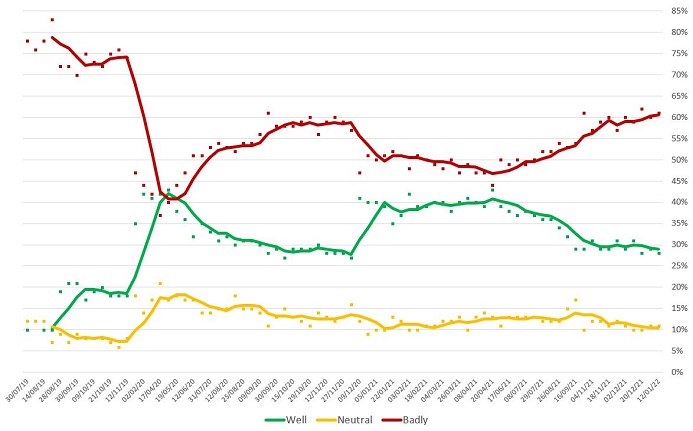
Of course you have to be blind or in denial to not see the telltale signs of a massive failure. The mass production of red tape, now the fastest growing industry in Britain. The massive delays and cancellations of all variants of trade to and from continental Europe. The shortages of basic commodities on the shelves. The reliance on pompous nationalist clichés and memories of the long-gone Empire, as a substitute to actual meaningful action. Then you have to wonder if there is some sort of buyer's remorse about Brexit itself. Admittedly there have been plenty of troubled waters under the bridge since, with other sensitive issues like the refugee crisis interfering, so the public's view is less one-sided than on the first question, though still prominently negative. But there is still a buffer of about 10-12% who still think Brexit was the right choice, even if the handling of it has gone pears up. Even Scots, the most reliable Remainers in 2016, are not fully consistent now, as the last YouGov surveys show 6-9% thinking Brexit was the right choice just handled badly.

This doesn't tell us what Brits would do if offered the option to rejoin the EU. What little polling there has been on this over the last two years is ambiguous at best. And probably just as reliable as 2016 polls, that were conspicuously off until the very last day when YouGov predicted Remain would win by 4%. This has probably become a moot point anyway, as even the Liberal Democrats have given up on campaigning for a second EU referendum. And of course Keir Starmer has promised to Make Brexit Work, which makes as much sense as promising to teach the Venus de Milo to play the fiddle, but never mind. They have to fill these Policy Papers with summat, haven't they? While cautiously avoiding the other options that should be on the table, and might get more support than rejoining the EU, like choosing EFTA instead. But this might split the Labour Party on a meaningful and forward-looking debate, and of course Keir will have none of that, and prefers to endorse the decidedly Corbynite concept of some variant of Lexit, no matter how fundamentally flawed it is. Keir should also be alerted by the fact that Owen Jones came up with the idea first, before the EU referendum, proof enough that he should definitely not touch it with a sixty-foot bargepole dipped in antiseptic. The ultimate irony is that a massive majority of Brits now support Leave, and Scots overwhelmingly so, of course when asked if Boris Johnson should leave or remain as Prime Minister. Did you really think it was about anything else?
When something goes missing, you can always recreate it by the hole it left
(The Doctor, Doctor Who: Hell Bent, 2015)
© Peter Gabriel, 1980
I like the LibDems cause they’re like, sort of, the political
equivalent of bisexual swingers, they just do it with anyone
(Sean Lock, 8 Out Of 10 Cats, 2015)
Clement Attlee won the 1945 election on a 11% swing from the Conservatives and a 11.5% lead. Tony Blair won the 1997 election on a 10% swing from the Conservatives and a 12.5% lead. Margaret Thatcher won the 1979 election on a teeny weeny 5% swing from Labour and a 7% lead. All of which of course pale in comparison with the SNP winning the 2015 election in Scotland on a 24% swing from Labour and a 26% lead, but that's not the point right now. The point here is that two successive poll this month hinted that Keir Starmer could do better than Attlee, Thatcher and Blair, and possibly win the next election on a peak 13% swing from the Conservatives and a peak 14.5% lead. Which might happen, or not, and other polls have been less optimistic about Labour's prospects by a few percentage points. But my current Poll'O'Polls also says that Boris Johnson's constant sparpling no longer works with huge swathes of the British public. They have their eyes on the prize, and the prize is getting Bozo and his herd of sycophantic fly-by-nights oot. Right now, the rolling average is based on the last seven polls, fielded between 13 and 17 January, with a super-sample size of 16,425 and a theoretical margin of error of 0.76%. It predicts a Labour lead over the Conservatives of 'only' 10.4%, with an 11% swing from the Conservatives to Labour since the December 2019 general election. Which is, just coincidentally, pretty much the punditariat-approved threshold for an outright Labour majority under the pre-gerrymandering boundaries.

The most recent polls were published just before rebel Conservative MPs started their own Operation Rinka in response to Johnson's Operation Big Dog. Now you have to wonder who is going to be Johnson's nemesis, and make Big Dog suffer Rinka's fate, metaphorically. Could be the ever-present Dominic Cummings, always one step ahead as long as it can help him not becoming one of the fatalities in one of many scandals. Or it could be the aptly-named Sue Gray, the most famous unknown in the UK, though I would not, at this point, wager a tenner on her delivering the fatal blow. Or, more unexpectedly, it might be Dim Dom Raab, who let himself be cornered again into saying something stupid on national TV. Not genuinely stupid actually, just the kind of stuff that can be used against you in a court of law. The predicted votes by nation and region, factoring in the regional crosstabs of GB-wide polls, are quite enlightening, in comparison to the 2019 results. Northern Ireland is not included as English pollsters just don't go there usually, and locals are not that interested in Commons elections.
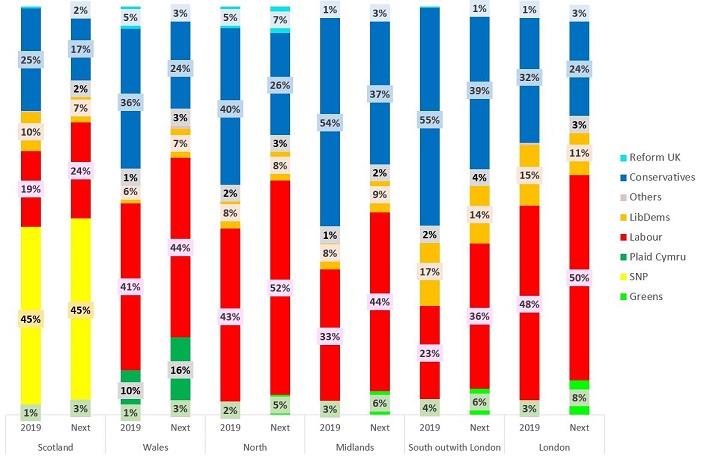
This is just what polls said in the few days leading into a week that might be crucial for Boris Johnson's future and the future of the UK. The Conservative MPs of the 2019 intake have definitely injected the most unforeseen element of slapstick into the whole farce, when Big Dog might now be taken down by the Pork Pie Putsch. They have every reason to be worried if they have seen the spectacular surge of Labour voting intentions almost everywhere, including what was thought to be True Blue Heartlands until the North Shropshire by-election, back then what now feels like a lifetime ago. But we can also take two steps back, and not just one, to get a broader view of the current situation. Labour's current voting intentions are now aboot 1% higher than the Corbyn surge of 2017, though with a wide variety of local situations. They're 6% higher than 2017 in the South and 2% higher in the Midlands. But just level in the North, 5% lower in Wales, 4% lower in London and 3% lower in Scotland. In many cases the surge of the LibDem vote, which is now projected 3% higher than in 2017, is a major factor in Labour gains as it snatches center-right voters from the Conservatives. The actual impact of the shifts in voting patterns is also somewhat obscured by the surge of the Green vote, now predicted 3% higher than in 2019, and 4% higher than in 2017. The LibDem surge might be just temporary, boosted by their recent by-election gains, but the Green surge is certainly more of a long-term trend. Labour will have to factor that in at the next election, and possibly adapt their strategy to make tactical voting attractive for potential LibDem and Green voters.
An MP who claims back £1.31 that he spent on jellied eels?
One, where have you ever seen jellied eels for £1.31?
Two, who gives you a receipt from a pub car park?
Three, a Conservative MP eating jellied eels?
I don’t touch souffle! Stick to your own!
(Rob Beckett, 8 Out Of 10 Cats, 2014)
© Peter Gabriel, 2002
People should not come to Blackpool thinking “dirty weekend”
It’s also very dirty during the week
(Jon Richardson, 8 Out Of Ten Cats Does Countdown, 2021)
The seat projection based on this polling is merciless for the Conservatives, who would lose 133 seats and a lot of prominent bigwigs. Labour would gain 117 seats, in the biggest shift since 1997, and easily doing better that Thatcher in 1979. It actually took Thatcher two elections, 1979 and 1983, to reach a similar level of gains. With Sinn Féin expected to hold their seven seats and still not take them, this would put Labour just two seats short of a working majority. Guaranteed support from the SDLP would allow them to scrape just past the hurdle and start with a 1-seat majority, 322 to 321. There is no doubt in my mind that Keir Starmer would then seek an agreement with the Liberal Democrats, to make his position more comfortable. Technically, a confidence and supply deal would be enough, though it wouldn't guarantee safe passage of all new legislation. So I'm ready to wager a tenner on Sly Keir actually offering the LibDems a full-blown coalition to tie them more securely to his flagship. There's little political capital at risk here, as New New Labour and the LibDems are so close on most issues that Keir wouldn't need to water down any meaningful legislation. Even the LibDem's stance on public ownership is phrased fuzzily enough in their latest policy papers, that it can accommodate Labour's equally half-baked proposals on this. So Britain will live happily ever after in the sunlit uplands of inclusive social-liberalism. Or summat like that.

Of course the loss of the Feeble Fifty from Scotland means Labour will probably never equal Blair's performance in 1997 and 2001 ever again. But here they match the 2015 result with 317 seats in England and Wales versus 315 back then. And, before you ask, the three Scottish Labour seats are projected to be Edinburgh South, Kirkcaldy and Cowdenbeath, Airdrie and Shotts. The SNP would make up the losses and more with one gain from the LibDems (Caithness, Sutherland and Easter Ross) and three from the Conservatives (Dumfries and Galloway, Moray, West Aberdeenshire and Kincardine). So we would have Alister Jack, Wee Andy Bowie and Doogie Ross on the list of Conservative fatalities, which would also include dozens all across England and Wales. I won't bore you with the full list of the other 130, as a lot of them are Red-To-Blue Wall backbenchers whom nobody has ever heard of, or ever will now. Though there are some of the Big Dog (or rather Middle Dog, and even some of Yesterday Dog) variety on the list: Stephen Crabb, Iain Duncan Smith, Graham Brady, Tobias Elwood, Victoria Prentis, Conor Burns, George Eustice, Amanda Solloway, Dominic Raab, Chloe Smith, Alok Sharma, Daniel Kawczynski, Lucy Frazer, Robert Buckland, Grant Shapps, Maggie Throup, Robin Walker, Steve Baker, new media darling William Wragg and Father of the House Peter Bottomley. The breakdown of projected seats by nation and region clearly shows the extents of the Conservative debacle pretty much all across the UK. Only the Northern Ireland seats are unchanged, because there has been no Commons polling there since the 2019 election, as the pollsters are focused on the incoming Assembly election.

Of course these projections must be compared not just to 2017 and 2019, but also to 2005, which is the true benchmark of a genuine Labour success. Just not mentioning Scotland here, for obvious reasons, even if bagging three seats North Of Berwick is something of a feat these days. Elsewhere, Labour would be pretty much level with 2005 in the North (134 projected seats now vs 133 then) and Wales (30 vs 29). Lagging noticeably behind in the Midlands (49 vs 64). And doing better in London (52 vs 44) and the rest of the South (52 vs 45). To stay in the mood of the medieval architecture metaphors, Labour here have successfully restored and improved the Red Keeps in the North and London, come short of fully restoring the Outer Red Wall in the Midlands, but punched gaping holes in the Blue Wall in the South. And, before I forget, predictions that Boris Johnson would lose his seat are grossly exaggerated and premature, as this would happen only if you assumed the same swing away from the Conservatives in London as in the rest of Great Britain, and we have already seen this is just not happening yet. Though Labour would stand a better chance if the LibDems and Greens both declined to stand in Uxbridge and South Ruislip, and actively campaigned for the Labour candidate. Then, and only then, would Big Dog be toast on his own turf. Just saying.
We don’t do charity in Germany, we pay taxes
Charity is a failure of governments’ responsibilities
(Henning Wehn)
© Peter Gabriel, 1977
What happens to an unstoppable force when it hits an unmovable object?
(Jon Snow)
Now is as good a time as any to assess the impact of the 2023 Periodic Review of Westminster Constituencies, the long-delayed exercise in redrawing the constituencies to account for shifts in population and voter registration, as UK law mandates that the allocation of seats by nation and region be done in proportion to the electorate, and not the population. This review, after a lot of comings and goings, false starts and discarded reviews over a period of nine years, was finally authorised by the Parliamentary Constituencies Act 2020. The four Boundary Commissions for England, Scotland, Wales and Northern Ireland have now published their initial proposals, which are now subject to public scrutiny. The four Commissions' websites have all the information you need about the Review, including detailed data about the proposed new seats, that I used for the reengineering of my model and my assessment of the proposals. Which are only a first draft as up to three consultations will happen before the final proposals, that will be sent to Commons some time in 2023, so that the revised boundaries may be used at the next general election. The Conservatives have a vested interest in these changes, as the proposed boundaries would have delivered a 113-seat notional majority in December 2019, 26 seats higher than the actual result. They could also turn around the result of a close election, as shown in the example below.

This projection for the next election is based on the Redfield and Wilton poll fielded on 10 January. The last that predicted a close election, before the next episodes of PartyGate propelled Labour to double-digit leads. On these numbers, the proposed boundaries would switch a 25-seat lead for Labour to a 6-seat lead for the Conservatives, who would remain the first party despite losing the popular vote by 4.5%. As always, the devil is in the details, and the details of the Act are where we find the explanation. More precisely in how the Boundary Commission for England implemented them in a creative way that favours the Conservatives. The Act defines what must be the average size of each constituency, based on registered voters on 2 March 2020. And also what the permissible variations are, based on a range of 95% to 105% of the average size. I will rely here on data from Great Britain only, as there are specific rules for Northern Ireland, and also a wholly different array of parties on offer there. I have also excluded the five 'protected island constituencies' (Isle of Wight West, Isle of Wight East, Na h-Eileanhan an-Iar, Orkney and Shetland, Ynys Mon) which are exempt from the rules, as specific communities that cannot be merged with a mainland constituency. Which might, or might not, be the wish of local voters, but has been the law for years, and in this case helped the Conservatives bag an extra seat by carving the Isle of Wight into two seats. The bias in recarving the seats is not obvious in the statistics by nation. But you readily see it in the statistics by party, which show quite noticeable discrepancies between the Conservatives and the rest.

The result here is quite stunning. The average Conservative constituency has an electorate lower by 1,265 than the legal average. Which amounts to 799,480 potential votes GB-wide, or the equivalent of 11 seats. As a mirror image, the average Liberal Democrat seat is 1,145 voters above average, a handicap of 723,640 GB-wide or the equivalent of 10 seats. Of course this is quite simplistic and the reality of the gerrymandering's impact is more subtle, as we have seen earlier. And there is little anyone can do about it, even if the matter was taken to a Court. There are multiple examples of Conservative seats, that were already within the legal range of electorate, being reduced in size so that new Tory-leaning seats could be carved from bits and bobs. And of Labour seats, that were also already within the legal range, being increased in size by the addition of more Labour-leaning wards, turning safe seats into genuine sinkholes. But, as long as the recarving is strictly within the parameters set by the authorising Act, no challenge will succeed. Unless the plaintiff argues that it also broke one of the basic guidelines of boundary changes: preserve existing community ties such as parliamentary seats being within just one Council area. Then the massive irony would be that Douglas Ross, of all people, would have one of the best cases for undoing the dismembering of his current seat. See my previous article for the how and why.
All tyrannies rule through fraud and force, but once the fraud is exposed
They must rely exclusively on force
(George Orwell)
© Peter Gabriel, David Rhodes, 1986
Never doubt the courage of the French
They were the ones who discovered that snails are edible
(Doug Larson)
Let's take a short detour through France now, and the last polling about their incoming presidential election. I won't bore you with all the vital statistics of the candidates, as you can gather pretty much everything from Wiki here. There's one, and often more, for every tribe from Trotskyists to far-right conspiracy nutters. I have chosen to track only the main ones, those who could plausibly bag more than 5% of the vote, or thereabouts, in the first round to be held on 10 April. And that's still seven of them, with only Emmanuel Macron so far clearing the 20% threshold, that seemed to be the one needed to carry on to the runoff, to be held on 24 April. But the current split of the right-wing votes hints that the threshold might be lower than that, possibly as low as 16%. Then the current list of candidates is not the final one, as candidates need to be sponsored, pretty much like the Labour leadership election. French law requires that candidates much be sponsored by at least 500 elected officials, so there might be some surprises in store before the filing deadline on 4 March. Trendlines of first-round voting intentions show that center-right candidate Valérie Pécresse enjoyed a brief 'honeymoon surge' after winning Les Républicains' primary, but the momentum as since died down. Pécresse in now tied with Marine Le Pen, who has benefited from far-right candidate Eric Zemmour shooting himself in the foot multiple times with extremist outbursts, after also enjoying a surge just after he announced his candidacy.

Interestingly, the issues of 'wokeism vs common sense' have also become prominent in the French campaign, as the cancel culture has also become a thing down there. Gender ideology has gained some traction within the radical left, but is still not a major concern for the general public, as the most controversial bits like gender self-identification are not part of the debate so far. Instead, major controversies focus on the left's endorsement of critical race theory and their attitudes towards radical political Islam. Which is what you might expect in a country where one of the pillars of the Constitution is 'secular republicanism', obviously something totally alien to British thought patterns. So far only the Communist Party's candidate Fabien Roussel is sticking to 'traditional left-wing values', though it does not serve him in the polls. The current weighted average of the latest polls shows the electorate split 1/4 for the different shades of the left, 1/4 for the Macronist variant of social-liberalism and 1/2 for the various clans of the right. Which is both good and bad for Emmanuel Macron. Good because he is predicted to bag roughly the same share of the vote as in the first round of the 2017 election, so seems immune to the anti-incumbent mood he triggered himself back then. Bad because he does not improve on that result, so there is no sign of an incumbency bonus or any sort of momentum in his favour, though he does relatively well in popularity polls. Better than Boris Johnson, that is.

Meanwhile, second round polling still surveys both Macron vs Le Pen and Macron vs Pécresse. With Macron winning in both cases in the most recent polls. The left have pretty much ruled themselves out of the second round by splitting the vote between eight candidates. There are major irreconcilable differences between the various factions, from nuclear energy and an hypothetical Green Deal to foreign policy and intersectional politics. This could spell doom for the left at the incoming legislative election, to be held in June, when they where already hit pretty hard at the previous one in 2017. Interestingly, current second round polling is not that good either for Emmanuel Macron, as it is mostly in the 55-to-45 range, instead of the massive 66-to-34 he bagged against Marine Le Pen in 2017. His supporters are hoping his handling of the various stages of the Covid pandemic will prove an asset in the last stages of the campaign, tough it hasn't been faultless, but still less chaotic than Boris Johnson's. But the success of the booster jag programme and a recently stronger stance against anti-vaxxers might help. Macron also obviously expects a surge in the polls when he will at last officially announce his candidacy, which is expected some time in late January or early February. Which is also the time-frame in which voting intentions have coalesced at previous elections, and become a fairly accurate predictor of the actual results. But, as always, no upset can be ruled out.
I’ve been keeping the fact that I’m a genius even from myself
(Aisling Bea)
© Peter Gabriel, 1982


