25/02/2020

The Great Gerrymander of 2020?


223 years ago today the Last Invasion of Britain was repealed at the battle of Fishguard and it's also Ed Balls's 53th birthday and Dominic Raab's 46th


© Christopher Foreman, Cathal Smyth, 1982


It was a dark and stormy night, the rain fell in torrents except at occasional intervals when it was checked by a violent gust of wind which swept up the streets (though it is not in London that our scene lied), and it had been ten weeks since the election, with nine new polls showing the Conservatives leading by 17% average. No buyers' remorse here, contrary to what happened in 2017 when we had eighteen polls in the first ten weeks after the election, sixteen of them with Labour leading by about 4% average. So it looked like as good a time as any to go back to another and possibly game-changing election issue. A year ago I discussed the impact the Sixth Periodic Boundary Review would have had on the 2017 election results. The proposed boundary changes were never sent to Parliament and never implemented, so the 2019 general election was fought on the same boundaries as in 2010, 2015 and 2017. These boundaries are the result of the Fifth Periodic Review that was held between 2000 and 2007. The obvious conclusion here is that these boundaries no longer reflect the current distribution of the electorate, so some sort of boundary changes is both legitimate and necessary. Then the real question remains the same as last year: would a seemingly neutral boundary review result in massive gerrymandering in favour of the Conservative Party? The obvious answer is that we don't know as there is every reason to believe the 2018 review will never be implemented and the Government will request another set of proposals before acting on the matter. But there is also every reason to believe that new proposals would not be massively different from the previous ones, as the Conservatives have a vested interest in passing a very similar set of boundaries, and their massive majority allows them to do just that. So it is quite legitimate to start by assessing how the proposed 2018 boundaries would have influenced the result of the 2019 election. Martin Baxter at Electoral Calculus has published the full notional results for the 2017 election on the initial proposals published in 2016, and the 2019 election on the slightly amended final proposals published in 2018, and I will rely on his data.


© Cecil Bustamente Campbell, 1964

The Guardian recently published a reader's letter arguing that first-past-the-post (FPTP) is rigged in favour of Labour. The problem is that the alleged 'evidence' here is based on past elections that were fought on different boundaries and voting patterns, so it basically proves fuck all. What the letter totally misses is that FPTP favours the winning party no matter who they are, and also that the winner's vote share is just one factor. The winner's lead over the second party is just as important, if not more, and the different sizes of majorities are also the result of how the battleground seats (those with the closest results at the previous election) behave under any national swing from one party to the other. Recent results definitely go that way. The Conservatives bagged 48.8% of the seats on 42.3% of the vote in 2017, and then 56.2% of the seats on 43.6% of the vote in 2019. While Labour bagged 40.3% on 40.0% of the vote in 2017, and then 31.1% on 32.2% of the vote in 2019. What the numbers actually say is that FPTP delivered a 42-seat bonus for the Conservatives in 2017 and an 82-seat bonus in 2019, compared to what proportional representation (PR) would have returned. A higher Conservative lead, flawed boundaries and unexpected upsets in marginal seats definitely played a part here and the hypothetical implementation of the proposed 2018 boundaries would only have made it worse. Here are the actual and notional results for the 2017 and 2019 elections, as there is an alternate reality somewhere where the initial proposals were used for May's failed snap election of 2017 and decisively changed the outcome, and the final proposals were enacted for the 2019 snap election and only made an awful result even worse.


In 2017 the new boundaries would have changed the result from Conservatives 9 seats short of a majority to an 16-seat Conservative majority, and in 2019 the Conservative majority would have risen from 80 to 104 seats. So a gerrymandering bonus of 25ish seats for the Conservatives, the biggest notional change since the Third Periodic Review that was implemented for the 1983 election and would have delivered 20 more Conservative seats if its boundaries had been used for the 1979 election. Other Periodic Reviews conducted after 1945 notionally displaced fewer than 10 seats and not always towards the winner of the previous election. Moreover this would have been a massively symbolically significant victory for the Tories as they would have bagged more than twice as many seats as Labour, an exceptional occurrence in the last 75 years. Even the Attlee landslide and the Thatcher landslide did not deliver a similar result (though Attlee missed it by just two seats), only the Blair landslides did. The comparison of vote shares with shares of seats at the last two elections also clearly shows how gerrymandering would distort the results one step beyond the usual FPTP distortion.


Of course the impact of gerrymandering is quite different in Scotland as FPTP massively helps the SNP here, but the changed voting patterns between 2017 and 2019 also deliver some surprising results. The altered boundaries would have worked quite as intended in 2017, protecting both the Conservatives and Unionist Labour while hurting the SNP. Also hurting the Liberal Democrats was probably seen as acceptable, yet not really unwelcome, collateral damage. The situation would have been quite different in 2019, similar to what Americans call dummymandering, one that helps the gerrymanderer at a specific point in time but bites him in the arse when voting patterns change. The main reason why it can happen is when many seats in a given area are marginals and gerrymandering can't significantly lower the number of such seats, a well known situation in Scotland where even smallish swings can switch many seats and bigger swings even more. So the tory dummymandering of Scotland would have increased the SNP's share of seats in 2019 from 80% to 87% and I'm not even counting Neale Hanvey as SNP here though he obviously is in anything but official denomination.  


Now it's worth having a closer look at the Scottish Gerrymander. But first bear in mind that the Boundary Review rests on two major principles: reduce the number of seats stretching over several Council areas, draw new seats based on 'community of interest'. The Scottish Gerrymander dismally fails the first test: 47 old seats were fully within one Council area and only 34 new seats do, 11 old seats stretched over two Council areas and 17 new ones do, just one old seat stretched over three Council areas and two new ones do. Then you might wonder what the actual 'community of interests' between Polbeth and Sighthill is, as both would be part of the new Livingston and Edinburgh Pentland constituency which covers a small southwestern part of Edinburgh City Council and a large southeastern part of West Lothian Council, while its predecessor seats (Livingston and Edinburgh South West) were both within one Council area. Then the real rationale behind this was obviously to pit SNP MPs Hannah Bardell and Joanna Cherry against each other and force Cherry out of Westminster. Now let's see what a seat by seat breakdown says (click on the images for larger and easier to read tables).


So seven Scottish seats would be abolished (six SNP and one Conservative, highlighted in red), and it's certainly no coincidence if several high profile SNP frontbenchers would find themselves without a seat, while losing Wee Andy Bowie too would certainly be considered an added bonus by the diehardest Boris cultists. We would also have one 'new' seat (Falkirk South), meaning it has no obvious predecessor seat as it is stitched together from 'leftovers' form other recarved seats, and finally five of the redrawn seats would notionally change hands (highlighted in yellow). For these seats, the notional MPs are the runner-ups (or should that be runners-up?) in the predecessor seats in December. Though of course candidacies would have been different if the boundary changes had been enacted and a couple of newly elected SNP MPs would not even have been candidates. I think we can safely assume Ian Blackford would have stood in the new Highland North and unseated Jamie Stone, and that Joanna Cherry would have stood in the redrawn Edinburgh South and unseated Ian Murray. I also venture Neil Gray would probably have moved some miles to the North East from Shotts to Falkirk and secured the orphan Falkirk South for the SNP. Then I have a hunch John Nicolson would have chosen a rematch against Jo Swinson in the redrawn and more SNP-friendly East Dunbartonshire, saving himself the embarrassing slip-of-the-tongue moment. Just kidding, John, love ya. Finally Philippa Whitford would have found an obvious landing pad in the new Ayr and Carrick seat, notionally Conservative Bill Grant's seat in 2017 and now an open seat after Grant's decision to stand down. So the artfully crafted scheme to unseat prominent SNP figures would certainly not have worked as planned, with only Glasgow North's Patrick Grady left without an obvious Plan B, except now becoming the next MSP for Glasgow Cathcart after James Dornan's retirement.

© Cecil Bustamente Campbell, 1963

A textbook case of the Boundary Review's flaws is the situation in Edinburgh, highlighting both the anti-SNP bias and the dummymandering factor. An early proposal, published in 2013 as part of the original Sixth Periodic Review, already reduced the Capital City's seats from five to four but all were neatly within the Edinburgh City Council boundaries. If this proposal had been used at the 2015 election it would have delivered four SNP MPs, as Ian Murray's Edinburgh South was abolished and split between the new Edinburgh East and Edinburgh South West constituencies. Then the resurrected 2018 Review produced two sets of proposals, an initial one in 2016 and a slightly amended final one in 2018. Both proposed four seats within the Edinburgh City Council boundaries but with the added monstrosity of a West Lothian seat protruding into Edinburgh in clear violation of two of the Review's basic principles as I already mentioned. Bear in mind that all Edinburgh seats have been neatly within the city's boundaries since 2005. So the 2018 Review's proposed boundaries are something of a 'once in two generations' monstrosity.. If the 2017 election had been fought under the initial proposal, it would have delivered two seats each for the SNP and Labour, with the new Edinburgh East seat carefully carved to inject enough Labour voters from Liberton and Gilmerton to unseat Tommy Sheppard while protecting Ian Murray in the redrawn People's Republic of Morningside seat. Then the notional 2019 results would have made the gerrymander backfire into dummymander with all four Edinburgh seats going to the SNP. Aye, ye ken, even the best-laid schemes....


© Lee Jay Thompson, 1979

The Guardian is now using the Labour leadership race to again push for proportional representation (PR) instead of the centuries-old first-past-the-post (FPTP) and urge Labour to endorse it without actually making a case for it, other than the odd point that it would weaken 'nationalists', insert SNP and Plaid Cymru here but of course mostly the SNP, just as you thought The Guardian had truly renounced their past insidious SNP-baddery. Anyway, and regardless of the likelihood of any system being ever used in the UK, I tried five options.

Proportional representation (PR): using the famous d'Hondt method but not based on a single UK-wide list which would be unacceptable for a fuckload of obvious reasons. Instead I used regional lists in twelve constituencies duplicating the ONS statistical regions and the now defunct European Parliament constituencies. Note that regional PR is more favourable for the two or three biggest parties as it creates a de facto threshold for representation even without such a provision in the electoral law. The first party does not need a majority of the popular vote to bag a majority of seats. Under current voting patterns, around 47% would be enough;

Majority Bonus System (MBS) (which is in fact two options here): the system used in Greece until last year and at some elections in Italy. With two simulations here; one with 600 seats filled on regional PR and 50 allocated en masse to the first party; one with 550 seats on regional PR and 100 allocated to the first party;

Additional Members System (AMS): the one infamously used at the Scottish and Welsh parliamentary elections, providing levelling (or compensatory) seats on regional PR for the losers of the FPTP vote. Here I simulated two thirds of seats filled on FPTP and one third on regional PR, the same proportions as the Welsh Senedd;

Mixed Membership System (MMS): with 325 seats filled on FPTP and 325 on regional PR. I used a true MMS with the PR seats allocated in a totally separate count regardless of the results of the FPTP vote. This is quite different from the allegedly 'mixed member representation' used in Germany and New Zealand, which is tweaked to deliver a similar result to pure PR, or from AMS which factors in the FPTP seats in the allocation of the additional PR seats.

The only options I did not try are Instant Runoff (IR) and Single Transferable vote (STV), as nobody has the fuckiest where the second and further preferences would go. Trying to approximate IR by some odd extrapolation of the winner-runner up combinations on FPTP would only be a very approximate approximation, and certainly widely and wildly off. So here is what the other options would deliver, in numbers and shares of seats. All based on the 12 December results though it's quite certain that voting patterns would have been different under a different electoral system, but that's all we have.


The proponents of PR quite clearly support it only to avoid any party ever getting a majority and to impose coalitions that the electorate don't actually want. For example, in the run-up to the last German general election, only 25% of the electorate actually wanted a CDU-SPD Grand Coalition and yet that's what they got in the end. In the UK last December the only mathematically viable option would have been a Con-Lib coalition. And we all know that, even if we loved to jibe at the LibDems' unique talent for betrayal and their appetite for ministerial cars, it would never have happened under Johnson's leadership. Foreign examples also demonstrate that coalitions can be the recipe for impotence as in Germany where Grand Coalition partners give up on their most divisive manifesto pledges and the Grand Coalition amounts to little better than a long-term caretaker government with no ambition for reform. In other contexts it can also be a recipe for extremism as in Israel where coalescing the fifty shades of racist theocratic far-right around Likud led to each coalition partner fuelling the worst instincts in the others, if they ever needed it. Back to my simulation, AMS here delivers an unexpectedly close result to PR. The reason is that there are many more seats up for grabs on the regional lists than in the real Scottish and Welsh elections, so the FPTP winners have significant opportunities to also bag list seats.

© Graham McPherson, Christopher Foreman, 1982

In my view, the best option is MMS as it can deliver a majority if the first party has both a strong plurality of the popular vote and a convincing lead over the second party, which is exactly what happened at the 2019 election. But the Conservatives would have bagged only a 10-seat majority under MMS, meaning the would be in a weaker position than under FPTP and would have to seek compromise in some cases. Bear in mind for example that only 330 out of 365 Conservative MPs voted for Johnson's Withdrawal Agreement Bill at the third reading. Even though there was no open rebellion, 10% of Tory MPs expressed discontent by not showing up to vote despite support for the WAB being carved in stone in the Tory manifesto. If Johnson had had a 10-seat majority instead of 80 seats, he would certainly have been forced to negotiate with his own 'soft Brexit' MPs and amend the WAB. For example by reinstating the provisions that were scrapped between the initial pre-election draft of the bill and the final draft that was tabled after the election. Just sayin'..... In different situations where the results are less one-sided than in 2019, MMS would nit deliver a majority, as the projections for the 2010, 2015 and 2017 elections show. So it can be seen as a perfectly acceptable compromise solution even for PR supporters, as it delivers a majority only if the popular vote goes strongly in one direction, and on more ambiguous results delivers a hung Parliament and a coalition.


For simplification 'Others' above include the 18 Northern Ireland seats, the Speaker and Plaid Cymru. Which is why the numbers are almost the same under FPTP and MMS, as Plaid Cymru is the least impacted by the switch to MMS, bagging three MPs at each election instead of the three or four they bagged under FPTP. I kept separate lines for UKIP and the Greens as both can be significantly impacted by the switch from FPTP to MMS, especially at the 2015 election that saw a more fragmented vote than 2010 and 2017. Under MMS we would still have had the Con-Lib coalition in 2010 but the stronger LibDem representation might have resulted in some changes in policy. Or not... More significantly both the 2015 and 2017 elections would have made the continuation of the Con-Lib coalition the only viable option. And you never know what might have happened then. No EU referendum? No Brexit? We will never know but one can dream, can't he? Anyway it would be daft to expect any significant electoral reform in the foreseeable future, whoever is in power, and for once that really means never-in-a-generation and probably never-in-a-lifetime. But I certainly don't rule out the current Tory government enforcing the 2018 Boundary Review or something very close. They have the votes to pass it no matter what, and losing only 13 seats under the new boundaries is very easy to manage with the natural attrition we witness at every election, with MPs standing down because of age, stress or any of the usual excuses. They could easily promise a seat to all incumbents willing to return and accommodate a batch of newcomers on top of that. So watch out for the new boundaries coming up in Commons, we only don't know when. Time will tell, but when it happens, remember you read it here first.


It's a good rule in life never to apologize
The right kind of people never want apologies
And the wrong kind take advantage of them
(The Orville, episode Pria, 2017)


© Graham McPherson, Michael Barson, 2019

02/01/2020

An attempt at a PM to PESD....


…. as in Post-Mortem to Post-Election Stress Disorder

Don't blame me, please, for the fate that falls
I did not choose it
I did not, no no, I did not
I truly did not choose it
(Peter Hammill, Darkness (11/11), 1970)


© Peter Hammill, Christopher Judge Smith, Hugh Banton, 1970

So 'tis this time of the year when the Realm's new motto is "Ein Volk, Eine Nation, Ein Führer". Which is just what happens when the now-elected First Minister of England has never apologized for a piece he published in the Spectator that advocated the final solution to the Scottish question, has made it clear that his one-nation Conservatism is nothing but Little England Conservatism, and sees a personal allegiance from his Cabinet Ministers and MPs as the foundation of his power. One of the oddities on Election Night was the Conservatives branding themselves as The People's Government, which Andrew Marr described as 'a bit French or possibly even Russian', and here he probably actually meant Soviet, as he reminded the Tories that 'we have a parliamentary democracy and the people are represented by all sorts of other people'. But don't expect Johnson to pay much heed to this self-evident truth. So after a brief moment of shameless cronyism, because there are only so many hermines that can be trinketed before the yearly supply runs out, he will go back to further Stalinist purges to make sure BorisSpeak becomes the official language of the UK. He already purged the party, now he's ready to purge the Civil Service and the state media that is not even Propagandastaffelish enough for his taste. Just give him one year and the UK will be a one-party state in anything but name with Dominic Cummings sending daily memos to all Ministers telling them what they are and are not allowed to say. Uh... wait... he does that already, or doesn't he?


So how the fuck did we get there? Difficult to name and shame pollsters this time as they did a better job than two years ago. Last day polling said Tories 43.8%, Labour 33.5% and LibDems 11.6% and we got (GB-wide only as this is where the pollsters polled) Tories 44.7%, Labour 32.9% and LibDems 11.8%. All vote shares right within 1% with just that little quirk that a predicted Tory lead of 10.3% turned into an actual lead of 11.8%. But the polls were a bit off in England outside London, where the election was decided as usual. Last Day polling predicted a 14.5% Conservative lead Doon Sooth and it ended up being 18%, more than enough to switch a score of marginals and explain why the predictors all underestimated the Conservative majority. The real test for the various prediction models and their solidity is what they predict when fed with the actual vote shares. The graph below shows the various projections by the models available online and also what uniform swing would have delivered. The deciding item is then the number of misses, calculated as the sum of the absolute values of differences between the predictions and the results, party by party. Here Electoral Calculus comes out as the best predictor by far with a score of 16, with my model a distant second with a score of 30 and Flavible a very close third with a score of 32. Though, in all fairness to them, Flavible come third only because their model got the SNP seats wrong by a wide margin and they did better than me for the English seats. Uniform swig is almost as good with a score of 36 while Election Polling is far behind with a score of 48. Now just let me bask in the spotlight for a wee moment as my own performance is definitely not bad for an amateur with no resources but himself. Especially as YouGov's and Focaldata's big MRP engines performed quite badly with a miss-score of 70 and 76 respectively, though of course their predictions were based on what polls were available two days before the election, not retconned with the actual vote shares.


Back to the real world, there are many oddities in this election's results. The LibDems' vote share rose significantly yet they managed to lose all seats they had gained since 2017 through defections and one by-election, and ended up with fewer seats than in 2017. Losing their leader's seat by a squirrel's hair was just another embarrassment for a party thrown into disarray. Labour managed to hold recently won ultra-marginals with increased majorities, think Canterbury or Portsmouth South, while the historic Red Wall fell apart from coast to coast, taking down iconic seats that had been Labour's even since before 1935, think Bolsover and its predecessor Clay Cross that had been in Labour's hands since 1922, or some that had been in Labour's hands since 1918 except for a brief interlude in 1931-1935 during the disastrous National Labour years. Or Tony Blair's Sedgefield which elected its first Labour MP in 1922 and had been a safe Labour seat continuously since 1935. It is a bit harsh to describe this election as Labour's worst since 1935, though it's mathematically correct, as the pattern here is more 1983ish. Had Bolsover and Labour's Scottish seats not fallen, Corbyn would indeed have matched Foot's performance. But Labour were indeed courting disaster last month with a manifesto even they did not seem to fully grasp. They had some 1,057 items for sale and all were priorities, except taking a clear stand on the one issue that mattered to disgruntled voters in their heartlands: Brexit. Procrasturbation can only take you so far, or can't it? To be fair Johnson also seemed to have a hard time remembering what the Tory manifesto actually proposed, except massive injections of freshly-printed dosh everywhere, but at least he stuck to the script on the two major soundbites: Get Fucking Brexit Done and No To Fucking IndyRef2. One worked and the other did not, and the one that worked was the only one that really mattered to harvest even the remoteliest plausible gains.


© Peter Hammill, David Jackson, 1975

Now it is quite clear to me that millions were not careful enough what they voted for, and Johnson's true First Hundred Days are bound to be the winter of their disillusion. They will soon discover it's safer to trust a snake with fangs at both ends rather than Johnson. Just don't think for even a nanosecond that Johnson intends to increase funding for the NHS out the goodness of his heart or because he genuinely cares. It is just a ploy to make the prey more attractive to foreign investors when the NHS will be on the table during trade talks between a weakened United Kingdom and Trump's high and mighty corporate donors using the US government as a front. Never forget what American Big Business actually mean by 'free trade': freedom to plunder. Another priority for Johnson is to repeal the Fixed-Term Parliaments Act 2011 (FTPA), which of course has emerged as a top concern for the elusive Workington Man during the campaign, or has not, but what does Johnson really care? In my opinion FTPA was a major step in modernizing British politics despite its many flaws and self-defeating loopholes, and now Johnson wants us back to the days of feudalism when the Monarch could dismiss Parliament on a whim because they disliked the Speaker's choice of a wig. Then you could argue that there is no need to formally repeal FTPA as it has already been de facto nullified by the Early Parliamentary General Election Act 2019 (EPGEA). A unique occurrence in parliamentary history when a secondary provision of an Act was used to circumvent the core provision of the very same Act, and the LibDems' and the SNP's everlasting shame as they were the ones who came up with that stunt in their haste to get an early snap election where both expected big gains and the possibility of a hung Parliament. Then the SNP proved the abler gamblers here as they did score the big gains while the LibDems failed miserably. Oddly Johnson at first rejected the idea as he was uncharacteristically trying to play it by the book and aimed for a clean dissolution on the 434 votes required by FTPA. Only after he failed thrice did he endorse the stunt into EPGEA. Quite ironically Labour then fell for it and shot themselves in both feet and the arse, choosing to back it and giving Johnson more than the proverbial 434 votes, on a bill that now required only a simple majority, while the SNP abstained because they disagreed with the proposed date. Because, ye ken, there are only two hours of daylight in Stornoway and Perth after 9 December. Strange days indeed in the last weeks of the 57th Parliament...

© Peter Hammill, David Jackson, 1970

Of course Labour UK-wide have only themselves to blame for a defeat of Titanic proportions. Since 2017 the Labour leadership had a once-in-a-generation opportunity to rebrand themselves as the English Syriza or Podemos and instead ended up being Militant 2.0, so don't expect the calls for New New Labour to die down anytime soon even if a now not-so-reluctant Keir Starmer becomes the new leader, as was my hunch many moons ago, but then I'd never tell you that I told you so, our would I?. Then Owen Jones has the perfect explanation for Labour's crashlanding, aye the same Owen Jones who told us to brace ourselves for a 2017ish upset in the last mile. But what's not to love with 20/20 hindsight? Owen definitely has his own special way around the five stages of Kübler-Ross, provided of course the whole thing is actually a thing and not just a stunt for phony psychologists to get some dosh out of gullible mourners. Anyway Owen was both in denial and angry before disaster struck and then he sped past the next three stages to an unprecedented sixth one: comment. Bur even Smart Owen has a hard time finding a way to blame anything and anyone but Corbyn for the disaster. Though you can still blame the Tories and you wouldn't be far from the truth. Yet you could also easily make the case that this election oddly echoes the last line of King Kong, only slightly rearranged: Oh no, it wasn't the Tories, it was Treeza killed Jezza. Why is that? Just look again at my seat projections since I started this blog 18 months ago. I did not include all projections as it would have lethally cluttered the chart, but only a selection of about one per month, and even what this redux shows is quite mindbogglingly flabbergasting. Just look at the bar for 12 May 2019, just ten days before the European Parliament election was held and a massive shitstorm hit the fans.


Aye, you got it right. Early May polling predicted a massive walloping for the Conservatives and Labour gaining more seats than in 2017. Of course this was before the hyper-tsunami of anti-Corbyn propaganda in the Tory-cuddling billionaire press, at a point where Theresa May was so discredited that Corbyn's PMability rating almost matched hers, and also before LibDems started mantraing their 'neither nor' that actually meant 'neither Jeremy nor Corbyn. Just take a deep breath and let it sink in that, if the general election had happened then, Jeremy Corbyn would be PM, Ed Davey Deputy PM and Ian Murray Secretary of State for Scotland (naw, just kidding here), and the SNP would already have strongarmed the Lab-Lib coalition into granting a Section 30 Order. Not to forget the added bonus that, in this alternate reality, Ruth Davidson would actually have skinny dipped in Loch Ness after the SNP cleared the 50-seat hurdle. Then the European Parliament election, the one that could have been avoided, totally reshuffled the deck and sent the mechanics of disaster into motion. At first polls showed that people tended to duplicate their European election vote rather than actually state how they would vote in a general election, triggering speculation that the English Conservatives might suffer the same fate as the Canadian Conservatives at the end of the 20th century. Even on Mayxit Day at the end of July, a Lab-Lib coalition remained a very plausible outcome, then the Brexit Party vote plummeted to UKIPish levels. But as long as it stayed at 2015 UKIP level, a hung Parliament was still the predicted outcome, which might explain why the LibDems and the SNP were so eager to get a quick snap election. Oddly the much publicized Boris Effect actually reached its full impact only after Parliament voted for dissolution and the Brexit Party vote foundered further to 2017 UKIP level and the rest is history as The Resistible Rise Of Alexander Boris became irresistible. What 20/20 2020 hindsight tells us is that Labour would be better off today if they had helped May pass her Brexit Deal (which was admittedly awful but definitely less so than Johnson's that will pass anyway now) before the end of the first Brextension, and then triggered a vote of no-confidence and a late spring or early summer snap general election. But allowing May to kick the can of worms down the road twice too many sealed their fate. And ours.

© Peter Hammill, 1970

This election was also devastating for the LibDems and deservedly so. Now the narrative is that they did not do that bad as they lost 'only one' seat, in a stunning replay of comments about the Alliance's performance in 1983. And todays' comments are as misleading as back then. Just remember that LibDems had 21 seats on Dissolution Day so the net result is that they lost half, and the detail is worse as they held only 8 of 21 and partially compensated with two gains from the Conservatives and one from the SNP. And if you look back a few months it is clear the LibDems suffered a major case of Midas In Reverse: everything they touched turned to shite and it got even worse after Jo Swinson took over from Vince Cable. They tried to attract Labour and Conservative defectors en masse so they could rebrand themselves as the English Macronists but only eight succumbed to the sirens and in the end all of them lost even after switching to different seats deemed more easily winnable. Then they tried to frankenstein a Remain Pact but it again failed miserably after showing cracks on day one when a number of Welsh LibDems refused to stand down for the 'separatist' Plaid Cymru, and then it gained only one of the 60ish seats where it actually happened: Richmond Park. But you could argue that this particular seat would have switched anyway and you would certainly be right. And in the end it did not matter the least as Zac Goldsmith came back through the out door as an unelected hermined expenses scrounger, as befits the First Minister of England's drinking buddy.


Textbook case of Unite To Remain's trainwreck is Brecon and Radnorshire, the much publicized LibDem by-election gain, that switched back to the Tories on GE day. I said quite clearly at the time that this poster gain was in fact nothing more than a Potemkin gain, an illusion only supported by misleading PR, and the general election proved it was just that. There is also a massive dose of irony in Tom Brake, the LibDem spokesman on Brexit, losing Carshalton and Wallington to a 27yr old Tory NHS worker. Brake was the longest serving LibDem incumbent standing in this election as he had represented the seat continuously since 1997 but of course it voted 56% Leave, strongly against the overall trend in London and the Brexit factor was enough to defeat him on just a 2% swing. But the election also leaves a stain on the LibDems: Kensington, the constituency where Grenfell Tower is located, switched from Labour to the Conservatives by 150 votes with Tory-turncoat-turned-LibDem Sam Gyimah bagging 9k votes after a smear campaign against Labour incumbent Emma Dent Coad. There are many things for which the LibDems will never be forgiven and this is one of them. But you can also enjoy the thought that some born-again Libdems like Philip Lee, Sam Gyimah and Chuka Umunna managed that memorable feat of losing two seats at the same time: their old seats stayed with their old party while they failed to gain their new seats of choice. So now it's: Bye bye Jo, Bye bye Sam and Chuka, Blame your emptiness, And I'm not gonna cry.

Hey Jo! Gotcha!

Now expect Boris Johnson to break an arm patting himself on the back for getting Brexit done when his amended worse-than-May's Brave New Deal is passed by Commons. Though in the real world nothing will be done and everything will remain to be done after 31 January. And when the economy collapses because of Johnson's inept handling of the Brexit transition period, we're going to be told that more austerity is needed and that we're all in this together, like Tories always say. Which means pretty much the same as when Bruce Ismay told the steerage passengers they were all in this together aboard the Titanic. Unless of course Johnson insists on delivering on his massive spending pledges without resorting to the Magic Money Trees in the now reconquered Kensington Gardens but instead borrows from the usual loan sharks on international markets. After all Tories have already successfully increased the national debt from 70% of GDP at the end of the 2009-2010 financial year, the last under full Labour control, to 84% in 2018-2019. Now Johnson can easily do better than this and increase it to above 100% at the end of his term, thus beating the record currently held by France, and we all should definitely be happy to beat France in any sort of competition, or shouldn't we?.

© Peter Hammill, 1971

A word now about a very serious issue that cost Labour dearly: antisemitism. First let's make it clear that I consider antisemitism to be an absolute abomination that must be absolutely eradicated. Then what happened in the UK cannot be solved by a black-and-white approach about who holds the moral high ground and who doesn't. Left-wing antisemitism is not a new thing, it existed already in the 1930s when 'Jewish finance ruling the world' was a favourite cliché for both Stalinists and Nazis. More recently, left-wing antisemitism is the direct consequence of extreme antizionism and unquestioning support for the Palestinians. So I do believe this specific kind of antisemitism exists within Labour, but I also believe it was grossly exaggerated for political gain as even Luciana Berger was unable to build a watertight case about the alleged 'institutional' Labour antisemitism, or even prove that Corbyn himself is an antisemite. Don't forget too that even the minutest allegation of antisemitism, however unfounded in most cases, is systematically weaponized against those who simply oppose the policies of Israel. So a serious debate is tainted by obfuscation and deliberate misrepresentation, culminating in Corbyn being labelled a supporter of terrorism, which he obviously never was. Bear in mind too that the not-unintended consequence was to shut down any honest investigation into racism, homophobia, islamophobia and antisemitism in Conservative ranks.


Let me just say that the Tories shamelessly playing the 'Labour antisemitism' card all along the campaign was definitely a low point. Michael Gove's victory speech, opening for Johnson in the wee hours of Friday the Thirteenth, was probably the most disgusting example of electioneering a very sensitive issue, when he claimed that British Jews 'should never have to live in fear again' of a Labour leader who 'embraced anti-Jewish terrorism'. Then subtlety and adhering to the truth have never been Sleekit Gove's fortes, or have they? I further think there is no antisemitism in stating the obvious fact that a number of 'representative' Jewish organizations in Western Europe and North America are in fact propaganda outlets for Likud and far-right Israeli expansionism. Or in stating that a number of British lobbyists act as paid agents of a foreign political party which means, as long as said party is in power, paid agents of a foreign power on British soil. Of course this is not just an Israeli thing, Saudi Arabia, Russia, China and American Big Business also have their lobbying networks in the UK to exert pressure on Parliament and Government, but at least they don't use alleged antisomethingism as a smokescreen to demonize their opponents. The claim by Likud-sponsored pressure groups that antizionism equates antisemitism is preposterous as Zionism is an ideology, not a religion or an ethnicity, and as such is a legitimate target for scrutiny, criticism and debate. Likewise calls for the UK government to criminalize the boycott of Israeli products, which unfortunately might succeed, is also unacceptable as organized boycott is a legitimate strategy to fight human rights violations and has been successful used against other countries in the past. And I'll leave it at that for now, or more likely forever.

© Peter Hammill, Hugh Banton, Guy Evans, David Jackson, 1971

Back to the fallout of the general election, voters in Northern Ireland also sent a clear message that was obvious already from the trend of polls, as I pointed out in earlier posts. The most obvious part is that Republican MPs now outnumber Unionist MPs for the first time ever, something I mentioned as a distinct possibility when commenting on the most recent NI poll, and has now happened. But as usual there is more here than meets the eye at first glance as voters actually sent a more comprehensive message. One that has nothing to do with Brexit and everything to do with local politics. The end of the DUP-Sinn Féin duopoly signals massive discontent with the breakdown of the power-sharing agreement that has resulted in Stormont now shut down for three years. Another part of the message was overshadowed by Sinn Féin unseating DUP Deputy Leader Nigel Dodds but the SDLP's rebirth also signals growing discontent within the Republican community at Sinn Féin's abstentionist stance. Republican voters, who are also massively Remainers, deeply resented not being heard in Westminster during the endless Brexit debate and came to the right conclusion that only the SDLP can be their voice. The massive 18% swing from Sinn Féin to the SDLP in Foyle is the most obvious sign. Sinn Féin can consider themselves lucky to not have lost South Down to the SDLP too, as a number of potential SDLP voters probably switched to the Alliance Party there. That the results were something of a best-case scenario for Sinn Féin and a worst-case scenario for the DUP can't hide the fact that both received a strong warning from the electorate to change their ways, or else...


But of course the Big Twenty-Twenty Constitutional Showdown will not be about Irish Reunification, the so-called Border Poll. It will be about Scottish Independence. We all know that both Nicola Sturgeon and Boris Johnson can be.... uh.... reactive given the proper incentives, so expect something like High Noon At The OK Corral unless it turns into Alien Vs Godzilla or whatever. And aye, Godzilla is one of the good guys, at least the reboot says so, or doesn't it? Anyway it will be interesting to see what comes out of a confrontation between a true believer in English Exceptionalism, coupled with a very English version of 'manifest destiny', and a true believer in Scottish Universalism, though I don't really expect it to reach that level of intellectualism. I fear it will end up closer to a bar brawl than a debating society session. Speaking of debates, we definitely need one between their Secretary of State for Scotland and our Secretary for Constitutional Relations, and I can't wait for the next day's headlines on how they kept barking at each other during the Jack-Russell confrontation. Aye, that's a lousy one but I definitely couldn't resist. Now Johnson has promised to love-bomb Scotland, whatever than means beyond the hypothetical £3.3 billion of Barnett consequentials mentioned in the fairy tale Tory manifesto. But are we really to trust that 2020Boris is any different from 2004Boris who implicitly endorsed 'comprehensive extermination' of the 'verminous race' of 'tartan dwarves'? Then we could also dare him to make good on having Hadrian's Wall refortified to pen us on the other side, as James Michie put it, before he realizes that would mean Scotland annexing Carlisle, most of Northumberland and Newcastle. But I certainly wouldn't bet a tenner on a Johnson-Sturgeon debate happening anytime in the foreseeable future. Johnson probably has an uncontrollable unconscious fear of Scots as he already chickened out of an interview with Andrew Neil. And he surely knows he would be drowned and quartered, quicklimed and woodchipped by Sturgeon in less time than it takes to say 'Our Precious Union Of Equals' so he has no incentive to risk a one-on-one he would lose because, ye ken, though she be but little, she is fierce.

We walked alone, sometimes hand in hand
Between the thin lines marking sea and sand
Smiling very peacefully, we began to notice that we could be free
© Peter Hammill, 1970

BBC One Scotland described the incoming constitutional trench-war as 'an irrepressible force applied to an unmoveable object' twice on Election Night after it was confirmed by multiple declarations that the SNP had done extremely well and ousted more than half of Scotland's Conservative MPs. Now we could have a debate within the debate about what is really the unmoveable object. Johnson's resolve to trample democracy underfoot again and refuse to even discuss a Section 30 Order? Or Sturgeon's determination to make the voice of our people heard through a peaceful democratic process? The irrepressible force is certainly not that of Johnson's willpower as he is known to U-turn, bully or manipulate rather than confront strong opposition head on. You might also want to know what Oor Jimbo Murphy, the luminary who wouldn't find a haystack in a noodle factory, has to say about the election and Scotland's future. Then watch him desperately waffle-piffling while being grilled by Andrew Neil during BBC One's (England version) Election Night coverage here between 3:26:30 and 3:31:45. It's quite hilarious especially when Jimbo tries to play the Paisley card and Neil hits back with 'just answer the question' in an exasperated tone hinting he actually means 'answer the fucking question, you fucking moron'. Hilariously embarrassing and again Jimbo has egg on his face and the yoke's on him. Aye, lame one again but couldn't resist. You might also enjoy Andrew Neil grilling a half-awake Kezia Dugdale later on Election Night here from 0:21:40 to 0:24:35. Always fun to see Tory Andy playing devil's advocate about IndyRef2 and making former Branch Office grandees look and sound like eejits, though his earlier test run with Theresa May (here from 2:12:20 to 2:14:45) wasn't bad either. Back to the immediate future, I hope the impromptu AUOB March in Glasgow will successfully prove that the will of the Scottish people is indeed the proverbial irrepressible force. Will Glasgow this time outperform Edinburgh where some 200k marched on a memorable 5 October last year? Now that would be really massively great if it happens. I have nothing further to add for now to what I said about the incoming fights a week ago, just bear in mind the IndyRef2 vote is the one we can't afford to lose, and yet it definitely also is ours to lose.

By the way, in case you wondered, there has not been any new poll since the election. Three weeks on and nothing, and I've turned fucking cold turkey now, quite a feat for a vegetarian. Our usual Band of Pollsters are probably still recovering from the shock of not having been devastatingly wrong again, or maybe they can't find a suitable sample with all these jolly Englanders holidaying on Mustique. For the record, at the same point in time in 2017 we already had four new voting intentions polls and all predicted a Labour victory. But that was just typical buyer's remorse polling. Just sayin'


For of all sad words of tongue and pen
The saddest are these: it might have been
(John Greenleaf Whittier, Maud Muller, 1856)


© Peter Hammill, 1970

27/12/2019

The Scottish Play - Act VI and last of MMXIX


Tomorrow and tomorrow and tomorrow 
Creeps in this petty pace from day to day,
To the last syllable of recorded time.
And all our yesterdays have lighted fools the way to dusty death.
Out, out, brief candle!
Life's but a walking shadow.
A poor player that struts and frets his hour upon the stage
And then is heard no more.
It is a tale told by an idiot, full of sound and fury,
Signifying nothing.


© Calum MacDonald, Roderick MacDonald, 1987

A lot of this article will be devoted to the post-mortem of the General Election in Scotland. Which fits the Shakespearian title as there is always someone dying at some point and the other characters spend the best part of the last act commenting on it. An aside first about the Neale Hanvey situation, which is quite tricky for the SNP, so let's get it out of the way and move on. His past posts were really shameful and offensive and the SNP's vetting process was definitely at fault here, but he looks sincerely contrite and has made what look like genuine amends. Of course the SNP is not the Roman Catholic Church and contrition does not grant absolution. But I have no doubt he will and indeed should be reinstated after a reasonably long period in the decompression chamber. And, before they even start howling at the moon about it, Scottish Tories are the least legitimate to take shots at the SNP about this when their own revered UK leader is an unrepentant racist white supremacist, the only trait he actually shares with his idol Winston Churchill, and CCHQ steadily ignored all calls to tackle racism, antisemitism and islamophobia in their own ranks and are in total denial about it.


One obvious lesson from the Christmas Shopping Spree Election is that Scottish polling was much better this year than it had been 30 months ago. This was also the case for GB-wide polling but that's another story that will be told later. Our problem, mine anyway, was that the traumatic experience of 2017 led us to believe that polls could only overestimate the SNP vote, and that we should be ready for an even worse result than the very last poll predicted. Only it absolutely did not work that way this time. In fact the very last poll, conducted by Survation in the last two days of the campaign, was quite close to the result and slightly underestimated the SNP. And the one that had the closest seat projection to the actual result was Ipsos-MORI's, conducted almost three weeks before the election. Then it takes a combination of both to actually see what I believe are the two main lessons from this election. First the Unionist vote failed to coalesce around the Conservatives, contrary to what many including myself expected, as they actually lost a fair number of center-right Europhile votes to the Liberal Democrats. The few cases where the Conservatives gained votes (7 seats out of 59) probably have more to do with the Brexit factor in Leave-heavy areas than the Union factor, and anti-SNP tactical voting too in a handful of seats. Best example of the Brexit factor is Banff and Buchan, where the Conservative vote increased by 2.2% and is now the only Scottish seat with a Conservative majority of the popular vote, and was also the only Scottish constituency with a Leave majority in 2016. Best, or worst, example of Unionist tactical voting is of course North East Fife with its 10% swing from the Conservatives to the LibDems, which you can't possibly explain by the Brexit factor alone. 


Labour's campaign fell mostly on deaf Scottish ears, as is exemplified by the number of seats with a 7% to 10% swing from Labour to the SNP. I see this as evidence that independence-leaning center-left voters got the SNP's message loud and clear and voted both for the party most able to defend Scotland's best interests against a hard-right Tory government, and to strengthen the mandate for Independence. One striking example is Edinburgh South West which turned from a SNP-Con marginal to a strong SNP hold, with a 12% swing from Labour to the SNP. Another is Ochil and South Perthshire where the Conservatives lost though bagging the same number of votes as in 2017, but there Labour lost 6k votes while the SNP gained almost 8k. You can also see a revealing pattern in Glasgow where the SNP (+26k votes) benefited from both the increased turnout (+16k) and Labour's slump (-9k votes). Also ten SNP MPs were elected with an outright majority of the popular vote two weeks ago compared to none in 2017. Best case here being probably Pete Wishart holding his seat on 50.6% of the popular vote, symbolically 0.1% higher than in 2015, when he nearly lost it 30 months ago. Yet another striking example is Alyn Smith gaining back Stirling on 51.1% of the vote when Steven Paterson had gained it for the SNP in 2015 on 'only' 45.6%. But there you can probably also factor in a very personal judgment on Stephen Kerr's subpar performance as constituency MP. 


One of the keys to the SNP's success was increased turnout. The sharp drop of the SNP vote in 2017 was for the most part the consequence of SNP voters not showing up then because the SNP's campaign was shambolic and unconvincing, the main black spot being the lack of conviction about Independence. It worked the other way round this time despite some embarrassing statements in the later stages of the campaign, notably Nicola Sturgeon stating that a vote for the SNP 'need not be a vote for Independence'. Which may have been a good way to attract a number of former Labour voters but totally contradicts later statements that the results strengthen the mandate for Independence. Another interesting point is how the votes evolved from 2017 to 2019. Of course we don't have stats based on the actual results and probably will never have. But Ipsos MORI and Survation crosstabbed 2019 voting intentions with the 2017 votes. Below is the chart of transfers based on the average of the two polls, which is of course only an approximate picture, but probably the best we have and will ever have. Major points here are that the SNP had the most faithful electorate of all, and also scored big among 2017 non-voters, which covers both genuine new voters who were not eligible in 2017 and 2017 abstainers who came back to the polling place on 12 December.


There were lots of good moments during Election night so it's kind of hard to select one in particular. Let's just say that the second best moment was probably the mildly embarrassing one when John Curtice 'mummified himself with caveats' (BBC One Scotland's comment, not mine). It's true that we have gotten used now to Curtice laboriously waffle-piffling his way through several minutes of bumblingly non-committal gobbledygook that he could sum up with just "I don't have a fucking clue" and save everybody's time for more relevant comments. How a lad so obviously out of his depth can still pass as an authority and harvest hefty consultant fees for his every TV appearance is way beyond me. John Curtice, or the Boris Johnson of psephology. Or should it be the Russell Brand of psephology? Your move....Depending on whether you consider piffling waffles or gobbledygooking the worst offence. And the best moment of Election Night is definitely a tie between the look on Jo Swinson's face when it dawned on her she had just lost her seat for the second time, and her whole political career with it, by a squirrel's hair, and Nicola Sturgeon's reaction to the news, which Nigel Farage found 'graceless and nasty' because of course he has always been tasteful and kind in his comments about his adversaries. Not-PM Jo should definitely not have listened to Boris The Used Ministerial Cars Salesman. And it's not like she wasn't warned.


There is a lot to say about Scottish LibDems and none of it is good. Or did you really expect it to be? There was this running joke about Jo Swinson during the campaign: the more people see her, the less they like her. Now it turns out those who did not see that much of her, like her former constituents in Kirkintilloch and Milngavie, liked her even less so she became the shortest-lived LibDem leader of all time and the shortest-lived for any party except UKIP. Bye, bye, Jo. And of course this election was once again proof of the Scottish LibDems' hypocrisy and duplicity when they solicited tactical Brexiter Tory voting to unseat Stephen Gethins in North East Fife. So the LibDems are political whores? What a surprise indeed. And what a fucking shame when you remember Stephen was the first SNP MP to actively support the LibDem-sponsored People's Vote when other SNP MPs like Pete Wishart and Angus MacNeil expressed strong doubts about it, and he is the strongest Europhile of all SNP MPs of the Class of 2015. But don't expect any modicum of consistency or dignity from the LibDems, or did you? Seriously?


Common wisdom has it that we have never been so close to IndyRef2, then as I said already on a different matter, we have never been so close to the Sun turning supernova too. Of course things will be moving fast soon as the First Minister of Scotland has formally requested a Section 30 Order for the New Year. And just as with all New Year wishes, you may ask but you may never get. The bolder than expected request, for a permanent transfer of constitutional powers rather than a temporary one, definitely makes sense in the context of a framework legislation designed to cover all referendums and not just IndyRef2. I don't expect the First Minister of England to agree but another important part of Nicola Sturgeon's post-GE strategy is shifting the burden of proof. Meaning the Scottish Government does not have to prove they have a mandate but the English Government has to prove that they don't. Which of course will not change Boris Johnson's or Jackson Carlaw's talking points, but is a good way to attract 'soft No' voters who won't support Johnson's total disregard for democracy. Getting Indy Done has now become a case of 'an irrepressible force against an unmoveable object' as the soundbite went on Election Night. Bear in mind the support for Independence has not gone down despite some bumps during the campaign and the trend of polls shows that it's again a statistical tie, while polls as far back as last summer suggest that 'getting Brexit done' on Johnson's terms could shift enough voters to Yes to deliver a win. The whole point now is not to fall for the once-in-a-generation diatribes from the Unionist right, but to conclusively move the Overton window: the English Government has to justify why they are ready to trample democracy underfoot denying Scots the power to make their own decisions about their future, and even some Tories are now beginning to argue just that though of course none of the Scottish ones.


The Yes movement now has some unexpected allies who have sensed the wind is shifting, so their political stance shifts too. We have former Labour First Minister Henry McLeish, former Labour Minister Malcolm Chisholm, COSLA President Alison Evison, Ged Killen and Monica Lennon openly supporting a second Independence referendum, while Paul Sweeney advocates federalism and Kezia Dugdale is just one dog's hair away from actually supporting independence. I venture we can expect a number of such conversions over the coming months. Just pay attention to the details of what Neil Findlay, a federalist too in the vast array of contradictory options within Labour, just said. Contrary to The National's caption, he did not say independence is wrong per se. He said that it would be wrong to hold IndyRef2 before Brexit, which leaves the door wide open to supporting it after Brexit without contradicting himself too obviously. Last upset is now Daniel Johnson calling for Labour to have 'more control over independence' whatever this actually means. Though I suspect this is just Tricky Danny launching a preemptive bid to become the next Branch Office Manager after the next Holyrood election. Richard Leonard needs some time to mull over his various options, and I feel he has little choice but reluctantly backing holding IndyRef2. Of course the real change would be allowing his MSPs and Councillors a 'free vote' and just sitting back while some of them come out as Yes supporters. Don't rush to the conclusion this won't happen as Red Dick backing IndyRef2 was a complete impossibility just two weeks ago and now it's on the table and I venture up to a fifth of Labour's current elected representatives will sooner or later join the Yes Camp. Just sit back and watch. And enjoy the massive irony in all these conversions, that make sense only if Labour in Scotland become independent first and cuts all ties with their Unionist Head Office.


Despite all the positive signs from various sources, I believe more than ever that there is little hope of IndyRef2 being held before the end of the current Holyrood term. Nicola Sturgeon obviously knows it too, she is too well versed in the antics of English politics to have missed this, and I have a hunch she is actually counting on it helping to build a stronger case for Independence in a future campaign after the next Holyrood election, as playing the long game while maintaining a strong stance looks like a smart strategy now. We have had two Holyrood polls in early December from Panelbase and YouGov, both also polling GE voting intentions in the same survey. So how they fared on the GE voting intentions is an indication of which one is the most likely to fairly represent current Holyrood voting intentions. Panelbase predicted the SNP on 39% at the GE, so 6% off and clearly outside margin of error, and YouGov had them on 44%, so just 1% off and within margin of error. Which is the reason why I will rely on the YouGov poll only. As you can see it projects into a 'renewed, refreshed and strengthened mandate', as Nicola Sturgeon phrased it on Election Night, with the pro-Independence majority on 71 seats against 58 for the Unionist parties, and the SNP remarkably bagging more seats than all Unionists combined. It also predicts another significant blow for Labour, returning one third fewer seats for these luminaries who couldn't find their own ass with both hands and a hunting dog. And this would benefit both the Liberal Democrats as the emerging junior partner of the United Unionist Front, and the Scottish Greens who must once again face the contradiction in gaining seats by attracting anti-SNP voters. Then the good news is of course that the SNP would be only one seat down, no mean feat after three consecutive election victories and twelve years in power. Many parties all over the world would welcome such results.


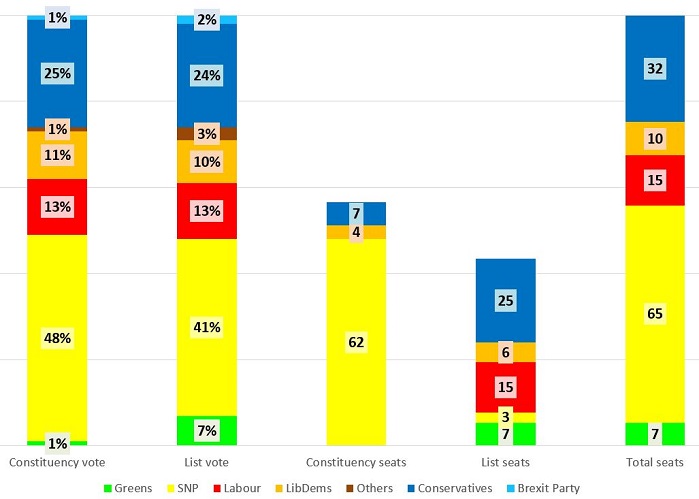
Such polling will of course revive the old debate about Both Votes SNP, which is widely understood to mean the SNP going after Green list votes to switch Yellow-Green to Yellow-Yellow en masse. Of couse I would welcome Both Votes SNP. We almost got it in 2011 and it delivered the only SNP majority so far. But simulations from current voting intentions show that it could backfire, delivering only a tiny SNP majority and reducing the projected overall pro-Independence majority thanks to the twisted quirks of AMS. An alternate path is for the SNP to win a majority on the constituencies alone, which never happened. The path to 62 constituency seats looks rather easy at first glance as it entails only holding all current 59 seats and unseating all 3 Labour constituency MSPs.  But even this is not as easy as it seems as current polling shows the SNP is in the danger zone in Perthshire South and Kinross-shire (Roseanna Cunningham's seat) and Edinburgh Southern (Labour Daniel Johnson's seat) might be a tougher nut to crack than expected. Then the road to 65 implies gaining Edinburgh Central, Aberdeenshire West and Ayr, the three most vulnerable Conservative seats, and this is far from a done deal. So the SNP might find it more convenient to choose a more diverse strategy, going after all the other parties in both the constituencies and the regional lists. That's my simulation in the chart below. The changes in the other parties' vote shares are all well within the margin of error of standard polls and the cumulative effect on the SNP vote would be like the best of both worlds: a one-seat SNP majority, as on current polling it's highly unlikely any scenario could get them past 65 seats, and no weakening of the overall pro-Independence majority.  


Now it's up to the SNP to make it work, with this kind of strategy or another that would deliver similar results. Wiping out Labour from the constituencies is the easy part, though all three will probably come back in through the outdoor as list MSPs, and the SNP should also keep their eyes firmly on the most obvious prize: Edinburgh Central. Which is eminently doable if a major figure with strong ties to the Capital City stands; and aye I'm thinking Joanna Cherry here. Only bump on the road could be the Little Green Punks again fielding a vanity candidate in a seat where their only hope is to not lose their deposit. Unless of course they back down because they have learned the lesson from their massive and deserved failure at the general election: voters don't like backstabbers especially when they could jeopardize a shared goal that is much bigger than anyone's inflated egos. With the Scottish Tories in disarray after their massive general election defeat, gaining Colonel Ruth's seat would be a major step towards their demise and the Harvie Party should know better than to stand in the way. 


Of course triple-locking the triple-lock is just one step and then the SNP must refine their strategy. Holding the predominantly Unionist media accountable for all falsehoods and misrepresentations is OK but telling them how to do their job is not the smartest trick in the book. Besides sounding patronizingly arrogant, just try to figure out how our very own John Nicolson would have reacted if he had received such summons from the Conservatives or Labour during his time at the BBC. Then don't make too much of the alleged similarity with Québec because there isn't one. Québec never was an independent nation for centuries before being annexed through fraud and deceit by a greedy colonial power. And Canada is a federal state, not a Union-cum-Devolution though their division of powers is arguably more favourable to the federal government than in the United States or even Germany. The SNP should also not rely too much on the well-rehearsed soundbite that 'Tories make the case for independence for us' as a number of voters might think otherwise, and it might even not always be true. I also think the SNP should avoid basing their campaign on the negatives of the Union as it would offer Unionists oven-ready counter-arguments. Concentrate instead on the positives of Independence and refine your talking points about the future currency and the future relation with Europe. And this is the moment when I wish to remind the SNP that rejoining the EU is not the one and only option. Joining EFTA should also be on the table as I strongly believe it would have as many upsides and fewer downsides than EU membership. And above all don't be distracted by Unionist stunts and win the fucking referendum. Or else the allegedly once-in-a-generation opportunity to achieve independence will become a very real once-in-a-lifetime.

My lifetime.


Hang out our banners on the outward walls.
The cry is still: "They come!".
Our castle's strength will laugh a siege to scorn.
Here let them lie till famine and the ague eat them up.
Were they not forc'd with those that should be ours,
We might have met them dareful, beard to beard,
And beat them backward home.


© Robert Burns, 1791

The Smile Signals Emptiness

I hear the approaching thunder that, one day, will destroy us too. I feel the suffering of millions. And yet, when I look up at the sky, I s...