20/03/2020

The Scottish Play - Act I Of MMXX

It's shite being Scottish
We're the lowest of the low, the scum of the fucking Earth
The most wretched, miserable, servile, pathetic trash that was ever shat into civilization
Some people hate the English, I don't, they're just wankers
We, on the other hand, are colonized by wankers
Can't even find a decent culture to be colonized by
We're ruled by effete arseholes, it's a shite state of affairs to be in
And all the fresh air in the world won't make a fucking difference
(Ewan McGregor as Mark "Rent Boy" Renton, Trainspotting, 1996)


For some time now, Nicola Sturgeon has accustomed us to what the French call douche écossaise (which technically is what English speakers would call 'contrast bath therapy'): alternating episodes of finely calculated boldness and extreme legalistic caution. But boldness seemed to have become more frequent in recent times. Which is why I had high hopes for her Dynamic Earth Announcement on Brexit Day and I suppose I should only blame myself for setting the bar too high. But on the other hand I can't help reaching the conclusion that it was a massively missed opportunity as there were a couple of ways to poke the English bulldog and challenge them to call our bluff. With Nicola speaking on a symbolic day and the Referendums Act 2020 having received Royal Assent just two days before, it was not extravagant to expect a game-changing proposal. And then there was none and many felt let down by her failure to endorse an alternate strategy to the SNP's Plan A. In a way we are lucky that Boris Johnson did not accept Plan A (granting a Section 30 Order) because, if he had, there would probably have been enough strings attached to fit the Edinburgh University Symphony for a whole season, and the terms would have made the 1979 Devolution Referendum look like a shining example of true democracy. Then the predictable failure of Plan A should have been an incentive to move on and boldly go where no FM had gone before. As King Solomon and Pete Seeger said, to everything there is a season and a time to every purpose....

© Pete Seeger, 1959

As I see it Brexit Day was definitely the time to raise the bar and explicitly support Joanna Cherry's Plan B: pass a motion in Scottish Parliament to hold a consultative referendum and wait for the English Government to challenge it in court. But then who would seriously expect Nicola to endorse Joanna's proposals? The various incarnations of the Scotland Act never explicitly ruled out a non-binding referendum being held without a Section 30 Order so it is definitely worth trying, and I venture we have even odds of it being validated by the Court of Session. And anyway not trying because you fear it might fail is not a valid option when there are strong hints it might succeed if you tried. Even Chris McEleny now backs down on his earlier self-billed Plan B, which in my opinion was never a plan at all as it would have been dangerously close to UDI, and grudgingly endorses the 'Cherry Option' as the real Plan B. Interestingly YouGov's last Scottish poll (which does not include voting intentions) shows that 49% of respondents support the 'Cherry Option' while 51% want a Section 30 Order. Their most significant finding is that 40% of Labour voters, 20% of LibDem voters and even 5% of Conservative voters support the 'Cherry Option'. Also 55% of respondents think IndyRef2 should happen within five years, including 12% of Conservatives, 48% of Labour and 35% of LibDems. Food for thought for the Unionist party leaders. But support for holding the referendum does not (yet?) translate into the same level of support for Independence, as the most recent polls show a statistical tie between Yes and No.


The summary above is the weighted average of the last four polls, all conducted after the general election and the last one after Brexit Day. Admittedly YouGov's poll does not use the standard 2014 question but it is close enough, in my view, to be considered valid and included in the sample. At least it is not as massively and deliberately misleading as previous Scotland In Union 'polls' were. No surprise in these results as Independence is still a work in progress, we all know that without needing a poll to hammer it home, unlike Gordon Brown who reads Scotland's state of mind from YouGov surveys. Now more than ever, every contribution is welcome and I fully support the view that AUOB's marches for Indy are a key component of our March To Indy and do gain us votes, notwithstanding some sour souls wanting us to believe otherwise. Of course you might want to forget about Kenny MacAskill's arrogant dismissal of the marches and hope that he shuts the fuck up but it is not to be. Expect to hear more from Maverick Kenny in all Scottish fish-wrappers as time goes by because, ye ken, nothing screams 'great clickbait' louder than some juicy Sturgeon-bashing delivered in a condescending tone. Ironically massive coverage of Covid-19 has saved us from lots of bullshit about IndyRef2 during Alex Salmond's trial, but it does not invalidate the new media rule that says 'every Salmond is deemed guilty until proven innocent' and the English common wisdom that any SNP member doing a bad thing is conclusive evidence that Independence is bad. Worst part here being of course that some within the SNP and the broader Yes movement have ulterior motives that will make that sort of cooshite sound credible.


© John Entwistle, 1966

General election prospects look good right now for the SNP though we haven't had any dedicated Scottish poll since the election. But subsamples of UK-wide polls, as always to be handled with the utmost Curticean caveats, have the SNP on 45%-50% of voting intentions, as good or better than the December election. The question now is what will happen to the other parties' votes. I think the major flaw in my esteemed colleague James Kelly's and others' approach is the implicit core belief that the Unionist vote is genetically engineered to coalesce around the Scottish Conservatives. I believed that for a while too and there is a paper trail in my blog to prove it. But the results of the December election and the Scottish subsamples of the 2020 polls prove this wrong, at least at this moment. Boris Johnson will definitely not be happy with Jackson Carlaw. Poor things.


Just look at the numbers. From the 2017 election to the current polls, the left-wing bloc (Greens, SNP and Labour) is stable on 64-65% while the right-wing bloc bags 34-35%. The election results and current polling show movement within each camp and hardly any crossover from one camp to the other. The Conservatives lost ground to the LibDems at the 2019 general election, most probably as the Brexit Effect, and have not fully recovered since. Labour fared poorly at the general election and now do even worse in polls because a significant number of pro-Indy Labour voters have switched to the SNP. Current Scottish Parliament polling goes pretty much in the same direction. We have had two Holyrood polls this year: one from Survation for Progress Scotland, conducted 20-22 January, and one from Panelbase for Scot Goes Pop, conducted 28-31 January. Both also polled a future Independence Referendum (see above). So here are the voting intentions and my seat projections for both polls and their weighted average, and how the average projection compares with the 2016 results by region (click on the images for larger and clearer versions):


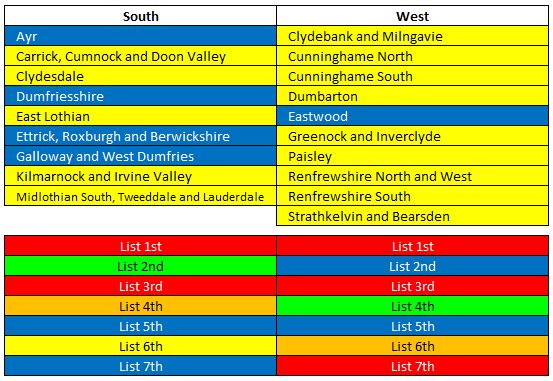
Interestingly the Panelbase poll is as close as we can possibly get to 'Both Votes SNP' with only a 3% gap between the two votes, and it does not hurt the Greens as the combined vote for pro-Indy parties is significantly up on the 2016 results. Another result worth highlighting is that there is no 'Unionist Coalescence' around the Tories here either. The best case for the Conservatives in Scotland is in fact their Holyrood vote aligning with their Westminster vote, something we have already seen earlier for other parties, and it can't be labelled an outstanding success whichever spin you put on it. But even that would be a startling achievement for Conservatives in Scotland, seeing how most of their lot couldn't find their own arse even with a hunting dog and a Ouija board. Then of course the most important point here is that both polls predict an outright majority for the SNP and a strengthened pro-Independence majority. The pro-Indy majority would even be stronger than after the historic 2011 election which defeated the in-built purpose of AMS for the first and so far only time. This clearly hints at the best strategy for the SNP: gain and keep pro-Indy Labour voters and go strongly after the Conservatives especially in their weakest seats. The last three Labour-held seats are definitely predicted to fall and the Tory-held Ayr and Edinburgh Central (more on this one later) are the next most likely gains, with Oliver Mundell's Dumfriesshire seat also quite close to the immediate danger zone. Then the SNP should have a selective strategy for the regional votes. Actively pursuing Both Votes SNP might be futile and even counter-productive in some cases but it's definitely worth trying in some regions (more on this later). Let's hope Sturgeon Central will weigh all the options and not flunk it. Anyway here is the breakdown of seats by region as projected from the weighted average of our two polls, with some interesting upsets on the list seats thanks to the unfathomably odd workings of AMS:


The next Holyrood campaign will have some predictable moments. Even the atheists within the SNP will pray that nobody brings up the Gender Recognition Act during the campaign but of course everybody will and expect the media to make good clickbait out of it. Labour will campaign against holding Indyref2. Labour will campaign for holding IndyRef2. Jackson Carlaw will do his best to convince us the Conservatives are not a single-issue party so he will have two. First will be 'No To IndyRef2'. This one has been asked and answered already but it does not hurt to try again, or does it? Trying thrice and expecting a different result would be a sign of madness, trying twice will be just a sign of daftness. Then of course he will make all sorts of points about the alleged managerial incompetence of the Scottish Government. Which is a bit rich coming from a lad who supports an English Government ready to waste billions on HS-To-Nowhere and the Portpatrick-Larne-Euphemism, and who contemplates scrapping NHS England's targets because they're chronically unable to meet them. Does Union Jackson really think we all just fell off a turnip cart? Surely he must if he believes Scotland will elect a First Minister whose last two forays into the private sector ended in administration. Then of course that whole line of attack might totally fall flat on its face when people consider the way the Scottish Government handled the Covid-19 emergency, and even Jackson might find it awkward to stick to these talking points after he expressed his trust in ScotGov's ability to handle the crisis. Bugger. But the best part is bound to be Jo Swinson's newfound love for hustings on the 7B to Kelty. Will she play it as 'FM Jo', seeing how successful her 'PM Jo' persona was? Will she have her Nicolson Moment telling amazed voters 'I am the only one who can beat the SNP here in East Dunbartonshire'? Sorry John, couldn't resist; Again. Then of course the main campaign guideline should be the SNP living up to the polls and making this election yet another resounding success. Yes We Can.


© Stevie Nicks, 1975

Of course I have a few things to say about the SNP's new self-inflicted mess: the Edinburgh Central selection fight between Angus Robertson and Joanna Cherry. Long ago when Angus and Joanna both started sending smoke signals that they contemplated standing in Central, I suggested a possible way out of the shambles, with one of them standing in Central and the other in the neighbouring Southern where incumbent Daniel Johnson is squarely in the danger zone thanks to Labour's dismal performance in the latest Holyrood polls. I did not say it explicitly but the idea was Joanna For Central and Angus For Southern. But it won't happen as both are stuck on Central Or Bust, and the Joannistas have effectively blocked an alternate solution anyway with Catriona MacDonald now seeking selection in Southern. The sad side of the whole bùrach is that it was never about who could best represent their constituents but always about the SNP's ongoing internecine feud, 'that or a fight among themselves' as the late DCI Jim Taggart once said: Eckites vs Nicolistas and now the 'woke lobby vs TERFs' inflammatory arguments have quite expectedly barged in to spice up the broth. Turf war turned into TERF war if you allow me my Lousy Joke Of The Week here, and everybody will get hurt.

In the grander scheme of things what is happening here is in fact pretty transparent: Joanna launches Stage One of her leadership challenge to Nicola and for this she needs to sit in Holyrood; then the SNP's establishment launch their preemptive counter-strike with Angus hastily announcing his candidacy. And it's already getting nasty. And it's gonna hurt. Since this is now primary season in the USA, I suggest the SNP's spads sit back and consider what happened in past American primaries. The divisive Democratic primary between Jimmy Carter and Ted Kennedy in 1980 paved the way for Ronald Reagan's election. Later a bitter Republican primary between George Bush I and Pat Buchanan in 1992 drove millions of Republican voters to switch their allegiance to Ross Perot and got Bill Clinton elected on just 43% of the popular vote. The latter might well provide the blueprint for the forthcoming election in Central, just factor in the Green Punks again fielding a vanity candidate there and snatching enough disgruntled SNP voters, and whichever goat with a blue rosette (insert Miles Briggs here) bags the seat. When it happens, remember you read it here first before equally cursing both Joanna and Angus.

© Paul McCartney, Linda McCartney, 1972

Against this background, I think the SNP's internal politics have reached a new level of absurdity. The outcome of the next Holyrood election, and possibly the very future of the party, might very well depend on how we feel about gender self-identification. Forget independence, Brexit, immigration, NHS, taxes and all that stuff. It's Woke vs TERF that defines us now, let that sink in. Of course peak absurdity was reached on Saturday with that totally moronic idea that sitting MPs should be banned from standing for a Holyrood seat. There's nothing even remotely principled about this, on top of the zillion reasons why only someone with an IQ below room temperature could have come up with such nonsense. It's 100% personal, a one-shot gun aimed squarely at Joanna Cherry. Besides it's not like there is no precedent, both Alex Salmond and John Swinney stood for a Holyrood seat and won while being MPs, Big Eck even did it twice. And both spent years double-jobbing while Joanna has already pledged she would resign her Westminster seat if elected to Holyrood.

As I write this we still don't know for sure if it was ever for real as it was in fact never tabled at the SNP's NEC, or if it was just a trial balloon from An Anonymous Source At Bute House, re-imagined by an over-zealous journalist at The National harbouring massive ulterior motives of her own. Either way it's appalling to see how many people were ready to endorse it without thinking it through, simply because they have been brainwashed into believing Joanna Cherry is Evil Incarnate. And they don't even realize that there are now three to six Unionist seats that rate as eminently gainable, and de facto nine SNP open seats (seven 'officials' plus Derek MacKay and Mark MacDonald), so ample room for everyone including all other sitting MSPs, all newcomers willing to stand, and the possibly two or three MPs contemplating a Holyrood candidacy. Sad times indeed for a once truly open-minded and enlightened party. And I won't even start questioning Nicola Sturgeon's own ulterior motives as I would then have to ask who has become Nicola's Dominic Cummings.


© Alec Dalglish, 2012

Finally we have the new breed of elephants in the room, or dead cats on the table depending on your perspective: the pro-independence New Party(ies) competing with the SNP and Greens for the regional lists vote. John Hutchison from Fort William recently wrote to the National asking for someone to do the math and I'm happy to oblige. George Kerevan in his Notional column has steadily advocated the creation of such a party. So I must first address a major flaw in George's approach: that the New Party could snatch up to 150k 'wasted' list votes from the SNP without damaging the SNP's or the Greens' prospects for list seats. This is clearly first-class delusion and is definitely not how AMS actually works, and George obviously knows it but won't admit it as it would wreck his whole point that the New Party would bag pro-Indy seats on top of those already bagged by the SNP and the Greens. It's fairly easy to simulate such a scenario, all it takes is to replay the 2016 election with the New Party on 6.5% and the SNP on 35.2% of the list vote in any simulation engine, with the constituency votes and all other parties' list votes unchanged, and see what happens. Which would be SNP 61 seats, New Party 8 seats, Greens 3 seats, Conservatives 28 seats, Labour 24 seats, LibDems 5 seats. So the pro-Independence majority would be stronger by three seats but the New Party would have snatched three from the Greens, two from the SNP and only three from the Conservatives. George should have thought this through and done the math himself before writing that line. It can be easily done with Election Polling, you just have to use the 'Brexit Party' slot to simulate the New Party.

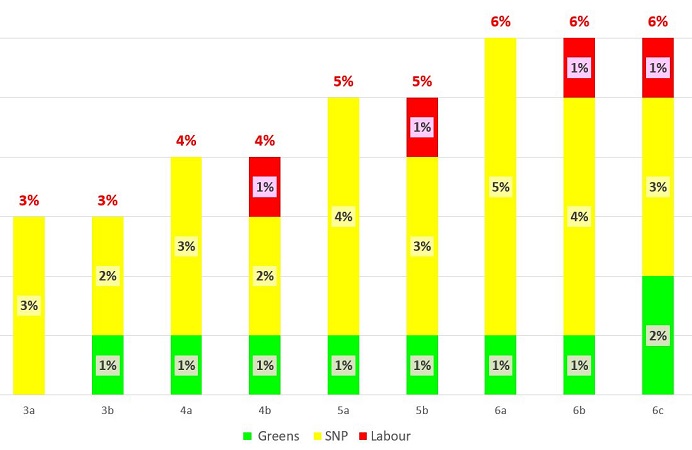
Of course I tried more elaborate options based on the 2016 results and how the New Party could have impacted them. First assumption is that the New Party would not actually have come out of the blue but that an embryonic New Party already existed with some minor lists representing 'alternative pro-Independence' views (Solidarity, RISE, Scottish Libertarians) despite their ideological differences on other issues. Here we have an hypothetical baseline of 26,930 votes or 1.18% of votes cast. Then I simulated nine options numbered from 3a to 6c meaning the New Party would progress from the baseline to 3%, 4%, 5% and finally 6% with the added votes coming from different sources including both other parties and abstentionists. So here are my scenarios with a breakdown of the hypothetical New Party votes by origin and then the resulting number of votes by party with the increased turnout shown by the labels on top. Of course only the changes in the list vote are shown here as it is understood the New Party would not stand in the constituencies, and all figures are in kvotes.


Then here is how these numbers of votes translate into shares of the popular vote for a more direct comparison with the 2016 results. In these scenarios the New Party's votes would not be evenly spread across all regions as their theoretical baseline is not. They would have a peak in Glasgow and lows in the North East and South, while Central and West would be the closest to their national average. Remember that the most successful 'alternative pro-Indy' list ever at the national level, the Scottish Socialist Party, were basically a Two Hit Wonder. They bagged 2% of the national vote and one seat in 1999 thanks to a 7.2% peak vote share in Glasgow, then 6.7% of the national vote and six seats in 2003, and then lost almost all the votes and all the seats in 2007 and were never seen again in Holyrood. Uncoincidentally my simulations for the hypothetical New Party are not very far from what the real-world SSP achieved at their peaks.
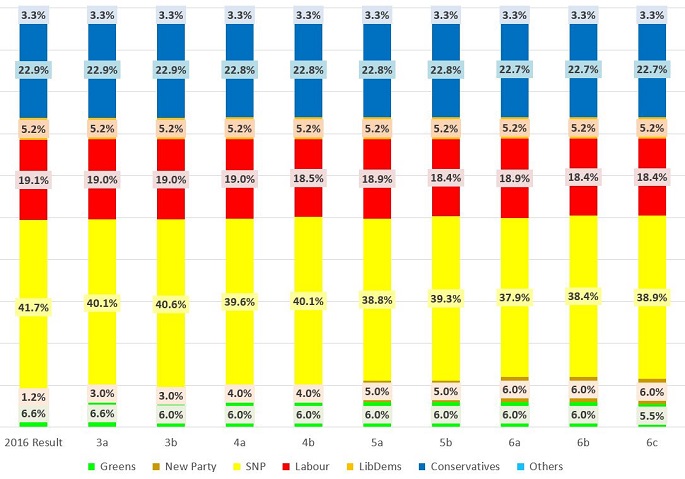

Final step is of course my seat projections for the various options and how they translate in number of seats for the Pro-Indy Bloc vs the Unionist Bloc. The results show that the supporters of a New Party in 2021 should be more careful what they wish for. The twisted AMS we have in Scotland works in wildly mysterious ways and getting votes does not mean you will get seats. And it may even be counter-productive if some of your votes are snatched from other parties with whom you supposedly share a common vision. Then you might object that the results would be different if the New Party relied more heavily on abstentionists finding their way back to the polling places, and less on other parties' voters making different choices. But remember George Kerevan's alternate scenario did not even include abstentionists but just the SNP's 'wasted votes' and it did not turn out to be better than my own approach. And even if the New Party drew all their votes from abstentionists, it would still reduce the other parties' share of the votes, which is in the end the deciding factor in the allocation of list seats, rather than the number of votes. QED.


The conclusion is quite clear: if the New Party is anywhere between 3% and 5%, which seems like a reasonably credible scenario, they actually weaken the pro-Indy camp. And even in the not-so-likely case where they reach 6%, most of the New Party's seats would be taken away from the SNP and the Greens and not from the Unionist parties. Whichever way you crunch the numbers, it delivers similar results. Food for thought. Especially as an 'alternative pro-Independence' option already exists: SNP in the constituencies and Greens on the regional lists. My own position here has evolved since 2016 as I am no longer convinced 'Both Votes SNP' is the right strategy. Rather it has to be a case-by-case approach similar to tactical voting. It is reasonable to assume the SNP will hold all their constituency seats and possibly gain some (see current polling above) so the choice becomes between 'Both Votes SNP' in regions where the SNP can bag list seats (that would be South, Highland and Islands and possibly North East) and a split SNP-Greens vote in other regions where the infamous AMS means the SNP has fuck all chances at bagging a list seat while the Greens can (Glasgow, West, Central and Lothian). And the next Holyrood polls will tell us more about the most efficient way to maximize the number of pro-Indy MSPs without resorting to extreme counter-productive options.

© Jon Anderson, Steve Howe, Jonathan Elias, 1991

I also replayed the simulations on the weighted average of the last two Holyrood polls I mentioned earlier, which are more favourable for the Yes camp than the 2016 election, just to check if starting from a higher baseline would alter the results. Spoiler alert: it doesn't. But let's go through all stages anyway. The underlying hypotheticals have to be somewhat different as we have no real data here and current polling shows that the voting intentions for 'alternative pro-Indy' lists are basically 0%. So my 3a to 6c scenarios now factor in the New Party snatching virtual votes from the left-wing parties in different combinations. So here we go with Stage 1 and Stage 2, the breakdown of the hypothetical New Party vote by origin and the resulting list vote shares for all parties:

On these numbers the pro-Independence parties would still bag a stronger majority than in 2016 as the polls are really favourable. But it still could be reduced if the New Party stays in the low-to-mid range of hypotheticals on 3-5%. And again their best simulated result would see them taking away more seats from the other pro-Indy parties than from the Unionist parties. Stage 3 and Stage 4 below, the projected breakdown of seats by party and for Indy vs Union blocs in my nine hypothetical options:


In case you missed it, the most significant result here is that the New Party's first and constant impact would be to deprive the SNP of a majority, though they would be just one seat short. This is most probably what the New Party supporters actually wish for as weakening the SNP is not even an ulterior motive here but a fairly transparently obvious one. Then I expect even the most rabid Independence purists can understand that weakening the SNP, no matter how bad we feel about their shortcomings, would be handing out oven-ready ammunition to the Unionists in Westminster to deny Scotland our right to self-determination for all of eternity. So be careful what you wish for even if my Evil Twin whispers to my ear that the SNP already do a pretty good job at undermining themselves anyway.


© Chris Squire, Billy Sherwood, Jon Anderson, 1997

Of course all this does not directly cover the hypothetical so-called 'Wings Party', which might be a credible alternate option if Stu Campbell had anything serious in mind beyond his fifteen minutes of the news cycle, and had not already alienated part of the Yes camp through his arrogance and questionable stance on some issues other than independence. I think the Wings Party would totally fail to attract voters from the radical left parties and would have to rely on a smaller voter base consisting mainly of discontent 'soft SNP' or 'soft Green' voters and possibly a few from Labour. So his possible performance would be somewhere in the low-to-middle range of my simulations on some 3-4%. Exactly where the 'alternative pro-Indy' strategy backfires and ends up hurting the Yes camp. Of course you may think I'm a wee smitch biased here and that the Wings Party would fare better, but I honestly fail to see how unless enough voters prove to be as thick as your granny's soup and fall for the cunning tricks of a lad whose first priority will always be to demean the SNP. Then strangest things have been known to happen, haven't they? Now it's up to the SNP to make their case, though I'll be more than happy to lend a hand occasionally. One key point is that Scotland definitely needs one big pro-Independence party, no matter how the smaller pro-Indy parties fare, because safety is in numbers, it's as simple as that.

There are very few cases in history, if any, where splinter groups actually helped The Cause. Here some would probably argue that we had such a case in Scotland: Margo MacDonald's independent candidacies in Lothian from 2003 to 2011. Then I would counter-argue that she was standing quite clearly against the SNP. No matter how much respect we have for her and her integrity, outwith the conspiracy theories, she was definitely not trying to help. Not the Scottish Government, that is. Margo's electoral history also gives some clues about the sort of voters' coalition an alternate pro-Indy New Party would need. She initially got significant support from discontent SNP fundamentalists and some from the radical left but failed to attract Greenish voters as the Greens did significantly better in Lothian than nationwide at every Holyrood election. Then she lost SNPish voters both in 2007 and 2011, probably because they felt strengthening the SNP government was more important than making a point about the path to independence, and she came dangerously close to the de facto threshold for a list seat. And the lack of a proper 'alternative pro-Indy' candidate in Lothian after her death clearly helped the Greens more than any other list as the radical left(s) qualified for endangered species status. The history of Margo's political adventure also shows that the 'alternative pro-Indy left' needs an iconic and preferably charismatic figure on the leaflets, and I doubt Colette Walker could ever be 2021's Margo MacDonald.


That's it for now. The game has just begun and the juicy bits are yet to come, so stay tuned.


Taggart: International? Scotland is not good enough for Edinburgh?
In Glasgow we don't put things on periscopes
Livingstone: Aye.... people would knock them off
(Mark McManus and Neil Duncan in Taggart, episode Death Call, 1986)
© Stewart Kerr Brown @kaithefilmgeek for ItsTime.Scot @ItsTimeScot, 2020


© James MacLean, 1970

25/02/2020

The Great Gerrymander of 2020?


223 years ago today the Last Invasion of Britain was repealed at the battle of Fishguard and it's also Ed Balls's 53th birthday and Dominic Raab's 46th


© Christopher Foreman, Cathal Smyth, 1982


It was a dark and stormy night, the rain fell in torrents except at occasional intervals when it was checked by a violent gust of wind which swept up the streets (though it is not in London that our scene lied), and it had been ten weeks since the election, with nine new polls showing the Conservatives leading by 17% average. No buyers' remorse here, contrary to what happened in 2017 when we had eighteen polls in the first ten weeks after the election, sixteen of them with Labour leading by about 4% average. So it looked like as good a time as any to go back to another and possibly game-changing election issue. A year ago I discussed the impact the Sixth Periodic Boundary Review would have had on the 2017 election results. The proposed boundary changes were never sent to Parliament and never implemented, so the 2019 general election was fought on the same boundaries as in 2010, 2015 and 2017. These boundaries are the result of the Fifth Periodic Review that was held between 2000 and 2007. The obvious conclusion here is that these boundaries no longer reflect the current distribution of the electorate, so some sort of boundary changes is both legitimate and necessary. Then the real question remains the same as last year: would a seemingly neutral boundary review result in massive gerrymandering in favour of the Conservative Party? The obvious answer is that we don't know as there is every reason to believe the 2018 review will never be implemented and the Government will request another set of proposals before acting on the matter. But there is also every reason to believe that new proposals would not be massively different from the previous ones, as the Conservatives have a vested interest in passing a very similar set of boundaries, and their massive majority allows them to do just that. So it is quite legitimate to start by assessing how the proposed 2018 boundaries would have influenced the result of the 2019 election. Martin Baxter at Electoral Calculus has published the full notional results for the 2017 election on the initial proposals published in 2016, and the 2019 election on the slightly amended final proposals published in 2018, and I will rely on his data.


© Cecil Bustamente Campbell, 1964

The Guardian recently published a reader's letter arguing that first-past-the-post (FPTP) is rigged in favour of Labour. The problem is that the alleged 'evidence' here is based on past elections that were fought on different boundaries and voting patterns, so it basically proves fuck all. What the letter totally misses is that FPTP favours the winning party no matter who they are, and also that the winner's vote share is just one factor. The winner's lead over the second party is just as important, if not more, and the different sizes of majorities are also the result of how the battleground seats (those with the closest results at the previous election) behave under any national swing from one party to the other. Recent results definitely go that way. The Conservatives bagged 48.8% of the seats on 42.3% of the vote in 2017, and then 56.2% of the seats on 43.6% of the vote in 2019. While Labour bagged 40.3% on 40.0% of the vote in 2017, and then 31.1% on 32.2% of the vote in 2019. What the numbers actually say is that FPTP delivered a 42-seat bonus for the Conservatives in 2017 and an 82-seat bonus in 2019, compared to what proportional representation (PR) would have returned. A higher Conservative lead, flawed boundaries and unexpected upsets in marginal seats definitely played a part here and the hypothetical implementation of the proposed 2018 boundaries would only have made it worse. Here are the actual and notional results for the 2017 and 2019 elections, as there is an alternate reality somewhere where the initial proposals were used for May's failed snap election of 2017 and decisively changed the outcome, and the final proposals were enacted for the 2019 snap election and only made an awful result even worse.


In 2017 the new boundaries would have changed the result from Conservatives 9 seats short of a majority to an 16-seat Conservative majority, and in 2019 the Conservative majority would have risen from 80 to 104 seats. So a gerrymandering bonus of 25ish seats for the Conservatives, the biggest notional change since the Third Periodic Review that was implemented for the 1983 election and would have delivered 20 more Conservative seats if its boundaries had been used for the 1979 election. Other Periodic Reviews conducted after 1945 notionally displaced fewer than 10 seats and not always towards the winner of the previous election. Moreover this would have been a massively symbolically significant victory for the Tories as they would have bagged more than twice as many seats as Labour, an exceptional occurrence in the last 75 years. Even the Attlee landslide and the Thatcher landslide did not deliver a similar result (though Attlee missed it by just two seats), only the Blair landslides did. The comparison of vote shares with shares of seats at the last two elections also clearly shows how gerrymandering would distort the results one step beyond the usual FPTP distortion.


Of course the impact of gerrymandering is quite different in Scotland as FPTP massively helps the SNP here, but the changed voting patterns between 2017 and 2019 also deliver some surprising results. The altered boundaries would have worked quite as intended in 2017, protecting both the Conservatives and Unionist Labour while hurting the SNP. Also hurting the Liberal Democrats was probably seen as acceptable, yet not really unwelcome, collateral damage. The situation would have been quite different in 2019, similar to what Americans call dummymandering, one that helps the gerrymanderer at a specific point in time but bites him in the arse when voting patterns change. The main reason why it can happen is when many seats in a given area are marginals and gerrymandering can't significantly lower the number of such seats, a well known situation in Scotland where even smallish swings can switch many seats and bigger swings even more. So the tory dummymandering of Scotland would have increased the SNP's share of seats in 2019 from 80% to 87% and I'm not even counting Neale Hanvey as SNP here though he obviously is in anything but official denomination.  


Now it's worth having a closer look at the Scottish Gerrymander. But first bear in mind that the Boundary Review rests on two major principles: reduce the number of seats stretching over several Council areas, draw new seats based on 'community of interest'. The Scottish Gerrymander dismally fails the first test: 47 old seats were fully within one Council area and only 34 new seats do, 11 old seats stretched over two Council areas and 17 new ones do, just one old seat stretched over three Council areas and two new ones do. Then you might wonder what the actual 'community of interests' between Polbeth and Sighthill is, as both would be part of the new Livingston and Edinburgh Pentland constituency which covers a small southwestern part of Edinburgh City Council and a large southeastern part of West Lothian Council, while its predecessor seats (Livingston and Edinburgh South West) were both within one Council area. Then the real rationale behind this was obviously to pit SNP MPs Hannah Bardell and Joanna Cherry against each other and force Cherry out of Westminster. Now let's see what a seat by seat breakdown says (click on the images for larger and easier to read tables).


So seven Scottish seats would be abolished (six SNP and one Conservative, highlighted in red), and it's certainly no coincidence if several high profile SNP frontbenchers would find themselves without a seat, while losing Wee Andy Bowie too would certainly be considered an added bonus by the diehardest Boris cultists. We would also have one 'new' seat (Falkirk South), meaning it has no obvious predecessor seat as it is stitched together from 'leftovers' form other recarved seats, and finally five of the redrawn seats would notionally change hands (highlighted in yellow). For these seats, the notional MPs are the runner-ups (or should that be runners-up?) in the predecessor seats in December. Though of course candidacies would have been different if the boundary changes had been enacted and a couple of newly elected SNP MPs would not even have been candidates. I think we can safely assume Ian Blackford would have stood in the new Highland North and unseated Jamie Stone, and that Joanna Cherry would have stood in the redrawn Edinburgh South and unseated Ian Murray. I also venture Neil Gray would probably have moved some miles to the North East from Shotts to Falkirk and secured the orphan Falkirk South for the SNP. Then I have a hunch John Nicolson would have chosen a rematch against Jo Swinson in the redrawn and more SNP-friendly East Dunbartonshire, saving himself the embarrassing slip-of-the-tongue moment. Just kidding, John, love ya. Finally Philippa Whitford would have found an obvious landing pad in the new Ayr and Carrick seat, notionally Conservative Bill Grant's seat in 2017 and now an open seat after Grant's decision to stand down. So the artfully crafted scheme to unseat prominent SNP figures would certainly not have worked as planned, with only Glasgow North's Patrick Grady left without an obvious Plan B, except now becoming the next MSP for Glasgow Cathcart after James Dornan's retirement.

© Cecil Bustamente Campbell, 1963

A textbook case of the Boundary Review's flaws is the situation in Edinburgh, highlighting both the anti-SNP bias and the dummymandering factor. An early proposal, published in 2013 as part of the original Sixth Periodic Review, already reduced the Capital City's seats from five to four but all were neatly within the Edinburgh City Council boundaries. If this proposal had been used at the 2015 election it would have delivered four SNP MPs, as Ian Murray's Edinburgh South was abolished and split between the new Edinburgh East and Edinburgh South West constituencies. Then the resurrected 2018 Review produced two sets of proposals, an initial one in 2016 and a slightly amended final one in 2018. Both proposed four seats within the Edinburgh City Council boundaries but with the added monstrosity of a West Lothian seat protruding into Edinburgh in clear violation of two of the Review's basic principles as I already mentioned. Bear in mind that all Edinburgh seats have been neatly within the city's boundaries since 2005. So the 2018 Review's proposed boundaries are something of a 'once in two generations' monstrosity.. If the 2017 election had been fought under the initial proposal, it would have delivered two seats each for the SNP and Labour, with the new Edinburgh East seat carefully carved to inject enough Labour voters from Liberton and Gilmerton to unseat Tommy Sheppard while protecting Ian Murray in the redrawn People's Republic of Morningside seat. Then the notional 2019 results would have made the gerrymander backfire into dummymander with all four Edinburgh seats going to the SNP. Aye, ye ken, even the best-laid schemes....


© Lee Jay Thompson, 1979

The Guardian is now using the Labour leadership race to again push for proportional representation (PR) instead of the centuries-old first-past-the-post (FPTP) and urge Labour to endorse it without actually making a case for it, other than the odd point that it would weaken 'nationalists', insert SNP and Plaid Cymru here but of course mostly the SNP, just as you thought The Guardian had truly renounced their past insidious SNP-baddery. Anyway, and regardless of the likelihood of any system being ever used in the UK, I tried five options.

Proportional representation (PR): using the famous d'Hondt method but not based on a single UK-wide list which would be unacceptable for a fuckload of obvious reasons. Instead I used regional lists in twelve constituencies duplicating the ONS statistical regions and the now defunct European Parliament constituencies. Note that regional PR is more favourable for the two or three biggest parties as it creates a de facto threshold for representation even without such a provision in the electoral law. The first party does not need a majority of the popular vote to bag a majority of seats. Under current voting patterns, around 47% would be enough;

Majority Bonus System (MBS) (which is in fact two options here): the system used in Greece until last year and at some elections in Italy. With two simulations here; one with 600 seats filled on regional PR and 50 allocated en masse to the first party; one with 550 seats on regional PR and 100 allocated to the first party;

Additional Members System (AMS): the one infamously used at the Scottish and Welsh parliamentary elections, providing levelling (or compensatory) seats on regional PR for the losers of the FPTP vote. Here I simulated two thirds of seats filled on FPTP and one third on regional PR, the same proportions as the Welsh Senedd;

Mixed Membership System (MMS): with 325 seats filled on FPTP and 325 on regional PR. I used a true MMS with the PR seats allocated in a totally separate count regardless of the results of the FPTP vote. This is quite different from the allegedly 'mixed member representation' used in Germany and New Zealand, which is tweaked to deliver a similar result to pure PR, or from AMS which factors in the FPTP seats in the allocation of the additional PR seats.

The only options I did not try are Instant Runoff (IR) and Single Transferable vote (STV), as nobody has the fuckiest where the second and further preferences would go. Trying to approximate IR by some odd extrapolation of the winner-runner up combinations on FPTP would only be a very approximate approximation, and certainly widely and wildly off. So here is what the other options would deliver, in numbers and shares of seats. All based on the 12 December results though it's quite certain that voting patterns would have been different under a different electoral system, but that's all we have.


The proponents of PR quite clearly support it only to avoid any party ever getting a majority and to impose coalitions that the electorate don't actually want. For example, in the run-up to the last German general election, only 25% of the electorate actually wanted a CDU-SPD Grand Coalition and yet that's what they got in the end. In the UK last December the only mathematically viable option would have been a Con-Lib coalition. And we all know that, even if we loved to jibe at the LibDems' unique talent for betrayal and their appetite for ministerial cars, it would never have happened under Johnson's leadership. Foreign examples also demonstrate that coalitions can be the recipe for impotence as in Germany where Grand Coalition partners give up on their most divisive manifesto pledges and the Grand Coalition amounts to little better than a long-term caretaker government with no ambition for reform. In other contexts it can also be a recipe for extremism as in Israel where coalescing the fifty shades of racist theocratic far-right around Likud led to each coalition partner fuelling the worst instincts in the others, if they ever needed it. Back to my simulation, AMS here delivers an unexpectedly close result to PR. The reason is that there are many more seats up for grabs on the regional lists than in the real Scottish and Welsh elections, so the FPTP winners have significant opportunities to also bag list seats.

© Graham McPherson, Christopher Foreman, 1982

In my view, the best option is MMS as it can deliver a majority if the first party has both a strong plurality of the popular vote and a convincing lead over the second party, which is exactly what happened at the 2019 election. But the Conservatives would have bagged only a 10-seat majority under MMS, meaning the would be in a weaker position than under FPTP and would have to seek compromise in some cases. Bear in mind for example that only 330 out of 365 Conservative MPs voted for Johnson's Withdrawal Agreement Bill at the third reading. Even though there was no open rebellion, 10% of Tory MPs expressed discontent by not showing up to vote despite support for the WAB being carved in stone in the Tory manifesto. If Johnson had had a 10-seat majority instead of 80 seats, he would certainly have been forced to negotiate with his own 'soft Brexit' MPs and amend the WAB. For example by reinstating the provisions that were scrapped between the initial pre-election draft of the bill and the final draft that was tabled after the election. Just sayin'..... In different situations where the results are less one-sided than in 2019, MMS would nit deliver a majority, as the projections for the 2010, 2015 and 2017 elections show. So it can be seen as a perfectly acceptable compromise solution even for PR supporters, as it delivers a majority only if the popular vote goes strongly in one direction, and on more ambiguous results delivers a hung Parliament and a coalition.


For simplification 'Others' above include the 18 Northern Ireland seats, the Speaker and Plaid Cymru. Which is why the numbers are almost the same under FPTP and MMS, as Plaid Cymru is the least impacted by the switch to MMS, bagging three MPs at each election instead of the three or four they bagged under FPTP. I kept separate lines for UKIP and the Greens as both can be significantly impacted by the switch from FPTP to MMS, especially at the 2015 election that saw a more fragmented vote than 2010 and 2017. Under MMS we would still have had the Con-Lib coalition in 2010 but the stronger LibDem representation might have resulted in some changes in policy. Or not... More significantly both the 2015 and 2017 elections would have made the continuation of the Con-Lib coalition the only viable option. And you never know what might have happened then. No EU referendum? No Brexit? We will never know but one can dream, can't he? Anyway it would be daft to expect any significant electoral reform in the foreseeable future, whoever is in power, and for once that really means never-in-a-generation and probably never-in-a-lifetime. But I certainly don't rule out the current Tory government enforcing the 2018 Boundary Review or something very close. They have the votes to pass it no matter what, and losing only 13 seats under the new boundaries is very easy to manage with the natural attrition we witness at every election, with MPs standing down because of age, stress or any of the usual excuses. They could easily promise a seat to all incumbents willing to return and accommodate a batch of newcomers on top of that. So watch out for the new boundaries coming up in Commons, we only don't know when. Time will tell, but when it happens, remember you read it here first.


It's a good rule in life never to apologize
The right kind of people never want apologies
And the wrong kind take advantage of them
(The Orville, episode Pria, 2017)


© Graham McPherson, Michael Barson, 2019

02/01/2020

An attempt at a PM to PESD....


…. as in Post-Mortem to Post-Election Stress Disorder

Don't blame me, please, for the fate that falls
I did not choose it
I did not, no no, I did not
I truly did not choose it
(Peter Hammill, Darkness (11/11), 1970)


© Peter Hammill, Christopher Judge Smith, Hugh Banton, 1970

So 'tis this time of the year when the Realm's new motto is "Ein Volk, Eine Nation, Ein Führer". Which is just what happens when the now-elected First Minister of England has never apologized for a piece he published in the Spectator that advocated the final solution to the Scottish question, has made it clear that his one-nation Conservatism is nothing but Little England Conservatism, and sees a personal allegiance from his Cabinet Ministers and MPs as the foundation of his power. One of the oddities on Election Night was the Conservatives branding themselves as The People's Government, which Andrew Marr described as 'a bit French or possibly even Russian', and here he probably actually meant Soviet, as he reminded the Tories that 'we have a parliamentary democracy and the people are represented by all sorts of other people'. But don't expect Johnson to pay much heed to this self-evident truth. So after a brief moment of shameless cronyism, because there are only so many hermines that can be trinketed before the yearly supply runs out, he will go back to further Stalinist purges to make sure BorisSpeak becomes the official language of the UK. He already purged the party, now he's ready to purge the Civil Service and the state media that is not even Propagandastaffelish enough for his taste. Just give him one year and the UK will be a one-party state in anything but name with Dominic Cummings sending daily memos to all Ministers telling them what they are and are not allowed to say. Uh... wait... he does that already, or doesn't he?


So how the fuck did we get there? Difficult to name and shame pollsters this time as they did a better job than two years ago. Last day polling said Tories 43.8%, Labour 33.5% and LibDems 11.6% and we got (GB-wide only as this is where the pollsters polled) Tories 44.7%, Labour 32.9% and LibDems 11.8%. All vote shares right within 1% with just that little quirk that a predicted Tory lead of 10.3% turned into an actual lead of 11.8%. But the polls were a bit off in England outside London, where the election was decided as usual. Last Day polling predicted a 14.5% Conservative lead Doon Sooth and it ended up being 18%, more than enough to switch a score of marginals and explain why the predictors all underestimated the Conservative majority. The real test for the various prediction models and their solidity is what they predict when fed with the actual vote shares. The graph below shows the various projections by the models available online and also what uniform swing would have delivered. The deciding item is then the number of misses, calculated as the sum of the absolute values of differences between the predictions and the results, party by party. Here Electoral Calculus comes out as the best predictor by far with a score of 16, with my model a distant second with a score of 30 and Flavible a very close third with a score of 32. Though, in all fairness to them, Flavible come third only because their model got the SNP seats wrong by a wide margin and they did better than me for the English seats. Uniform swig is almost as good with a score of 36 while Election Polling is far behind with a score of 48. Now just let me bask in the spotlight for a wee moment as my own performance is definitely not bad for an amateur with no resources but himself. Especially as YouGov's and Focaldata's big MRP engines performed quite badly with a miss-score of 70 and 76 respectively, though of course their predictions were based on what polls were available two days before the election, not retconned with the actual vote shares.


Back to the real world, there are many oddities in this election's results. The LibDems' vote share rose significantly yet they managed to lose all seats they had gained since 2017 through defections and one by-election, and ended up with fewer seats than in 2017. Losing their leader's seat by a squirrel's hair was just another embarrassment for a party thrown into disarray. Labour managed to hold recently won ultra-marginals with increased majorities, think Canterbury or Portsmouth South, while the historic Red Wall fell apart from coast to coast, taking down iconic seats that had been Labour's even since before 1935, think Bolsover and its predecessor Clay Cross that had been in Labour's hands since 1922, or some that had been in Labour's hands since 1918 except for a brief interlude in 1931-1935 during the disastrous National Labour years. Or Tony Blair's Sedgefield which elected its first Labour MP in 1922 and had been a safe Labour seat continuously since 1935. It is a bit harsh to describe this election as Labour's worst since 1935, though it's mathematically correct, as the pattern here is more 1983ish. Had Bolsover and Labour's Scottish seats not fallen, Corbyn would indeed have matched Foot's performance. But Labour were indeed courting disaster last month with a manifesto even they did not seem to fully grasp. They had some 1,057 items for sale and all were priorities, except taking a clear stand on the one issue that mattered to disgruntled voters in their heartlands: Brexit. Procrasturbation can only take you so far, or can't it? To be fair Johnson also seemed to have a hard time remembering what the Tory manifesto actually proposed, except massive injections of freshly-printed dosh everywhere, but at least he stuck to the script on the two major soundbites: Get Fucking Brexit Done and No To Fucking IndyRef2. One worked and the other did not, and the one that worked was the only one that really mattered to harvest even the remoteliest plausible gains.


© Peter Hammill, David Jackson, 1975

Now it is quite clear to me that millions were not careful enough what they voted for, and Johnson's true First Hundred Days are bound to be the winter of their disillusion. They will soon discover it's safer to trust a snake with fangs at both ends rather than Johnson. Just don't think for even a nanosecond that Johnson intends to increase funding for the NHS out the goodness of his heart or because he genuinely cares. It is just a ploy to make the prey more attractive to foreign investors when the NHS will be on the table during trade talks between a weakened United Kingdom and Trump's high and mighty corporate donors using the US government as a front. Never forget what American Big Business actually mean by 'free trade': freedom to plunder. Another priority for Johnson is to repeal the Fixed-Term Parliaments Act 2011 (FTPA), which of course has emerged as a top concern for the elusive Workington Man during the campaign, or has not, but what does Johnson really care? In my opinion FTPA was a major step in modernizing British politics despite its many flaws and self-defeating loopholes, and now Johnson wants us back to the days of feudalism when the Monarch could dismiss Parliament on a whim because they disliked the Speaker's choice of a wig. Then you could argue that there is no need to formally repeal FTPA as it has already been de facto nullified by the Early Parliamentary General Election Act 2019 (EPGEA). A unique occurrence in parliamentary history when a secondary provision of an Act was used to circumvent the core provision of the very same Act, and the LibDems' and the SNP's everlasting shame as they were the ones who came up with that stunt in their haste to get an early snap election where both expected big gains and the possibility of a hung Parliament. Then the SNP proved the abler gamblers here as they did score the big gains while the LibDems failed miserably. Oddly Johnson at first rejected the idea as he was uncharacteristically trying to play it by the book and aimed for a clean dissolution on the 434 votes required by FTPA. Only after he failed thrice did he endorse the stunt into EPGEA. Quite ironically Labour then fell for it and shot themselves in both feet and the arse, choosing to back it and giving Johnson more than the proverbial 434 votes, on a bill that now required only a simple majority, while the SNP abstained because they disagreed with the proposed date. Because, ye ken, there are only two hours of daylight in Stornoway and Perth after 9 December. Strange days indeed in the last weeks of the 57th Parliament...

© Peter Hammill, David Jackson, 1970

Of course Labour UK-wide have only themselves to blame for a defeat of Titanic proportions. Since 2017 the Labour leadership had a once-in-a-generation opportunity to rebrand themselves as the English Syriza or Podemos and instead ended up being Militant 2.0, so don't expect the calls for New New Labour to die down anytime soon even if a now not-so-reluctant Keir Starmer becomes the new leader, as was my hunch many moons ago, but then I'd never tell you that I told you so, our would I?. Then Owen Jones has the perfect explanation for Labour's crashlanding, aye the same Owen Jones who told us to brace ourselves for a 2017ish upset in the last mile. But what's not to love with 20/20 hindsight? Owen definitely has his own special way around the five stages of Kübler-Ross, provided of course the whole thing is actually a thing and not just a stunt for phony psychologists to get some dosh out of gullible mourners. Anyway Owen was both in denial and angry before disaster struck and then he sped past the next three stages to an unprecedented sixth one: comment. Bur even Smart Owen has a hard time finding a way to blame anything and anyone but Corbyn for the disaster. Though you can still blame the Tories and you wouldn't be far from the truth. Yet you could also easily make the case that this election oddly echoes the last line of King Kong, only slightly rearranged: Oh no, it wasn't the Tories, it was Treeza killed Jezza. Why is that? Just look again at my seat projections since I started this blog 18 months ago. I did not include all projections as it would have lethally cluttered the chart, but only a selection of about one per month, and even what this redux shows is quite mindbogglingly flabbergasting. Just look at the bar for 12 May 2019, just ten days before the European Parliament election was held and a massive shitstorm hit the fans.


Aye, you got it right. Early May polling predicted a massive walloping for the Conservatives and Labour gaining more seats than in 2017. Of course this was before the hyper-tsunami of anti-Corbyn propaganda in the Tory-cuddling billionaire press, at a point where Theresa May was so discredited that Corbyn's PMability rating almost matched hers, and also before LibDems started mantraing their 'neither nor' that actually meant 'neither Jeremy nor Corbyn. Just take a deep breath and let it sink in that, if the general election had happened then, Jeremy Corbyn would be PM, Ed Davey Deputy PM and Ian Murray Secretary of State for Scotland (naw, just kidding here), and the SNP would already have strongarmed the Lab-Lib coalition into granting a Section 30 Order. Not to forget the added bonus that, in this alternate reality, Ruth Davidson would actually have skinny dipped in Loch Ness after the SNP cleared the 50-seat hurdle. Then the European Parliament election, the one that could have been avoided, totally reshuffled the deck and sent the mechanics of disaster into motion. At first polls showed that people tended to duplicate their European election vote rather than actually state how they would vote in a general election, triggering speculation that the English Conservatives might suffer the same fate as the Canadian Conservatives at the end of the 20th century. Even on Mayxit Day at the end of July, a Lab-Lib coalition remained a very plausible outcome, then the Brexit Party vote plummeted to UKIPish levels. But as long as it stayed at 2015 UKIP level, a hung Parliament was still the predicted outcome, which might explain why the LibDems and the SNP were so eager to get a quick snap election. Oddly the much publicized Boris Effect actually reached its full impact only after Parliament voted for dissolution and the Brexit Party vote foundered further to 2017 UKIP level and the rest is history as The Resistible Rise Of Alexander Boris became irresistible. What 20/20 2020 hindsight tells us is that Labour would be better off today if they had helped May pass her Brexit Deal (which was admittedly awful but definitely less so than Johnson's that will pass anyway now) before the end of the first Brextension, and then triggered a vote of no-confidence and a late spring or early summer snap general election. But allowing May to kick the can of worms down the road twice too many sealed their fate. And ours.

© Peter Hammill, 1970

This election was also devastating for the LibDems and deservedly so. Now the narrative is that they did not do that bad as they lost 'only one' seat, in a stunning replay of comments about the Alliance's performance in 1983. And todays' comments are as misleading as back then. Just remember that LibDems had 21 seats on Dissolution Day so the net result is that they lost half, and the detail is worse as they held only 8 of 21 and partially compensated with two gains from the Conservatives and one from the SNP. And if you look back a few months it is clear the LibDems suffered a major case of Midas In Reverse: everything they touched turned to shite and it got even worse after Jo Swinson took over from Vince Cable. They tried to attract Labour and Conservative defectors en masse so they could rebrand themselves as the English Macronists but only eight succumbed to the sirens and in the end all of them lost even after switching to different seats deemed more easily winnable. Then they tried to frankenstein a Remain Pact but it again failed miserably after showing cracks on day one when a number of Welsh LibDems refused to stand down for the 'separatist' Plaid Cymru, and then it gained only one of the 60ish seats where it actually happened: Richmond Park. But you could argue that this particular seat would have switched anyway and you would certainly be right. And in the end it did not matter the least as Zac Goldsmith came back through the out door as an unelected hermined expenses scrounger, as befits the First Minister of England's drinking buddy.


Textbook case of Unite To Remain's trainwreck is Brecon and Radnorshire, the much publicized LibDem by-election gain, that switched back to the Tories on GE day. I said quite clearly at the time that this poster gain was in fact nothing more than a Potemkin gain, an illusion only supported by misleading PR, and the general election proved it was just that. There is also a massive dose of irony in Tom Brake, the LibDem spokesman on Brexit, losing Carshalton and Wallington to a 27yr old Tory NHS worker. Brake was the longest serving LibDem incumbent standing in this election as he had represented the seat continuously since 1997 but of course it voted 56% Leave, strongly against the overall trend in London and the Brexit factor was enough to defeat him on just a 2% swing. But the election also leaves a stain on the LibDems: Kensington, the constituency where Grenfell Tower is located, switched from Labour to the Conservatives by 150 votes with Tory-turncoat-turned-LibDem Sam Gyimah bagging 9k votes after a smear campaign against Labour incumbent Emma Dent Coad. There are many things for which the LibDems will never be forgiven and this is one of them. But you can also enjoy the thought that some born-again Libdems like Philip Lee, Sam Gyimah and Chuka Umunna managed that memorable feat of losing two seats at the same time: their old seats stayed with their old party while they failed to gain their new seats of choice. So now it's: Bye bye Jo, Bye bye Sam and Chuka, Blame your emptiness, And I'm not gonna cry.

Hey Jo! Gotcha!

Now expect Boris Johnson to break an arm patting himself on the back for getting Brexit done when his amended worse-than-May's Brave New Deal is passed by Commons. Though in the real world nothing will be done and everything will remain to be done after 31 January. And when the economy collapses because of Johnson's inept handling of the Brexit transition period, we're going to be told that more austerity is needed and that we're all in this together, like Tories always say. Which means pretty much the same as when Bruce Ismay told the steerage passengers they were all in this together aboard the Titanic. Unless of course Johnson insists on delivering on his massive spending pledges without resorting to the Magic Money Trees in the now reconquered Kensington Gardens but instead borrows from the usual loan sharks on international markets. After all Tories have already successfully increased the national debt from 70% of GDP at the end of the 2009-2010 financial year, the last under full Labour control, to 84% in 2018-2019. Now Johnson can easily do better than this and increase it to above 100% at the end of his term, thus beating the record currently held by France, and we all should definitely be happy to beat France in any sort of competition, or shouldn't we?.

© Peter Hammill, 1971

A word now about a very serious issue that cost Labour dearly: antisemitism. First let's make it clear that I consider antisemitism to be an absolute abomination that must be absolutely eradicated. Then what happened in the UK cannot be solved by a black-and-white approach about who holds the moral high ground and who doesn't. Left-wing antisemitism is not a new thing, it existed already in the 1930s when 'Jewish finance ruling the world' was a favourite cliché for both Stalinists and Nazis. More recently, left-wing antisemitism is the direct consequence of extreme antizionism and unquestioning support for the Palestinians. So I do believe this specific kind of antisemitism exists within Labour, but I also believe it was grossly exaggerated for political gain as even Luciana Berger was unable to build a watertight case about the alleged 'institutional' Labour antisemitism, or even prove that Corbyn himself is an antisemite. Don't forget too that even the minutest allegation of antisemitism, however unfounded in most cases, is systematically weaponized against those who simply oppose the policies of Israel. So a serious debate is tainted by obfuscation and deliberate misrepresentation, culminating in Corbyn being labelled a supporter of terrorism, which he obviously never was. Bear in mind too that the not-unintended consequence was to shut down any honest investigation into racism, homophobia, islamophobia and antisemitism in Conservative ranks.


Let me just say that the Tories shamelessly playing the 'Labour antisemitism' card all along the campaign was definitely a low point. Michael Gove's victory speech, opening for Johnson in the wee hours of Friday the Thirteenth, was probably the most disgusting example of electioneering a very sensitive issue, when he claimed that British Jews 'should never have to live in fear again' of a Labour leader who 'embraced anti-Jewish terrorism'. Then subtlety and adhering to the truth have never been Sleekit Gove's fortes, or have they? I further think there is no antisemitism in stating the obvious fact that a number of 'representative' Jewish organizations in Western Europe and North America are in fact propaganda outlets for Likud and far-right Israeli expansionism. Or in stating that a number of British lobbyists act as paid agents of a foreign political party which means, as long as said party is in power, paid agents of a foreign power on British soil. Of course this is not just an Israeli thing, Saudi Arabia, Russia, China and American Big Business also have their lobbying networks in the UK to exert pressure on Parliament and Government, but at least they don't use alleged antisomethingism as a smokescreen to demonize their opponents. The claim by Likud-sponsored pressure groups that antizionism equates antisemitism is preposterous as Zionism is an ideology, not a religion or an ethnicity, and as such is a legitimate target for scrutiny, criticism and debate. Likewise calls for the UK government to criminalize the boycott of Israeli products, which unfortunately might succeed, is also unacceptable as organized boycott is a legitimate strategy to fight human rights violations and has been successful used against other countries in the past. And I'll leave it at that for now, or more likely forever.

© Peter Hammill, Hugh Banton, Guy Evans, David Jackson, 1971

Back to the fallout of the general election, voters in Northern Ireland also sent a clear message that was obvious already from the trend of polls, as I pointed out in earlier posts. The most obvious part is that Republican MPs now outnumber Unionist MPs for the first time ever, something I mentioned as a distinct possibility when commenting on the most recent NI poll, and has now happened. But as usual there is more here than meets the eye at first glance as voters actually sent a more comprehensive message. One that has nothing to do with Brexit and everything to do with local politics. The end of the DUP-Sinn Féin duopoly signals massive discontent with the breakdown of the power-sharing agreement that has resulted in Stormont now shut down for three years. Another part of the message was overshadowed by Sinn Féin unseating DUP Deputy Leader Nigel Dodds but the SDLP's rebirth also signals growing discontent within the Republican community at Sinn Féin's abstentionist stance. Republican voters, who are also massively Remainers, deeply resented not being heard in Westminster during the endless Brexit debate and came to the right conclusion that only the SDLP can be their voice. The massive 18% swing from Sinn Féin to the SDLP in Foyle is the most obvious sign. Sinn Féin can consider themselves lucky to not have lost South Down to the SDLP too, as a number of potential SDLP voters probably switched to the Alliance Party there. That the results were something of a best-case scenario for Sinn Féin and a worst-case scenario for the DUP can't hide the fact that both received a strong warning from the electorate to change their ways, or else...


But of course the Big Twenty-Twenty Constitutional Showdown will not be about Irish Reunification, the so-called Border Poll. It will be about Scottish Independence. We all know that both Nicola Sturgeon and Boris Johnson can be.... uh.... reactive given the proper incentives, so expect something like High Noon At The OK Corral unless it turns into Alien Vs Godzilla or whatever. And aye, Godzilla is one of the good guys, at least the reboot says so, or doesn't it? Anyway it will be interesting to see what comes out of a confrontation between a true believer in English Exceptionalism, coupled with a very English version of 'manifest destiny', and a true believer in Scottish Universalism, though I don't really expect it to reach that level of intellectualism. I fear it will end up closer to a bar brawl than a debating society session. Speaking of debates, we definitely need one between their Secretary of State for Scotland and our Secretary for Constitutional Relations, and I can't wait for the next day's headlines on how they kept barking at each other during the Jack-Russell confrontation. Aye, that's a lousy one but I definitely couldn't resist. Now Johnson has promised to love-bomb Scotland, whatever than means beyond the hypothetical £3.3 billion of Barnett consequentials mentioned in the fairy tale Tory manifesto. But are we really to trust that 2020Boris is any different from 2004Boris who implicitly endorsed 'comprehensive extermination' of the 'verminous race' of 'tartan dwarves'? Then we could also dare him to make good on having Hadrian's Wall refortified to pen us on the other side, as James Michie put it, before he realizes that would mean Scotland annexing Carlisle, most of Northumberland and Newcastle. But I certainly wouldn't bet a tenner on a Johnson-Sturgeon debate happening anytime in the foreseeable future. Johnson probably has an uncontrollable unconscious fear of Scots as he already chickened out of an interview with Andrew Neil. And he surely knows he would be drowned and quartered, quicklimed and woodchipped by Sturgeon in less time than it takes to say 'Our Precious Union Of Equals' so he has no incentive to risk a one-on-one he would lose because, ye ken, though she be but little, she is fierce.

We walked alone, sometimes hand in hand
Between the thin lines marking sea and sand
Smiling very peacefully, we began to notice that we could be free
© Peter Hammill, 1970

BBC One Scotland described the incoming constitutional trench-war as 'an irrepressible force applied to an unmoveable object' twice on Election Night after it was confirmed by multiple declarations that the SNP had done extremely well and ousted more than half of Scotland's Conservative MPs. Now we could have a debate within the debate about what is really the unmoveable object. Johnson's resolve to trample democracy underfoot again and refuse to even discuss a Section 30 Order? Or Sturgeon's determination to make the voice of our people heard through a peaceful democratic process? The irrepressible force is certainly not that of Johnson's willpower as he is known to U-turn, bully or manipulate rather than confront strong opposition head on. You might also want to know what Oor Jimbo Murphy, the luminary who wouldn't find a haystack in a noodle factory, has to say about the election and Scotland's future. Then watch him desperately waffle-piffling while being grilled by Andrew Neil during BBC One's (England version) Election Night coverage here between 3:26:30 and 3:31:45. It's quite hilarious especially when Jimbo tries to play the Paisley card and Neil hits back with 'just answer the question' in an exasperated tone hinting he actually means 'answer the fucking question, you fucking moron'. Hilariously embarrassing and again Jimbo has egg on his face and the yoke's on him. Aye, lame one again but couldn't resist. You might also enjoy Andrew Neil grilling a half-awake Kezia Dugdale later on Election Night here from 0:21:40 to 0:24:35. Always fun to see Tory Andy playing devil's advocate about IndyRef2 and making former Branch Office grandees look and sound like eejits, though his earlier test run with Theresa May (here from 2:12:20 to 2:14:45) wasn't bad either. Back to the immediate future, I hope the impromptu AUOB March in Glasgow will successfully prove that the will of the Scottish people is indeed the proverbial irrepressible force. Will Glasgow this time outperform Edinburgh where some 200k marched on a memorable 5 October last year? Now that would be really massively great if it happens. I have nothing further to add for now to what I said about the incoming fights a week ago, just bear in mind the IndyRef2 vote is the one we can't afford to lose, and yet it definitely also is ours to lose.

By the way, in case you wondered, there has not been any new poll since the election. Three weeks on and nothing, and I've turned fucking cold turkey now, quite a feat for a vegetarian. Our usual Band of Pollsters are probably still recovering from the shock of not having been devastatingly wrong again, or maybe they can't find a suitable sample with all these jolly Englanders holidaying on Mustique. For the record, at the same point in time in 2017 we already had four new voting intentions polls and all predicted a Labour victory. But that was just typical buyer's remorse polling. Just sayin'


For of all sad words of tongue and pen
The saddest are these: it might have been
(John Greenleaf Whittier, Maud Muller, 1856)


© Peter Hammill, 1970

New Dreams Of Freedom

It’s chilling to see the most powerful man in the world bragging that he passed a test that they give people to find out whether they should...