02/11/2020

America Votes And Goes Home - One Day To Lift-Off

I want a world without the hypocrisy, with the kind of people
Who wouldn't just eat from the fruit of the forbidden tree
But who'd cut the fucking tree down and burn it for firewood

(Michael Langdon, American Horror Story: Apocalypse, 2018)

© Kerry Livgren, 1975

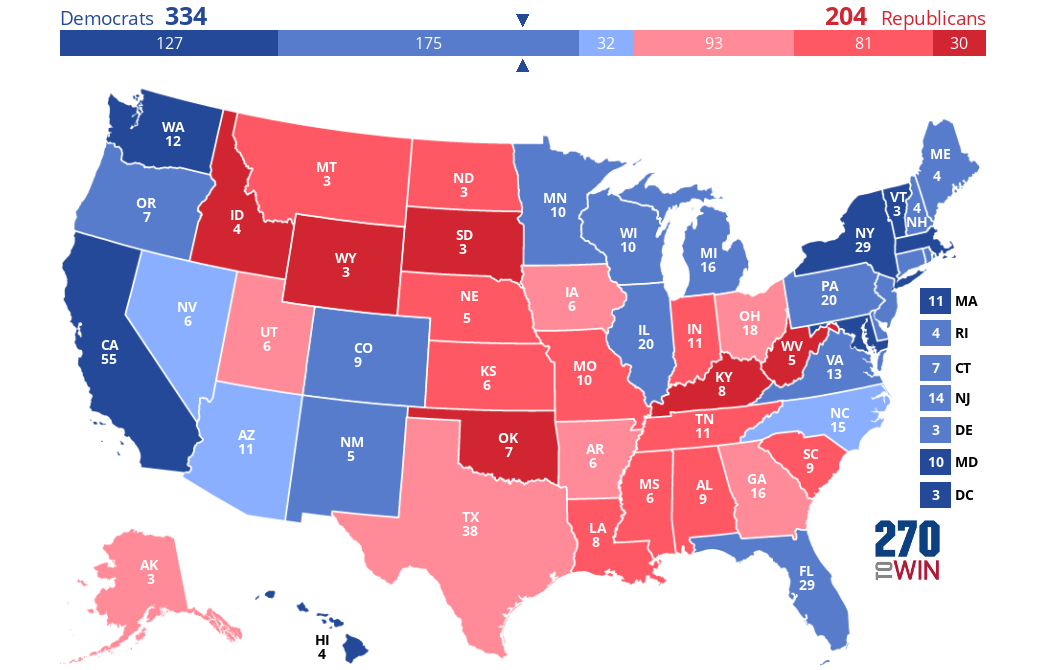
Technically we're one day away for Election Day in the USA, but 'tomorrow' doesn't have the exact same meaning here and there, as do so many words in English. Polling places will actually open tomorrow at 11am Edinburgh Standard Time on the East Coast, and close at 7am on Wednesday morning in Hawaii. I won't even mention the US Territories that are on the far side of the International Date Line and will vote on 2 November, or is it 4 November? Never got that one quite right, and it will be 3 November local time for them too anyway. Nuff said. And of course polling places are bound by law to stay open until the last person in the queue at closing time has voted, which might require an extra hour or two in some cases, despite the huge number of postal votes already cast. So don't expect anything close to a clear picture until Wednesday lunchtime at best, and probably even later, over the week-end or so. Only hours away from in-person voting, most major headlines deal with the nationwide polling for the Presidential election, even though it is just an indication of a general trend, as the outcome of the election depends on state-level results. Some might have expected that Donald Trump's wee bout of Covid would boost him in the polls. After all this was The Man who had just world-beaten serial world-beater Boris Johnson for the shortest Covid-related hospital stay in living memory. But it did not, as previous events seem to have influenced voting intentions in a more decisive way. More specifically the first Presidential debate, where a shouty and incoherent Trump made a complete arse of himself. This debate between Trump and Biden did little to enlighten the public. The next morning, media described it as 'a shitshow' and 'a hot mess inside a dumpster fire inside a trainwreck'. And it was followed by a Biden surge in polls, which then died down. For some unfathomable reasons, the trend of polls has recently become more Trump-friendly, though not enough to drag Biden down into a major danger zone. 


And then the American public were deprived of the second 'town hall' debate that Trump reportedly turned down because only weaklings need extra protection from a contagious disease. But I can reveal The Donald actually never turned down the second debate, his spads did. And then injected him with enough of his experimental Covid Specials to make him believe he had. They had everything to fear from a debate involving a real audience of real Americans who had not been 'prepared' by the White House PR team. Finally the formerly-third-and-now-second debate was a definite letdown as it failed to deal with foreign policy. So we missed Trump being asked about his offer to buy Denmark from Greenland, or it might have been the other way round, his spads don't quite remember which tweet had the correct version. Or Trump reiterating his opposition to Scottish Independence because his golf tournament couldn't be called the British Open anymore. Not that it mattered anyway as Americans are not known to be fluent in foreign policy and are more likely to focus on domestic issues, like their constitutional right to one school shooting per week. The whole sequence of events definitely had an impact on voting intentions though, as the weighted average of the last six published polls has Biden on a single digit lead, instead of the double digit lead he enjoyed in the immediate aftermath of the first debate.


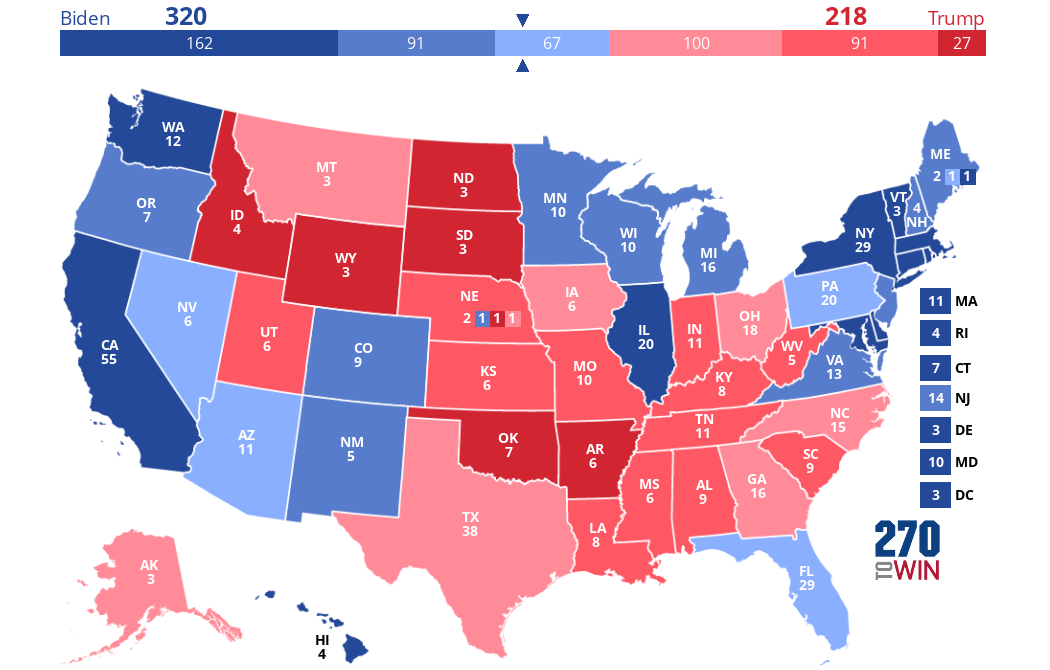
State by state polling shows that Joe Biden's post-debate surge mostly translated into more votes in states he already had in the bag, and his later slump mostly translated into fewer votes in swing states, which is obviously not good at all. At one point after the first debate, polls even said Biden would gain Georgia by the weest of margins. Which would have been quite a feat as the last Democrat to win it was Bill Clinton in 1992, and he owed a lot to Ross Perot snatching a big chunk of the Republican vote. But now Georgia is back in Trump's column and Biden's lead in the Electoral College has shrunk by 14 votes compared to early September. Biden's supporters take comfort in the fact that no candidate with an 8% lead in the popular vote on Election Eve has ever lost the Presidency. Then, before 2016, no candidate with a 2.9 million votes' lead had ever lost the Presidency either, had they? Team Blue have reasons to be cautious as the trend of recent state-level polls has made Biden weaker in a specific and limited way, after a counter-intuitive Trump surge in a number of key swing states. Compared to my last projection eight weeks ago, Biden has gained one electoral vote in the 2nd Congressional District of Nebraska, one of two states that split their electoral votes instead of the classic winner-takes-all allocation, but lost 15 in North Carolina that is now projected to back Trump by less than 1%. Biden's base of Solid and Likely states has shrunk from 302 to 253 votes. Most notably, predicted gains in Pennsylvania, Florida and the 2nd Congressional District of Maine have now shifted from Likely to Weak, as well as a few East Coast states shifting from Strong to Likely. Meanwhile another key state, Ohio, remains in Trump's column, which Republicans see as a good omen as no Republican has ever won the Presidency without also winning Ohio. Which does not mean that all Republicans who won Ohio have also won the Presidency, Thomas Dewey in 1944 and Richard Nixon in 1960 are proof of this. Then the most encouraging sign for Team Blue has nothing to do with the campaign issues and serious politics, as it is Trump's latest soundbite, promising to unleash his lawyers all across the USA as soon as the last vote is cast. Not the words of a confident candidate expecting a fair win.


The now very unlikely scenario where we have a repeat 2016, with Biden winning the popular vote and losing the Electoral College, would again trigger calls for a reform of the presidential electoral process. Article II, Section 1, Clause 2 of the United States Constitution devolves it to the states, so a reform could proceed without the need to amend the Constitution. The only option that would require an amendment would be to abolish the Electoral College altogether and make the winner of the popular vote the President-elect, which has exactly fuck all chance of ever happening. More recently some Republicans came up with a proposal that would have allocated 435 votes by congressional district (as Maine and Nebraska already do), 100 (two per state reflecting the Senate seats) to each state's winner of the popular vote, and the three votes for the District of Columbia to the popular vote's winner. If this had been implemented in 2012, Mitt Romney would have won the presidency 282-256, instead of the actual Obama victory on 332-206, because of heavy gerrymandering in Republican states after the 2010 census. The idea has since been dropped as no state except Pennsylvania seriously considered switching to it. Another and more popular option is the National Popular Vote Interstate Compact, where states could individually decide to allocate their votes to the winner of the popular vote nationwide. It would effectively be 'nullification without suppression' of the Electoral College, and is unsurprisingly much more popular in Democratic states than in Republican states. It would reach the desired effect once states totalling 270 electoral votes joined it, which is far from a done deal right now, even if the 2016 result has given it some additional appeal. So the current process is likely to remain in effect for the foreseeable future, for better of for worse.

© Klaus Meine, 1991

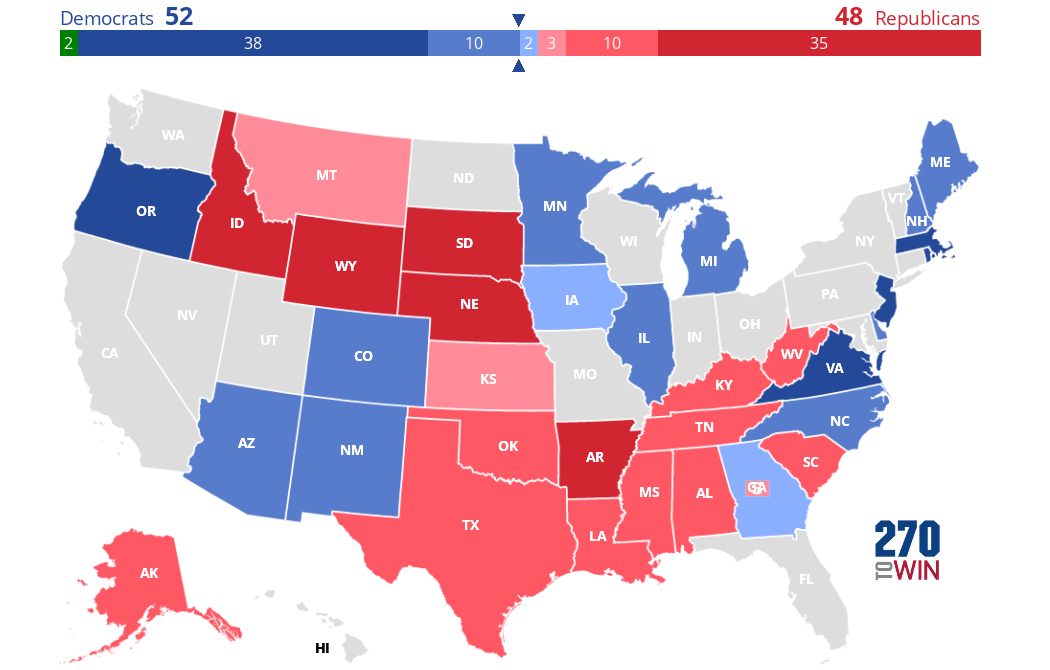
There is no such thing as nationwide polling for the Senate elections, but each competitive race has been surveyed independently many times during the campaign. State-level polls show the Democrats in a very favourable position even in states they're predicted to lose at Presidential level, such as Georgia and Iowa. Even hardcore Republicans admit that the Democrats have been better at campaigning and that Trump is more of a liability than an asset in close Senate races. Best estimate right now is that Democrats will end up with 50 seats and Republicans with 48. And the two Independents caucusing with the Democrats will allow them to take back control of the Senate with a four-seat majority. Polls here are often better for Democrats than the presidential polling, as they appear to have lost just one possible gain since September, the Georgia seat that is part of the regular election cycle. Which does not in fact change the overall projection, as Democrats are now predicted to gain the other Georgia seat, that will be decided at a by-election. I don't expect any further major upset here, though the Republicans appear to be weaker than expected in Georgia, Kansas, Montana and South Carolina. So Republican candidates definitely have to hope Trump does well in these four states and they can ride his coattails to re-election. Democrats also appear weaker than expected in just one seat: Minnesota, that they gained by a cat's whisker in 2008 on Obama's coattails, and then held with a 10% lead in 2014. The states labelled as 'Tilt' are those where a seat is predicted to change hands: six from Republicans to Democrats, one from Democrats to Republicans. The predicted Democratic gains (Arizona, Colorado, the Georgia by-election, Iowa, North Carolina and Maine) definitely qualify as 'Weak' and will probably be decided by tiny margins only. The Republican gain in Alabama looks much more solid as Democrats gained the seat only by serendipity at a by-election in 2017 and the state has a strong Republican leaning.


The situation in the Senate during the proverbial lame-duck session would draw attention to three states: California, Arizona and Georgia. If Joe Biden wins the presidency, as is highly likely, Kamala Harris will have to resign her Senate seat in California. Which would create only a very short suspense as California law does not require a by-election to fill a vacancy. The Governor has the power to appoint a new Senator for the balance of Harris's term ending in 2022. He would obviously do just that in a matter of hours and another Democrat would replace Harris. Things are more interesting in Arizona as the Senate election there is a by-election, not part of the regular cycle. In this case, Arizona law requires that the Senator-elect be seated immediately to avoid any long vacancy that would deprive citizens of representation. So, if Democrat Mark Kelly wins, as polls currently predict, he would be sworn in and seated on 30 November at the latest. The situation is even weirder in Georgia thanks to local election laws that require a jungle primary for by-elections. If none of the candidates bags an outright majority tomorrow, as is the hugely likely scenario, a runoff will be held on 5 January 2021 between the two top contenders. The combination of all this means that the Senate will be reduced to 99 seats and the balance of power altered to 51 R-48 D during the lame-duck session, opening the door to all sorts of surprises in any vote. This is why the Republicans fast-tracked the confirmation of Trump's Supreme Court nominee Amy Coney Barrett ahead of Election Day, to avoid any possible fuckup, and finally won it 52-48. Two Republican Senators had pledged they would not support the nomination in an election year, applying the same informal rule as in 2016 when another vacancy happened, that the Republican Senate majority then controversially reneged on. But only one (Susan Collins of Maine) kept her promise and voted with the Democrats against confirmation. The other one (Lisa Murkowski of Alaska) reneged on her commitment not to renege on the 2016 rule. I guess the Whip reminded Murkowski she had a rough re-election when standing against her party in 2010 and wouldn't want to risk another such gamble.

© Paul Kantner, Grace Slick, Marty Balin, 1975

Oddly, the House of Representatives polling is not as obviously good as the Presidential and Senate polls for the Democrats. There is even a very credible scenario where they could lose some marginal seats in swing states, while not gaining enough elsewhere to make up for the losses. The trends of nationwide polling for the House of Representatives still show Democrats ahead, but they have seen better days. More significantly, the weighted average of the last six generic House polls has Democrats on 52.6%, Republicans on 45.5% and Others on 1.9%. Which is as close as can be to duplicating the 2018 results, with Democrats a wee smitch down. Compared to the Presidential polls, both parties here snatch some 2% of the vote from 'Others'. Which probably does not count as a real pattern, but just reflects the fact that minor parties like the Greens and Libertarians are fielding just a minuscule number of House candidates, as they are not willing to spend shitloads of dosh on multiple local campaigns that will deliver fuck all seats.


The projections for the next House have to rely on a mix of generic nationwide polling and targeted polls in individual districts, which you surely remember is American for constituencies. Something we don't see often in the UK, unless Lord Ashcroft pays for it from his pension pot. But it's quite common in the United States where campaign spending is limited only by the depth of the donors' pockets. There has been quite a flurry of district-level polling over the last two weeks. Most of it has been concentrated on supposedly marginal seats that could possibly change hands, and has not always delivered the expected results. Many marginals are projected to remain in the same party's hands, which only confirms the weight of the incumbency factor in close elections. But polling of supposedly safe districts has also delivered some possible upsets, most of them in the Democrats' favour. A number of seats are now in the balance that were not expected to, in Republican-leaning states such as Georgia, Montana, Nebraska, Ohio, South Carolina and Texas. Which is of course in line with Joe Biden making inroads in states where the demographics favour the Democrats, most prominently in areas where Hispanics and African-Americans are expected to turn out in larger numbers than at earlier elections. 


The projection above, after the dust has settled, is obviously good news for the Democrats, though an unprecedented and unforeseen number of seats might prove too close to call on Election Night. What I have now is the Democrats gaining 17 seats and losing 8, thusly slightly consolidating their majority from the 2018 midterms. As you might expect, the American punditariat don't really have a consensus vision of the gory details here. Current estimates are 220-239 Democrats vs 181-188 Republicans, the rest being tossups, as in American for 'tie'. Of course the odds of Republicans taking back the House with a clean sweep of all 45ish marginal seats are somewhere to the south of fuck all. Some pundits even have a more optimistic vision of the Democrats' prospects than me, with predicted net gains somewhere between 10 and 15. Anyway, if I had to wage a tenner on the global outcome, I would go for a Democratic trifecta: Biden and Harris at the White House, House majority confirmed and strengthened, Senate back to a Democratic majority. Then the surest bet is that we won't know anything for sure on the day after Election Day and can expect a lot of court challenges from the Republicans. No doubt Trump and his cronies will prove to be the sorest losers since Dog domesticated Man, and nothing can be taken for granted until everyone duly elected tomorrow is sworn in. Fingers crossed.

© Jeannette Sears, Pete Sears, 1982

08/10/2020

A Scottish Play Reboot - Episode II: Attack Of The Yoons


© Bruce Hornsby, 1986

We Scots are an easy con. We like to think we’re a hard canny race,
But after a couple of bevvies, we become maudlin romantics.
(Willy Kinross, Lovejoy: The Colour Of Mary, 1993)

Since the December snap election, we have become accustomed to a monthly dose of Scottish polling, with thirteen IdyRef2 polls, ten Holyrood polls and seven Westminster polls conducted in 2020 already. This is just the beginning as we can expect weekly doses shortly, probably after everybody has recovered from the Hogmanay hangovers. All these polls have delivered a continuously favorable trend both for Yes to Independence and for the SNP. But there are also many reasons why the SNP should stay alert and not indulge in the sort of complacency that undid the SNP majority in 2016 and delivered some unexpected upsets in 2017. The Holyrood election is still seven months away and the second Independence referendum... err... uhhh... let's settle on 'some time later' for now. Of course the overall trend of Independence polling is now strongly favourable to Yes, but we've seen support for Yes nosedive already, not surprisingly because of some SNP fuckup that could still happen again. There is one clear way out of this: the SNP conference supporting the 'Plan B motion' proposed by Angus MacNeil and Chris McEleny. We know that the Unionists need only one No vote to defeat Nicola Sturgeon's Plan A: Boris Johnson's, and that vote has already been cast. So the SNP definitely do need a Plan B, even if that infuriates Serial Blocker Pipe'N'Slippers Wishart. There is no doubt Scottish Independence is now on the winning side, as Yes has come to be dubbed 'the default option' by some pundits. The arguments against Independence become weaker by the day and will be further weakened by the Full Brexit, and right now Boris Johnson is unable to make a case for the Union when faced with the reality of his government's incompetence. It is quite revealing that the last Attack Of The Yoons is not targeting the drive to Independence as such, but the very foundations of devolution. Fortunately the Internal Market Bill is likely to be challenged in British courts now that the EU has threatened legal action of their own. So now is not the time for the SNP to procrasturbate again and again. Only decisive action on their part can strengthen the trend of polls that show a strong and unprecedented shift towards Yes.


Then I fear that SNP HQ is going for some smoke-and-mirrors game and will do all they can to have Plan B rejected by the conference. Which would be a dick move, especially as more and more voice suspicion about the party's actual commitment to Independence, after it emerged that some in the party's NEC are actually content with devolution. There is also a truckload of circumstantial evidence that some SNP MPs feel really comfy aboard the Westminster gravy train and would be reluctant to do anything that could jeopardise their position there, which can only fuel doubt in many people's minds. Of course I am ready to be on the optimistic side, as nine of the thirteen IndyRef polls held this year have Yes ahead, including a continuous winning streak in the seven most recent ones, so this might be an incentive for SNP HQ to act more boldly and more swiftly. The weighted average of the last four shows a convincing Yes lead, though not quite completely overturning the 2014 result just yet, but only after undecideds are counted out. It's also worth remembering that only one poll actually delivered an outright majority for Yes before undecideds were factored out, and that the number of undecideds has doubled over the last six months. So I can only repeat what I already said: the best strategy is to go after the undecideds rather than after the 2014 Noes who are still hypothetical 'soft Noes' today. Just saying, and oddly now Angus Robertson agrees with me. Then Douglas Ross' bizarre outburst at the Zoomed Conservative Conference might help more than you imagine. If even the Tory Branch Office Manager for Scotland says that English Unionists don't actually give a rat's fuck about the Union, it may be one of those light-bulb 'what the fuck?' moments for some undecideds and switch them to a 'soft Yes' next time somebody polls them.


So now the big question is: what Scottish Labour will say next year about IndyRef2. And don't tell me they will do as Keir Starmer says, as I would ask 'which Starmer?'. So far he decided he would allow policies into the Labour manifesto only if they contribute to strengthening the union, strongly opposed holding IndyRef2, said that the SNP winning the next Holyrood election will give them a mandate to hold it, and that the issue 'needed looking into'. Just wait until the campaign starts and Sly Keir will have more U-turns on this than Boris Johnson on Covid regulations, and more positions on it than the SNP has mandates. And by the time he's sorted it out, over 50% of Labour voters in Scotland will also be Yes voters, only boosted by STUC's support for holding IndyRef2 as an act of resistance to Boris Johnson's Power Grab Bill. But of course Not-So-Hardy Keir always zigzags with barristerish dignity and no comical side-effect, unlike Ed Davey when he lectures Scots on how to secure a mandate for Independence, which is a bit like the lamppost trying to teach the dog to pee. Then of course the most serious threat to the Yes Camp is now the Dream Team of Neil Oliver and Kevin Hague, ready to unleash a whole shitload of blue-only Excel charts on an unsuspecting Scotland. No shit. Would I pull your leg over such clear and imminent danger? But of course the SNP might also find it clever to adopt a more Cummingsian data-based approach to targeted campaigning. Coatbridge Analytica, anyone?

Where do I belong? Where do I fit? Who are my people? Where do my loyalties lie?
We all choose our tribe, it’s that need to belong, to live within boundaries
Cause it’s scary on the outside, on the fringes.
Some labels are forced on us, they mark us and set us apart till we’re like ghosts
Just drifting through other peoples’ lives, but only if we let the labels hold.
You can piss your whole life away trying out who you might be.
It’s when you’ve worked out who you are that you can really start to live.
(John Mitchell, Being Human: Episode Four, 2009)

© Roderick MacDonald, Calum MacDonald, 1987

When the carpets start leaving the bedroom, stay clear of the… um…
Removal men? Husbands? Parquet floor? Well, whatever…
(Eric Catchpole and Tinker Dill, Lovejoy: Loveknots, 1992)

Survation's last big tent poll also surveyed the Commons voting intentions, and I have already mentioned and discussed this part in my last article about Westminster polling. So now let's have a look at what the seven Scottish polls conducted this year have to say, and how they would translate into seats. I don't rule out a minimal Conservative revival all over the UK if Boris Johnson is kicked out in a very Thatcherite and ruthless way early next year, and Rishi Sunak is anointed as the next First Minister of England. Keir Starmer and Labour HQ obviously see this as a plausible scenario and have started targeting 'Brand Rishi' accordingly. If this happens, it would certainly have some fallout in Scotland. Just remember the PR around Ruth Davidson and how it revived the Conservatives, and picture this to the power of a-lot, centered around Rishi as The People's PM, and Oor Doogie Ross relegated to the sidelines he is so familiar with. The very last poll should also ring an alarm at SNP HQ, as it shows the SNP down 3% on the previous poll and these 'lost votes' obviously going to Labour who would come back to second place by a nose. Bear in mind too that the voting patterns inherited from the 2019 election mean that the SNP don't even need a majority of the popular vote to bag 55 seats or above. So even a relatively underwhelming performance, compared to current polls, would still deliver a massive majority of seats and strengthen the PR about 'yet another mandate', no matter how many are already collecting dust on the highest shelf at Bute House. As long as it is not too underwhelming, and of course we're not there yet. But SNP HQ should stay alert and remember that complacency always come with a high price. Consider yourselves warned.


So, for now at least, Ian Murray would again be the sole survivor of all Unionist MPs after another SNP tsunami. The same Ian Murray who reneged at the last minute on his pledge to join the British Union of Macronists as it would have endangered his position as MP for Morningside Polo Club, and cut him off from both fat expenses claims and Tory dark money. Now Ian is probably firmly entrenched as a New New Labour enthusiast, no matter what the SNP throw at him, and a further Labour surge might put a few other SNP seats in jeopardy. Neale Hanvey in Kirkcaldy and Cowdenbeath is probably immune to a challenge if he stands as a bona fide SNP candidate with full support from SNP HQ. But Labour may find it a good idea to stage a full-blown attack against Kenny MacAskill in East Lothian. Kenny's maverick ways, though they were to be expected, have definitely not made him a favourite son in Nicola Sturgeon's eyes and those of her Ninth Circle. Don't rule out them triggering a selection challenge from a more compliant candidate and, if that fails, offering only lukewarm support that could endanger Kenny. Labour might also choose to campaign strongly in seats that were once part of their heartlands, and where they overperformed in 2019. First obvious choice is Glasgow North East, Willie Bain's seat in the olden days, and where Paul Sweeney still bagged almost 40% of the vote amidst Labour's December trainwreck. Next in line would be.... come on.... try a wild guess.... aye, you got it... Rutherglen and Hamilton West. Which might turn into a suspense story long before the next general election if Margaret Ferrier 'does the right thing', as the saying goes, and resigns her seat after her Cummingsian Homecoming that made her the SNPBad Icon Of The Week. I must confess I have mixed feelings here. On one hand, once a bit of the dust had settled down, I found myself ready to lend an understanding, if not wholly sympathetic, ear to Kevin McKenna's take on the situation. On the other hand, one wrong can't make another wrong right or be used as an ex post facto excuse for it, and I still think Margaret should resign without waiting for a recall petition that would be an even more hurtful career-ender, especially now that her constituency association has urged her to do just that. So let's just try and see how an hypothetical by-election could turn out, once the Conservatives find out that Rutherglen and Hamilton are not in Glasgow, no matter what it looks like from Ettrick. Some numbers first and full decoding after the break.


Here you first have the results of the last five elections, that is all held on the current boundaries. Then a projected result for the next general election, based on the national results from the Survation poll conducted 2-7 September. Finally two hypotheticals of what could happen if a by-election was held in the coming weeks. Just a reminder of how my projection model works: it is not based on uniform swing but a mix of 70% uniform swing and 30% proportional swing, as described on this Canadian site. I have also tweaked it to specify which candidates would stand in each constituency. Which I used here to rule out UKIP at the next election, and hypothetically reallocate half their potential votes to the Conservatives. Which is why my 2024 projection is different from what you would get from a basic calculation on uniform swing with the same candidates as the last time. For the record, Electoral Calculus predict it now as 50.0% SNP, 34.2% Labour and 10.7% Conservatives; and Flavible as 47-51% SNP, 34-37% Labour and 12-13% Conservatives. Conclusion: the SNP are highly unlikely to do as well in this constituency as in 2015, even if they do better nationally, and Labour are still a force to reckon with. Which says nothing about a possible by-election, which could deliver two scenarios, both including a significant drop in turnout and tactical voting for Labour. Which could result in a very close result if the SNP select a strong enough candidate to hold the seat by the hair of their teeth. Or you can have the SNP going down to their 2017 level of support while Labour go back up to their 2015 result and take back the seat. I think this second option is far from unlikely and is within the range of possibilities, and even quite plausible. Obviously Labour have done their homework and juggled with the numbers too, as Sly Keir appears confident they can win this one. Conclusion: nobody has the fuckiest scoobie how this would turn out and all we can do is random guesses. But, if this actually happens, expect it to be a tough one for the SNP. And if they lose, they will blame Margaret Ferrier for it, just as they blamed Michelle Thomson for the loss of one Holyrood seat and one Westminster seat in Edinburgh.

Every disaster is a photo opportunity in disguise
(Francis Urquhart, House Of Cards: To Play The King, 1993)

© Roderick MacDonald, Calum MacDonald, 1987

I believe in you, I just don’t believe in this version of you.
(Michelle Davis, The Stray, 2017)

Finally Survation also surveyed voting intentions for the next Scottish Parliament election and the results are a mixed bag for the SNP. Bottom line, or headline depending on your perspective, is that this poll would deliver a 25-seat majority for the pro-Independence camp, or a 9-seat majority for the SNP alone, achieved this time on the constituencies only. The SNP's constituency vote, up 6% on the 2016 election, is obviously a major success even if earlier polls predicted they would do better. But the list vote, level with the 2016 result, should trigger some alarms at Gordon Lamb House. Clearly the 'Both Votes SNP' talking point does not work and the gap between their constituency and their list votes has more than doubled since the 2016 election, a situation most of the earlier polls did not predict. Unsurprisingly, the ongoing debate about the wisdom of supporting alt-Yes regional lists, or lack thereof, has again become more heated. Which is exactly what you can expect after a poll predicting the SNP would bag fuck all list seats despite again bagging 1 million 'wasted votes', give or take. This time I won't even bother trying alternate scenarios including various levels of support for alt-Yes lists, but I will shed a light of what the exact opposite would deliver. With 'Both Votes SNP' across all regions, my model says that the SNP would win six list seats: one each snatched from the LibDems and the Conservatives, four from the Greens. The math usually don't lie, except when they do, so I can just ask you to trust me that 'Both Votes SNP' would actually increase the pro-Independence majority. Whether achieving this mostly by undermining the Greens is a blessing or a curse is just a matter of opinion, and you know which side I'm on on this one.


For some unfathomable reason, Nicola Sturgeon chose last month to revive one of many SNP Civil Wars by taking on 'cybernat keyboard warriors' and offering unquestioning support to Rhiannon Spear on Twitter. Not surprisingly The National tell only one side of the story here, forgetting the 400ish replies to that last tweet, most of them reminding the party's leader of the obnoxious and degrading smear campaigns waged by the SNP's Woko Cult against bona fide Yessers whose sole fault is disagreeing with a fringe extremist agenda that the party has come to embrace. There is some some sort of deluded defiance here as the Scottish Government announced plans to bring back the unpopular GRA reform just days after the English Government dropped the English version and rolled back the use of 'educational' material promoting the extreme version of the Woko ideology. Then Nicola has obviously underestimated the amount of negative coverage this would trigger, especially about the part where she implicitly endorses a double standard on online abuse, depending on who is the target: one rule for those who support her and another for those who don't. Nicola can't avoid criticism too on the time and energy spent on attempting to deliver on divisive side issues, while Holyrood could have worked on more pressing and popular issues like full use of the devolved part of fiscal powers, land reform, stronger incentives for the transition to a green economy in deprived rural areas and post-industrial cities, etc.. I also have a hunch that Peter Murrell pretty much admitting to foul play in the handling of the Alex Salmond case and Nicola's own not too convincing submission about it won't help, and neither will her account of what she does remember and what she does not of her talks with Big Eck two years ago. Now there's a good angle of attack handed to the Unionists on a silver platter. But surely some damage has already been done and I can only advise SNP HQ to not just gloat at each poll predicting a win at the next election, but also to factor in the whole sequence of seat projections from all the Holyrood polls fielded this year. Which is not all milk and honey to their ears recently.


In this context, Martin Keatings announcing he intends to stand for Alliance For Independence in the Mid-Scotland and Fife region is not good news for the SNP. Martin has gained name recognition with his 'People's Action On Section 30' crowdfunder, which uncoincidentally pursues the same goals as the SNP's 'Plan B Motion' I mentioned earlier. A wee smitch of math helps here too: Mid and Fife has the de facto lowest threshold for a list seat, on 5.6% of votes cast. So Martin would need about 16k votes to snatch the seventh list seat there, or 14% of the predicted SNP list vote, and the added bonus is that he would take that seat from the LibDems. I'm not saying Martin could be 2021's Margo MacDonald, but he surely looks like a serious contender for the analogy. Then we heard the very sad news of Jo Swinson's passing.... on a Holyrood candidacy. I guess that, after a thorough study of the electorate, she found out she had as many chances of becoming First Minister if she did not stand as she had if she stood. Fuck all. And of course not standing saves her the bother of campaigning and the humiliation of having to watch somebody else deliver a victory speech at the proclamation. Again. Of course this is incredibly sad news for the SNP as the probability of the LibDems holding North East Fife has now significantly increased. There is another interesting finding in the Survation poll: Labour are up again, gaining 6% on the constituency vote and 4% on the list vote, compared to their all-time low two months ago. Which puts them just one seat away from the Conservatives and two down on the 2016 result, a much better performance than the Tories. A new scenario, in which Labour come back from the grave to become the second party again, is not as far-fetched as some may think and shouldn't be dismissed with condescending irony. Oor Doogie Ross could be of considerable help here, seeing how he has made it a habit of falling flat on his face after making a complete arse of himself, no matter how anatomically challenging that might sound. Now there would be some delicious irony if Labour could dig themselves out of their hole by becoming both the acceptable face of Unionism and a credible center-left alternative to the SNP for a number of Yes-supporting voters, proving the common wisdom wrong that says you can't have it both ways.

How do you make a rat look less threatening? You put it next to a shark.
(Nick Cutler, Being Human: Making History, 2012)

© Roderick MacDonald, Calum MacDonald, 1987

20/09/2020

House Of Cards: To Play The People

There are a few of us who are unwilling to just troop along
A few of us who are clever enough to see that there is more to be done
Than just live the small complacent lives of the great masses, the moron millions
A few of us who desire a more profitable type of government
When you think of it, the competence of totalitarian nations is much higher than ours
They get things done
(Charles Tobin, Alfred Hitchcock’s Saboteur, 1942)

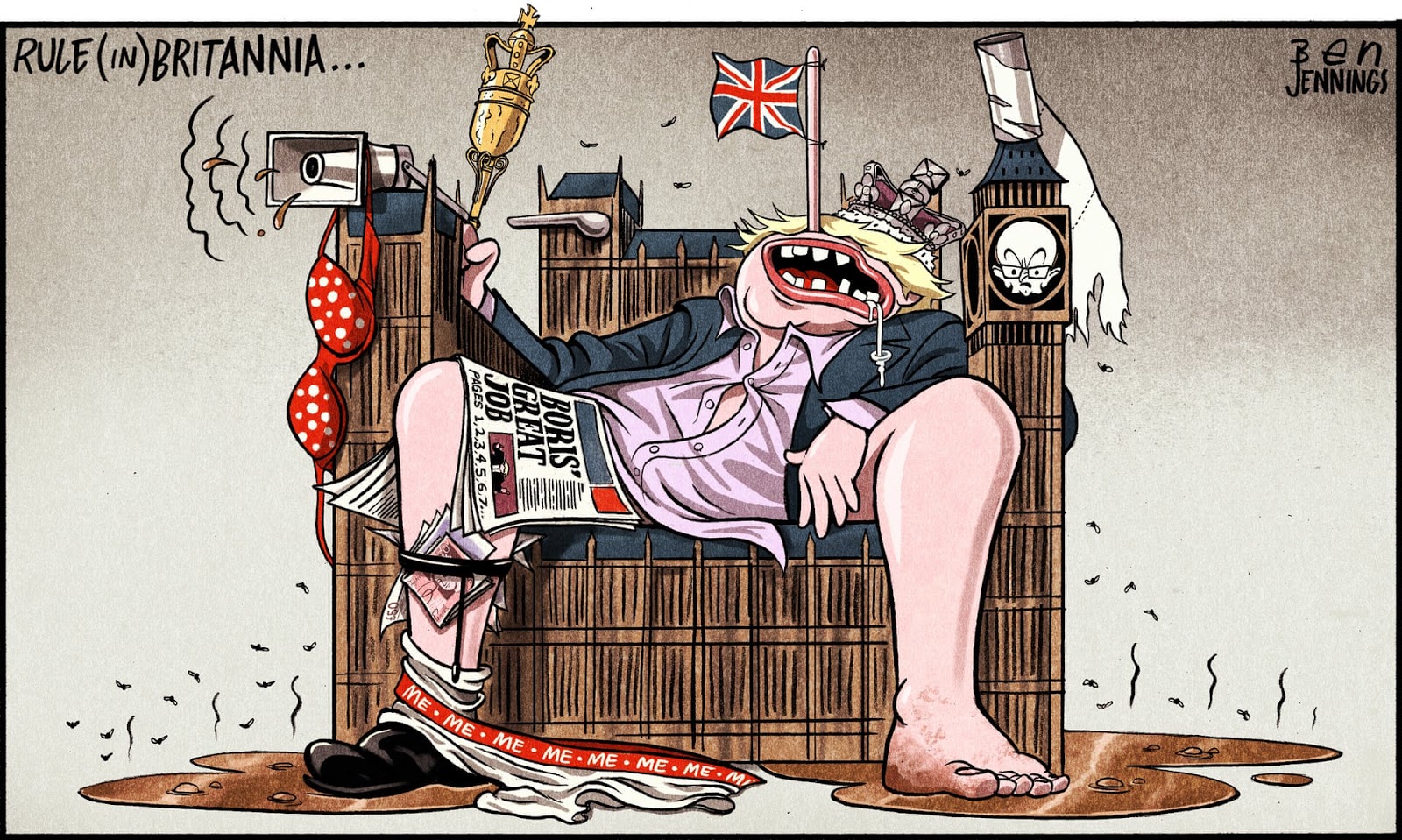
© Ben Jennings, The Guardian, 2020

The few are those men of such intellectual and cultural superiority
That they’re above the traditional moral concepts
Good and evil, right and wrong, were invented for the ordinary average man
The inferior man, because he needs them and what is called “civilisation” is hypocrisy
The lives of inferior beings are unimportant
Moral concepts of good and evil and right and wrong don’t hold for the intellectually superior
I’d hang all incompetents and fools, there are far too many in the world
(Brandon Shaw, Alfred Hitchcock’s Rope, 1948)

There's definitely a continuity in general election polls these days, inasmuch as they're continuously contradicting one another, and thusly we ain't none the wiser after scrolling through the latest batch that says the Conservatives could win the popular vote on anything from fuck all, which would be a considerable setback, to a 6% margin, which would still deliver a slimmed-down majority. Meanwhile Boris has come up with the brilliant idea that the best way to respect the people's will is to make breaking the law the Law Of The Realm. Which will pass Commons no matter how loud the outrage. Let's pause the polls for a wee while and do some basic math. When divisions are called in Commons, 637 votes are counted (650 MPs minus Sinn Féin, the Speaker, Deputy Speakers and Tellers), meaning the actual magic number is 319. The Conservatives account for 362 of these 637, so you would need at least 44 Tory MPs not just grumbling and moaning at the Strangers Bar, but actually voting with the opposition, and all opposition MPs also present and voting en masse against the Government. And we all know the probability of that actually happening is somewhere south of fuck all, as the second reading of the Internal Market Bill has shown, so any bills will pass, even the most fucked up ones. But don't think it won't leave lasting stains even if people are more concerned with the incoming second wave of Covid-19 right now, the one Johnson saw coming two weeks after everybody in Europe started mentioning it. One thing on top of the other certainly lays the groundwork for Winter Of Discontent 2.0. Polls are not quite there yet, even with two recent ones predicting a tie between Conservatives and Labour on 40% each, as the overall trend still has the Conservatives leading by a wee nose.


Some of us had great hopes after Bernard 'Mark-Francois-By-Proxy' Jenkin confessed the European Research Group voted for the Withdrawal Agreement only because Boris Johnson promised them he would renege on it, and minutes later soon-to-be-sacked Northern Ireland Secretary Brandon Lewis admitted the English Government would not shy away from breaking international law in a 'specific and limited way', if not in a sensible and convincing way. Then the next day's sensation at PMQs was not Steer Calmer, as Diane Abbott had called him the Sunday before on live TV, grilling Boris Johnson about it, but Keir not grilling Boris about it. Which came as no surprise to those who paid attention and noticed Sly Keir rebranding himself as 'the competent Leaver' in an artfully timed interview with Sky News. So a Classic American TV reference still works, but we've shifted from 'Keirry Mason' to 'Leave It To Leaver'. Perhaps Keir thought it was a good idea not to mention Northern Ireland at PMQs, as it would have opened the door to Boris waffling about the IRA, but it was definitely a letdown as it allowed Lindsay Hoyle, of all people, to steal the show with his crucifixion of Tigger Matty Hancock, who had the sad puppy face of the lad who already knows he's going to be sacked for failing at things he never imagined were his responsibility, like... err... uuh... managing public health operations in England. Instead of devolving them to the Jockey Club. Too bad for Keir he then had to self-isolate, as it was up to Ed Miliband and Angela Rayner to shred Johnson to mincemeat, though one could argue Angela needs one more rehearsal before being fully up to the task. But the looks of despair on Johnson's face when Ed delivered blow after blow were pure gold. Notwithstanding, Keir's performance in the Preferred Prime Minister polling has improved as the penis-shaped trendlines show. Though they are a wee smitch misleading as only YouGov and Opinium have Starmer steadily in the lead, but being the two most frequent pollsters, they definitely set the tone.


Now one of Not-Too-Hardy Keir's problems, and there are many, might be that a lot of voters in The Area Formerly Known As The Red Wall may have detected that Boris is a fucking chancer, but are still willing to give him a second chance at proving he's not the worst First Minister of England ever but just the second worst after Chamberlain. Besides, even the ambiguously Starmer-friendly Guardian has some doubts about what the stripped-down Labour Conference can possibly deliver. Another likely stumbling block is Keir's obsession with sounding more Unionist than the Conservatives, and his unchallenged decision to filter all policy proposals at the Labour Conference on three criteria, the second one being how they contribute to strengthening the Precious Union. The United Kingdom now is beyond dysfunctional and broken, it's somewhere between unfunctional and afunctional, and definitely falling apart. The big question about Scottish Independence, Irish Reunification and Welsh Independence is no longer 'if?' but 'when?', and Scotland will most probably be the first to go her own way. And, to paraphrase Rent Boy, all the huff and puff in the world won't make a fucking difference. That's something Keir will definitely fail to realise as long as he thinks Ian Murray is a reliable source about Scotland's mood and part of the solution, instead of being the problem all by himself. Aye, THE Ian Murray who dropped out of Change UK minutes after the last rehearsal of their Big Announcement on 18 February 2019, the one where Luciana Berger made Chuka Umunna's jaw drop to the floor when she introduced herself as a 'Labour MP'. Of course the antics of the Honourable Member for Morningside Polo Club might be Keir's least worry when Johnson again resorts to his oven-ready populist rhetoric, playing the people against whatever elite he made up over breakfast, and making the oiks believe the world-leading empire can strike back. It might work again and help the Conservatives rebound in polls, or it might not when people will take the full measure of the double whammy of a second major health emergency the English Government is unprepared to deal with, and the most massive economic downturn since the UK defaulted on its foreign debt in 1932. Quite a gamble but I have a wee hunch it will actually be up to the next First Minister of England to deal with all the incoming bùrach. More on this later.

No Tory MP wants to go back and face the local sharks saying he voted with his social conscience
(Patrick Woolton, House Of Cards, 1990)

© Chris Riddell, The Guardian, 2020

We do seem to be learning by trial and error, mostly error
(Doctor Lee Rosen, Alphas: Blind Spot, 2011)

Since my last post we have had another London poll, coupling Westminster voting intentions with those for the mayoral race, and another Scotland poll. Neither was a big surprise and neither shed any new light on the situation as both are roughly duplicates of the ones we had a month ago. Voting intentions and seat projections below, with London on top and Scotland next. In London we still have Iain Duncan Smith, Theresa Villiers and Felicity Buchan unseated by Labour. But Stephen Hammond and Elliot Colburn could save their asses against under-performing LibDems, though just barely. But of course the best part for Labour is the one about the mayoral election. Sadiq Khan would shred Conservative born-again nyaff Shaun Bailey to mincemeat and is predicted just inches away from winning his second term on first preferences only, a feat no directly elected Mayor of London ever achieved. The Scotland poll is again bad news for Oor Doogie Ross as the Conservatives would again be wiped out for the first time since 1997. But last month they had a marginal chance at holding three seats, though not Doogie's own, and now they're down to two at best and again just by the skin of their teeth on a bad day for the SNP. And the worst part for Doogie is of course the Conservatives being relegated to third place in the popular vote by an unexpected Labour resurgence. Though of course Labour are so far behind in their target seats that it would again get them just the Tory-sponsored seat for the People's Republic of Morningside, the one Ian Murray loves so much, at least for the expenses, he wouldn't leave Labour in 2019, though he was really tempted, as he knew he wouldn't have stood any chance as a Change UK or LibDem candidate against an official Labour candidate. Of course Ian did not stay with Labour out of principle as he has none, but you already knew that.


Then we also have had some real new news with a Full Welsh poll by YouGov. Oddly it was conducted between 28 August and 4 September but released for public consumption only on 15 September. Quite possibly YouGov's Conservative shareholders needed all that time to let the true meaning of their findings sink in, and asked nicely for it to be released at an appropriate time, when it would be drowned in all the noise from other quarters. Miss. The paradox here is that the results are actually not that good for Labour who would crawl back to just their 2019 vote share, which was a serious setback compared to 2017 and well below the level of support they enjoyed in Wales during the Blair years. Anyway this is one of these situations where Labour shouldn't look the gift horse in the mouth as it would allow them to reclaim Bridgend and Delyn, two of the six Welsh Red Wall seats they lost to the Conservatives last December. The poll's results are more convincingly bad for the Liberal Democrats, who find themselves too far down the drain to entertain any hope of gaining back a Welsh seat in the foreseeable future. And also for the Conservatives, who would not only lose two seats, but find themselves squarely in the danger zone in another five (Aberconwy, Clwyd South, Vale of Clwyd, Vale of Glamorgan, Wrexham). The results are also encouraging for Plaid Cymru, who would skyrocket from 10% to 15% of the popular vote. But the oddities of Welsh electoral geography mean they would bag just one extra seat, Ynys Môn, once a solidly Red seat though Outside The Wall, and now a three-way marginal. Unfortunately even this excellent result would still leave Plaid Cymru's next two target seats, Caerphilly and Llanelli, well outwith reach.


Interestingly, the Senedd part of the YouGov poll is far better for Plaid Cymru who would bag 24% of the constituency vote and 23% of the list vote. Which is also quite close to the level of support for Welsh Independence, which an earlier poll had on 25%. Bear with me for just a wee moment as I digress from the article's main purpose of discussing mostly the Westminster polls. But I just want to stress the situation in Wales, as described by recent polls, has some striking similarities with the situation in Scotland fifteenish years ago. The SNP's surge also started with major gains at the devolved Parliament's elections and a weak support for Independence, and the rest is history. So there is definitely hope for Plaid Cymru to progress first from Labour's only possible choice for a coalition government to second party status, and then to first party and Wales' government while taking the support for Welsh Independence beyond 50%. Don't dismiss this as "can't happen there" just yet. Just consider how many Scots in 2005 would have wagered a fiver on the SNP becoming the governing party two years later and Independence the majority choice fifteen years later. Just sayin'.

My theory is the best so far because it is the only one we have
(Gary Bell, Alphas: The Devil Will Drag You Under, 2012)

© Chris Riddell, The Guardian, 2020

Blessed are they who expect nothing, for they shall not be disappointed
(Captain Albert Wiles, Alfred Hitchcock’s The Trouble With Harry, 1955)

Despite their predicted successes in London and Wales, the big picture remains unsatisfactory for Labour. With the English Government displaying just the finely tuned mix of incompetence, arrogance and corruption you usually expect to find only in third-rate banana republics or in Washington, D.C. but not in a moderately civilised country, you would have thunk it's Red Carpet on the Stairway to Heaven for Labour. But it isn't. Admittedly it took England 18 years to get rid of the Tories last time aboot, just as it took Chile 17 years to get rid of Thatcher's protégé Pinochet, but what we have now is Starmer doing a pretty good Kinnock 2.0 when what he needs is upgrade to Blair 2.0. I'm not trying to say today's politics are not complex. It would be easier for everyone if it was a clear-cut choice between Ashes and Paradise, but there are more shades of grey here than meet the eye. Unfortunately for Labour, it means public opinion is moving slow and drifting towards them in baby steps. So my Poll'O'Polls for this month includes the last six fielded between the 1st and the 17th of September. Which is quite a long timespan and not really an instant snapshot of public opinion, but blame that on the pollsters who have gone into some sort of part-time activity recently. The super-sample size is 10.667 with a highly theoretical 0.95% margin of error. Most important result is that it shows the Conservatives leading by just a measly 3% UK-wide, and by a not-really-much-better 5.5% in England outside London. Which means the Conservative vote has gone down faster in England than on average since December, and that might open new prospects for Labour, once they come to terms with the basic fact that the battleground is in England and not in the vain search for Scottish seats.


As usual, the models beg to differ somewhat as different algorithms imply different ways to process marginal seats. This is usually more visible when the projected shares of the popular vote are close, as we have here. But this time we are spared the rather confusing situation where some say Johnson would lose his majority by a few seats, while others say he would hold it by an equally wee number of seats. This time every model predicts he would lose it after totally losing it. The alternate extreme scenarios factoring in the marginals should also ring an alarm within the Tory ranks. Their best case scenario is pretty much a repeat 2015 and I guess they all remember how that one ended. More interesting is Labour's best case scenario where there would be a tie in seats. It becomes even more interesting if you do some math on top of that. An hypothetical Conservatives-DUP coalition, if that can still happen now, would bag 286 seats. While a Rainbow Coalition around Labour would bag 299 seats with the SDLP, the Greens, the Liberal Democrats, Plaid Cymru and the Alliance Party on board. Sly Keir could even argue that just Labour and SDLP together would bag four more seats than the Conservatives and that he should be granted the first shot at forming a government. And just don't rule out just yet Keir actually getting the broader coalition up and running. The key point here is that Labour would not need support from the SNP, as the headcount would still be 298 to 286 in Labour's favour if Scotland was independent by then. Which rules out any Project Fear involving the "Keir in Nicola's pocket" narrative, And again makes the point that the winning strategy for Labour is going after weak Tory seats in England and Wales, not tilting at Scottish windmills. Just a friendly advice.   


Of course things might change in the near future as public opinion is highly volatile, and a lot might depend on what happens with the Power Grab Bill, aka the Internal Market Bill, before it comes back to Commons for the third and final reading at the end of November. The English Government have not just driven the thin edge of the wedge between them and legality, them and the international community. They have shoved a king-size crowbar into the crack. The massive irony here is of course that the unelected House of Lords might be the best protection of the rule of law, even with Johnson invoking the Salisbury Convention that probably doesn't even apply here. Of course the Lords' votes don't matter technically as Commons will overturn all their amendments and restore the ideological purity of the original bill. But the main challenge for Johnson, and the most serious threat to his Presidency... oops... sorry.... Premiership, might come from a wholly different direction: massive popular disobedience to further Covid-linked regulations. Not because of a bunch of pound-shop libertarians whining that protection against a contagious and potentially lethal disease is an unacceptable breach of civil liberties. But because of massive loss of confidence in the English Government and all those associated with it, including the scientists who are definitely not immune to criticism over their contradictory and confusing messages over time. So bad PR over resistance in the Lords could be the least of Johnson's worries if he faced resistance from the people all across England and from the devolved governments protecting their constitutional prerogatives. This could only make matters worst at a point where the Conservatives are already predicted to bag their worst performance since the last election. They are projected 63 seats down on the election result and a massive 103 down on their peak performance during Johnson's 'Covid Honeymoon' earlier this year, when millions rallied around the flag without having the fuckiest scoobie about the incoming clusterfucked disaster.


So, with the Conservatives' predicted performance at an even lower point than in the immediate aftermath of Dominic's trip to Durham, we might have reached the moment of truth sooner than expected, when Tory backbenchers decide it's as good a time as any to kick Johnson out of the lifeboat, rather than waiting for him to paddle away after Getting Brexit Overdone. I have a hunch some kind of Withdrawal Agreement for Boris is imminent, if not quite impending, and that it would be more of an injunction that an actual agreement. For a lot of Tory MPs, this would go beyond loyalty, this would be about survival when even Tory devotees in the billionaire-owned fishwrappers can't miss an opportunity to go after Boris. And that might also be the reason why some 'sources at Number Ten' have leaked that Boris intends to stand down anyway early next year, in the vain hope it could soften some of the wannabe Bruti. Or should that be Brutuses? Anyway time is not on Johnson's side here and he will probably have to face a reboot of The Night Of The Long Knives sooner than later. Here enters the New Kid In Town, Wunderkind Rishi Sunak The People's Chancellor, dancing to his own song of ice and fire.

© Steve Bell, The Guardian, 2020

Unlike Boris Johnson, who is the Daenerys Targaryen of Prime Ministers, riding Drogon Cummings to wreak havoc on Queen's Landing, Sunak is more like Westminster's Petyr Baelish (minus the throat-slit-with-his-own-dagger bit), good at using the truth to tell lies. And of course the Conservative PR squad could have a field day for all of eternity bragging that the Conservatives are world-leading at promoting diversity as the first Asian PM would be a Conservative just as the first, and so far only, Jewish PM was a Conservative. You might and probably will argue that Michael Gove is just as likely and credible a candidate, but I think Sleekit is more of an ageing Joffrey Baratheon than the man for all seasons, and especially not fit for the post-Brexit season. Gove is too closely associated with the twists and turns of the Brexit omnishambles and definitely part of the Old World Order, when the Conservatives will need to put on a Brave New Face with enough visibility and popularity. Besides, Sunak is much better armed to take on New New Labour on their own turf, and could become Disraeli 2.0 with the proper balance of modernisation and tradition to revive the Conservatives' chances with the centrist electorate both parties need for a landslide. And I definitely can't see him playing the long game, allowing Gove to prevail and lead the party to an humiliating trainwreck at the next election, and then coming back as the salvator ex machina. Rishi is young enough he can afford to wait, but old enough to know missed opportunities never come back, so he won't wait. Mark my words.

There’s no such thing as a lie, there’s only expedient exaggeration, you should know that
(Roger Thornhill, Alfred Hitchcock’s North By Northwest, 1959)

© Ben Jennings, The Guardian, 2020

Sometimes the shortest distance between two points is a straight line
Never attribute to malice that which is adequately explained by stupidity
(Jason Bull and Hanlon’s Razor, Bull: Split Hairs, 2019)

Knowledge is a deadly friend if no one sets the rules
The fate of all mankind I see is in the hands of fools
When every man is torn apart with nightmares and with dreams
Will no one lay the laurel wreath when silence drowns the screams?
Confusion will be my epitaph as I crawl a cracked and broken path
If we make it we can all sit back and laugh but I fear tomorrow I'll be crying
© Robert Fripp, Ian McDonald, Greg Lake, Michael Giles, Peter Sinfield, 1969
This version recorded live on 20 November 2015 at Queen Elizabeth Theatre, Toronto

06/09/2020

A Tale Of Two Conventions. Almost.

Try not. Do. Or do not. There is no try.
(Master Yoda, Star Wars: Episode V – The Empire Strikes Back, 1980)

© Bob Weir, John Perry Barlow, 1987

There are only two seasons in Washington, lovers of liberty
Tax season, a shameful time when your nation’s leaders 
Rob you blind for their own amusement and unending sloth 
And election season, a shameful time when your nation’s leaders offer you
Empty platitudes in exchange for your votes and your hard-earned cash
I can smell the change in the air
It smells like hairspray and apple pie and fresh manure like America itself
So let’s rejoice, lovers of liberty, all the leaves are brown but the sun is out and the sky is blue
(Sally Langston, Scandal: Wild Card, 2016)

So it's this time of Election Year when American political parties have had their National Conventions. Or some version of them. As this year they have been mostly covided out and replaced by socially-distanced micro-events and Zoom sessions, which the punditariat will of course punditify about for days without end, just as they have done with the full-fledged conventions of years past. Of course the best moment of the Republican Convention was Donald Trump Junior telling his audience that Joe Biden is Nessie and Loch Ness is a swamp. Which would not have struck American audience as odd, as most of them probably think Loch Ness is an amusement park near London. Then we had the next news cycle totally hijacked by right-wingers outraged at Bette Midler's comments on Melania Trump's speech. Which were indeed unfair as Melania does speak better English than her husband.  Pundits will now keep a close watch on post-Convention polling, awaiting the proverbial Convention bounce that could benefit Trump. The last time the Republicans actually had a Convention bounce was in 2008. when they got Team Blue all sweaty for a few days as John McCain briefly overtook Barack Obama in national polls. Then Sarah Palin spoke and Obama cruised to victory. But this year Trump would need way more than a bouncelet to prevail, as the trend of national polls and the weighted average of the six most recent ones conclusively show Biden ahead by a safe margin, even with a few less good polls recently. And remember this is the USA, so Red is Blue and Blue is Red.


Now Biden's main problem will be to keep the momentum for the next two months and avoid any embarrassing gaffes. He still has a margin of progress in a few states if he wants to upgrade from 'convincing victory' to 'fucking Trump-woodchipping landslide', even if most of the South and Midwest look like lost causes. If you think Trump's core electorate in the backwaters of America, from Appalachia to Terrebonne Parish, are going to desert him because he went campaigning in 'Frorida' before discussing 'Yo-Semites' going on vacation (that's American for holiday) in 'Thighland', just bear in mind half of America can't even spell 'G8', and those who can think it's some sort of car engine. Never forget this is a country where a solid third of voters will never mind being ruled by an illiterate psychopathic moron because they are illiterate psychopathic morons themselves, who still think that Father Knows Best, there would be fewer deaths in school shootings if all the kids carried guns and universal publicly funded healthcare is a plot by Communist reptilian aliens hell-bent on removing God from the American Way Of Life. Or something like that involving France and North Korea. But right now even Trump calling Biden 'Joe Hiden' will misfire as most people are likely to conclude he was just mispronouncing and not trying to make a lame joke.

© Paul Kantner, Marty Balin, 1969

Of course what really matters is what state-level polls say, and how many Electoral Votes (EV) they predict for each candidate. The punditariat are as always punditifyingly cautious but sill lean Biden's way, with the most recent 'pundit consensus' predicting 278 EVs for Biden, 169 EVs for Trumps and 91 tossups (which, as you remember, is American for marginals). This is already enough to take Biden to the White House as 270 EVs are needed, but I think the situation is actually worse for Trump as my own calculations have Biden with a more solid base of 302 EVs to Trump's 111 EVs and 125 possibly going either way. The most likely outcome is Biden winning with a projected 334 EVs and possibly more. Biden still hasn't gained back Iowa and Ohio, two swing states won by Obama and then by Trump but both are extremely close. It says a lot too that several states supposedly safe for Republicans are now close to a tie like Arkansas, Georgia and Texas. So a pro-Biden upset in the last stages of the campaign appears now more likely than a pro-Trump upset, and the map below shows what my calculations say, with thanks to 270ToWin for this and other templates.


Compared to the 2016 result, Arizona, Florida, Michigan, Pennsylvania, North Carolina and Wisconsin are predicted to switch from Trump to Biden for a total of 101 EVs. No state this time is predicted to switch from Biden to Trump. Compared to Obama's winning map in 2012, Biden would add North Carolina (which Obama bagged just once in 2008) and Arizona (which Obama never won). But he would lose Iowa and Ohio, both of which Obama bagged in 2008 and 2012. That leaves out just one difference with Obama's 2008 map: Indiana, which Obama won then to everybody's surprise including his own as Democrats had not won it since Johnson in 1964, and before that Roosevelt in 1932 and 1936. The most interesting case here is Arizona, which voted for a Democratic candidate for the last time in 1996. Here the demographics have slowly changed the Democrats' way, with both the Latino population share and the Latino turnout increasing. These are the same trends that made New Mexico first and then Nevada and Southern California turn Blue, including Richard Nixon's home turf in Orange County, the affluent southern suburbs of Los Angeles. And might even switch Texas back to the Democrats for the first time since 1980, probably not at this election but quite possibly at the next one. The current projections have Biden in a very strong position anyway as even his worst case scenario would still have him winning by a convincing margin. What remains to be seen though is the impact of Trump's Project Fear, switching to a hawkish 'law and order' message and calling major unrest in a few cities the 'Biden riots'. It doesn't seem to have switched many voters so far, but of course the effect of deception and lies on swing voters should never be underestimated. 

© Chris Riddell, The Guardian, 2020

The main event since my last post has been of course Joe Biden choosing California Senator Kamala Harris as his running mate. Harris is a clever and yet safe choice for several reasons. The first and obvious one is that she is a woman, only the second time in US history a woman has an actual shot at becoming Vice-President. She is also of Indian and Jamaican ancestry, both her parents were immigrants to the USA in the 1960s and she self-identifies as African-American. Which ticks quite a number of boxes on the Democratic scorecard, though her background is definitely a privileged one, quite far away from the deprived inner cities. Then she has held elected office continuously since 2004, meaning she has been vetted often enough and under scrutiny for long enough to make any unpleasant surprise highly unlikely. In a country that loves nothing more than having all skeletons in the closets dusted off and lined up so they can have a good look at them, it's a safe bet that Republicans will not unearth any smoking turd from Harris's past. But paradoxically the main positive in selecting Harris is that she is ideologically ambiguous enough to be a difficult target for the Trump campaign. They will have a hard time making the 'radical left' label stick to either Biden or Harris (but bear in mind that, by American standards, the SNP would be radical left and Jeremy Corbyn totally off the chart), while the Democrats have plenty of ammunition to fire at Trump and his far-right nutcase of a Vice-President and running mate, Mike Pence (who, by British standards, would still be a far-right nutcase). Ironically the best weapons Trump would have come from disgruntled supporters of Bernie Sanders, but he can't use them as they hit at Biden-Harris for not being radical enough. So my best educated guess now is that Biden will win the Electoral College by at least the same margin Trump had in 2016, and probably by the same margin Obama had in 2012 when the Republican candidate was way saner and had a lot less baggage than Trump.

Hope is like the sun
If you only believe in it when you can see it, you’ll never make it through the night
(Leia Organa, Star Wars: Episode VIII – The Last Jedi, 2017)

© Seamus Jennings, The Guardian, 2020

The day we stop believing democracy can work is the day we lose it
(Queen Jamillia of Naboo, Star Wars: Episode II – Attack Of The Clones, 2002)

© Bob Dylan, 1974

The Senate is a gilded cage, a place of great comfort and wonderful perks
Where you think that you’re making a difference, but you’re not
It’s just you and 99 others grimly reminding yourselves every day
That the only way out of this, the only way to make your mark, is to be President
(Senate Majority Leader Edison Davis, Scandal: Pencils Down, 2016)

The second major battle is for control of the Senate, and the Democrats' prospects also look really good. 33 of the 35 seats up for re-election this year are the same that were up in 2014 when Democrats lost control of the Senate, so we have 23 Republican incumbents to only 12 Democrats. Republicans are clearly on the defence here and Democrats on the offence as several key seats are in states that are predicted to give a majority to Biden at the presidential election. Democrats now have 45 seats and need only 49 to take back control as the two Independent Senators (Angus King of Maine and Bernie Sanders of Vermont) caucus with them. Which could be translated into English English as 'take the Democratic whip' if there was anything like a formal whip in the US Senate. But there isn't and Senators have voted outside of party lines multiple times without any consequences, even during the more ideologically polarised last four years. And technically the Democrats actually need only 48 seats as it would lead to a clean 50-50 split. If Joe Biden is elected, Kamala Harris, as Vice-President and ex officio President of the Senate, would have the 101st and tie-breaking vote. There is a distinct possibility of this happening as the current spread of projected seats is 48-53 Democrats and 45-50 Republicans. But polls actually predict 50 Democrats and 48 Republicans when you sort out the marginals, which would avoid any heart-attack-inducing suspense on key votes. And this result has also a direct impact on the United Kingdom as the Senate is constitutionally empowered to ratify international treaties, or not. Including.... aye.... you got it.... a US-UK trade deal. Not that Democrats in charge would necessarily make a bad deal less likely or less threatening to the food industry or the NHS, but there is definitely a slightly-larger-than-fuck-all probability that the worst could be avoided. So here is what we have now, with the grey states indicating no Senate election this year. Projected Democratic gains: Arizona, Colorado, Georgia, Iowa, Maine, North Carolina. Projected Republican gain: Alabama which Democrats won by serendipity at a 2017 by-election and don't really expect to hold. 


Democrats are unlikely now to stage an upset in Kansas, though the Republicans' position remains surprisingly weak in a state that has been represented by two Republican senators continuously since 1938. But it says a lot that polls suggest Iowa could kick out their incumbent Republican Senator after just one term and bring back a Democrat, even with presidential polls predicting the state's EVs will go to Trump. Or that 'moderate' Republican Susan Collins, who has an ambiguous record on alternating between opposition and support to Trump, would fight the one election too many and lose her seat after 24 years in the Senate. Another significant gain for the Democrats would be Arizona, both politically and symbolically. The Democratic candidate there is Mark Kelly, a retired Captain in the US Navy and astronaut who flew four Space Shuttle missions, two as Pilot and two as Commander. Kelly is also the husband of Gabrielle Giffords, a former Democratic Representative for the city of Tucson, who retired from politics after being severely wounded in an assassination attempt in 2011 and has since become an icon for the supporters of stronger gun control, which Kelly has also fully embraced during his campaign. Less emotionally charged but probably more politically significant would be a Democratic gain in Georgia. Atlanta, the state capital and largest city, is home to a successful, affluent and well-organised Black community who massively supports the Democrats. While the rural areas, once part of the historic Cotton Belt, are mostly Republican strongholds. Remember this is where Gone With The Wind was set and it was not all fantasy, though of course the Democrats were the evil slaveowners and the Republicans the progressive abolitionists back then. So now we have the perfect mirror image of that, with demographics again vastly favourable to the Democrats. 

It is my experience that senators focus only on pleasing those who fund their campaigns
And they’re in no means scared of forgetting the niceties of democracy in order to get those funds
(Obi-Wan Kenobi, Star Wars: Episode II – Attack Of The Clones, 2002)

© Bob Dylan, 1978

There’s no such thing as a clean campaign, it’s an oxymoron
(Fitzgerald Thomas Grant II, Scandal: A Criminal, A Whore, An Idiot And A Liar, 2013)

Current polling for the House of Representatives is also very favourable to the Democrats, though it is not much different from the 2018 result which was already a very good year as they took back control of the House after eight years of Republican majority. So this year's polls predict Democrats cruising towards a second consecutive victory at the House elections, something that has not happened in twelve years. The trend and the weighted average of the three most recent polls both point to a higher Democratic vote share than in 2006, the midterms of George W. Bush's second term, when they took back the House on 52.3% of the popular vote and 233 seats. Or 2008 when they rode Obama's coattails to 53.2% of the vote and 257 seats. The discrepancies between past results and today's projections show the impact of heavy-handed gerrymandering in states controlled by the Republicans during the redistricting cycle that followed the 2010 census. A rough estimate is that Democrats need a 5% lead in the popular vote nationwide to achieve a tie in seats, and beyond that the dominoes will only fall slowly as Republicans post-2010 mostly avoided the post-2000 dummymandering that cost them dearly in some states in 2006 and 2008.


The weeish swing in the popular vote would only switch a few swing seats from Marginal Red to Marginal Blue. The punditariat's expert opinion says five to ten and my model says seven. Enough anyway to solidify the Democratic majority in the House and turn the elections into the Magic Trifecta result every party wishes and doesn't always get even when they win the White House. And even a Trifecta in a presidential year can be overturned at the next midterms. Clinton, Bush Junior, Obama and Trump have all known this, not to mention all earlier Presidents who suffered the same fate. Now the seat projection is an exact mirror image of the 2010 midterms, when Republican took back the House in the middle of Obama's first term. But at these elections, the last held before the last redistricting, the Republicans needed only 51.7% of the popular vote for their 242 seats, which again illustrates how the post-2010 gerrymandering in Republican states was used to make a victory more difficult for the Democrats. The next redistricting cycle (what would be called a boundary review in the UK) will probably be less controversial than the last two as about a third of the states have now taken it out of hands of the state legislatures and devolved it to an independent commission without political interference. For now we have Democrats cruising to a 50ish-seat majority, give or take. And we can expect a stronger party loyalty in the current ideologically polarised context, with 'centrist' Democrats (who, in British terms, would be the left wing of the Conservatives) much less likely to vote with Republicans to defeat 'progressive' legislation (which, in British terms, would be the Liberal Democrat manifesto, no shit).


What matters most for the Democrats is that even their worst case scenario has them holding their majority in the House. But the bigger the majority, the better it is for the progressive wing of the party as the House has the final say on the federal budget and a stronger Democratic majority makes 'compromise deals' with 'moderate' Republicans less likely here. Another challenge for the Democrats is to take back control of state legislatures they have lost over the last ten years, especially in the now Republican states where redistricting is still under political control and produced obvious gerrymandering in the last cycle. Which is definitely a square-the-circle thing as the states the Democrats need to gain back the most are also the ones most heavily gerrymandered by the Republicans like Ohio, Pennsylvania, Florida, North Carolina and South Carolina, so a string of uphill battles even if some are projected to turn blue at presidential or senatorial level. Finally the major key to all of this year's elections in how much PAC money (which would be dark money in British terms) each party can inject into their campaigns. The Democrats certainly have an advantage here as unfavourable polling will force the Republicans to divert resources to some states that were supposedly safe for them, and don't look like it now like Texas, Florida, Pennsylvania or Georgia. The larger the state, the more money you need to pour into it and the less you have for competitive states, something Democrats don't really have to worry about as their own safe states like New York, Illinois, most of New England and the Pacific West, definitely look immune to any sort of Republican offensive and could even prove safer than expected. There is even a double-whammy against Republicans here as political advertising is already more expensive in large states with large cities, and the more competitive the state gets, the more the prices rise again and again. Still two months to go before we know how the whole circus ends....

We need a system where the politicians sit down and discuss the problem
Agree what's in the best interest of all the people and then do it
If the people don't agree, well, then they should be made to by someone wise
Might sound an awful lot like a dictatorship but, well, if it works...
(Anakin Skywalker, Star Wars: Episode II – Attack Of The Clones, 2002)

© Bob Weir, Eric Andersen, John Perry Barlow, 1973

Riding Shotgun In The Sky

The poetry of the Earth is never dead. When all the birds are faint with the hot sun and hide in cooling trees, a voice will run from hedge ...