09/10/2018

Westminster projection - 09.10.2018 update

Eyes Wide Open


Conference Season often brings out the worse out of the parties and this year was no exception. So the LibDems want a second referendum but don't want the other. Tories still haven't made up their minds about austerity and when to throw their own PM under the bus. And Labour are like "we don't rule out not ruling out killing off the Nats, or not". Nice.

So the party currently in charge have lost all sense of direction except the one taking the whole UK over the cliff. And the ones challenging them know no better than bashing Scotland because they finally realized many of their English members actually have a sympathetic view of the SNP and what they stand for. Sad.

Then all have been expecting some sort of Conference bounce. But looks like the Brighton bounce was wiped out by the Liverpool bounce which in turn died down after the Birmingham bounce. And in the end we're pretty much where we were not so long ago. Again.

Polls continue to paint a bizarre picture, swinging back and forth between the two main parties almost at random. Though they now do show a smallish Conference bounce for Labour, but not enough for a decisive victory. Yet?


Trends definitely show Labour closing in on the Tories but at a sluggish pace. They still end up in second place and at this rate they would need months to finish first. And they certainly don't have that sort of time if the snap GE actually happens in the wake of Brexitocalypse. Or earlier if Mogglodytes finally make up their minds on their home movie version of Night of the Long Knives and when to stage it.


Now more than ever it's up to Little England to make up their minds. London, Wales and Scotland have already chosen. London and Wales want to be represented by Labour. Scotland wants to be represented by the SNP. Only Little England is still sitting on the fence and still won't swing decisively one way or the other. More on this later.


Pictures of a City


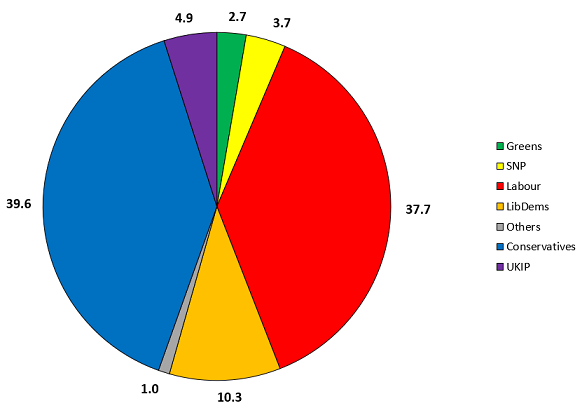
My updated super-sample includes six polls fielded between 26 September and 5 October, so partly overlapping the Conference season. Sample size is 10,364 with a 0.93% MOE. And here is what we get:


Statistically we have a tie between Labour and Tories. We've been down this road before and already know it doesn't end well. And again only the SNP and the Liberal Democrats are doing well enough to improve their representation significantly.

Of course the current uncertainty also has a lot to do with how people see the Lady In Charge and the Pretender. This one is still really not good for Jeremy Corbyn as 'Preferred PM' polling shows. And these are the numbers after undecideds have been cleaned off. Because the actual preferred PM is either 'None of the above' or 'Don't know' depending on which poll you read last.


So public opinion send a mixed message. Not really sure they still want Tories in charge but still sure Jeremy Corbyn is a worse pick than Theresa May. Public opinion not really sure of what they want is no novelty and MSM these days are certainly not helping. When all you're after is soundbites all you get is soundbite politics and a soundbite answer to that.

One More Red Nightmare


Now here is the projected House of Commons on this polling. Tories 25 seats down but still the first party and Labour only 7 seats up so not yet on a winning streak. As was the case a while ago when we already had a tie between Tories and Labour, the net effect would be to make the UK ungovernable unless some unholy alliance happened. Like a formal Lab-Lib coalition loosely supported by the SNP, Plaid Cymru and the Greens.


Such a result would only be an invitation to hold another snap election quickly to get a working majority. So 2019 could become one of those Years Of Two Elections like 1910 and 1974. Not that a second election would necessarily deliver a much different result, December 1910 did not. But Tories and Labour would probably agree on holding one anyway.

For the record, and one last time, here is what Electoral Calculus' Regional Predcitor projects when fed with the same polling data. Better for the Conservatives at face value but it's not like five seats would make much of a difference in this kind of stalemate situation. They would if they were the last five seats needed for a majority. Which in this case they aren't.


Just like last time only a few seats away from my models, and still showing mine just a wee smitch better for the SNP and LibDems.

Fallen Angel


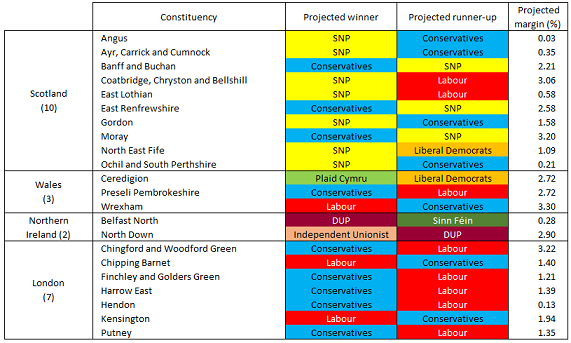
Under current polling just 32 seats would be changing hands. Still far below what is needed for a clean change. And again the SNP being 11 seats up and the Liberal Democrats 6 seats up would make them the winners in comparison to the 2017 results. Unfortunately for Labour these would probably make them gaining only 7 seats overall less of a headline.


Even with Labour starting to make inroads deeper into Tory territory no senior member of the Cabinet would be in real danger. Just a few PPSs or PUSSs going down would not be a political earthquake especially when they hold positions the general public doesn't even know exist. And would anyway wonder 'what the fuck is that for?' if they knew they existed. And don't even get me started on what people might think a PUSS does for a living.

So MSM would have to be content with former glories like Soubry, Villiers and Rudd going down for their headlines. Though we all know some sort of totally unexpected upset might happen and probably will under the proper circumstances. Possibly in Wales or London if Labour somehow get their act together there.


Due to the lack of even a few juicy Portiballs moments, the most interesting situation here might be East Devon. There Councillor Claire Wright already stood twice against scandal-prone Tory MP Hugo Swire on an anti-austerity and environmentalist platform. Third might be a charm if she stands again so she might very well unseat Swire next time.

Technically Wright stands as an Independent but she sits in the same group as the Greens on Devon County Council, which is why I added her to the Greens' tally in my summary. And if she chooses not to stand next time, there is still a strong possibility Liberal Democrats could swing the seat as their voters provided the bulk of Wright's votes both times she stood.

The Law of Maximum Distress


Right now we have 52 ultra-marginal seats that might swing the election either way, 30 of them in England outside London. But it's not necessarily good news for Labour as Tories might have better chances for a majority in most of the English marginals.


Of course Labour might have some good moments like gaining back Copeland or Morley and Outwood. Best one could be unseating Iain Duncan Smith. But the general climate right now makes these less likely than Tories holding a few of these marginals by a hair.

Three of a Perfect Pair


Even with all the marginals reallocated to one side or the other, current polling still delivers an unstable situation with all possible majorities coming out of likely shaky deals.


Even a peak Tory performance would fail to get them a majority and the continuation of the DUP deal would only result in a three-seat majority. And in the end it might very well hinge only on DUP actually unseating Sylvia Hermon in North Down and the Lady might prove resilient enough to avoid just that.


Not that a peak Labour performance would look better. Being the first party would deliver fuck all unless they find a way to some loose big tent coalition. Which might be the recipe for an early failure to get anything done and pave the way to yet another snap election.

Fracture


Let's have a look now at the Geographical Divide across the UK. It's just as obvious now as in was in 2015 and 2017, even with voters slowly switching against the Tories. Scotland is still decisively yellow and London and Wales different shades of red. While England has somewhat moved away from Tory heartland to opposition-not-too-unfriendly territory, but not in the way that would benefit Labour most.

I left out Northern Ireland as different rules and voting patterns apply there, as Karen Bradley recently discovered. Anyway their 18 seats would not change the general landscape dramatically except for the amount of bribe the DUP would need and the kind of blackmailing they would allow themselves to indulge in to keep a Tory government on life support on a month-by-month basis.


Even if the Conservatives' lead in England outside London has shrunk dramatically from 2017 (1% down from 8%), Liberal Democrats are the ones actually snatching most of the disgruntled Tory voters (bagging 10% up from 4%) as Labour are barely level with their 2017 vote there. Which of course doesn't help gaining the number of seats needed for a successful UK-wide upset and confirms what kind of new direction Labour strategy should take.

Note too that Scotland has the highest anti-Tory voting intentions in all of the UK outside of London. Too bad Scottish Labour choose to ignore it and make the right decisions as they keep thinking that bashing the SNP and bedding with Tories on Councils is their best strategy. When it obviously isn't as they're still losing ground across all possible crosstabs pollsters can think of.

By the way we also know that Scotland is the most politically aware of all. Official statistics show we have the highest voter registration of all the UK though unfortunately it does not always translate into higher turnout. Which is something the SNP especially have to work on if we want actual election results to reflect the polls. And I can't help mentioning we also have the highest membership population-wise for any party. That is the SNP with 125k members or 3.2% of the Scottish Electorate.

The Divide is actually not just between England and the rest of us, neatly following Offa's Dyke and Hadrian's Wall. It actually neatly cuts midway through England. BMG Research routinely crosstab voting intentions with the NUTS-1 regions, aka the now defunct European Parliament constituencies. And here is what the average of their last four polls delivers, with the usual caveats about smaller subsamples. Plus the fact that BMG tend to be more Labour-friendly than others like YouGov so the actual situation might be 1 or 2 points more Tory-leaning depending on the region.

So we see the Divide again between Southern Little England and the Northern Powerhouse, broadly along the Severn-Wash Line as we've already noticed. And the more you move up towards The Wall, the more you wander into Labour heartlands. From deep blue South to still slightly purplish Midlands to rust red North.

Just bear in mind that Southern Little England has 44% of the English electorate outside London while the Labour-leaning North has only 33% and Midlands 23%. So a massive Tory victory in Little England, which FPTP makes more than likely, might be just enough to keep them in power no matter what.

We'll Let You Know


What will happen next is as always a matter of conjecture. The next batch of polls might actually show a Labour bounce big enough to get out of the current deadlock. Recent polling also shows that Boris Johnson becoming PM would boost the Labour vote. And so would Labour firmly committing themselves to a second EU referendum, whatever this would actually mean.

The combined effect of all these factors would probably be a 3% to 5% swing from Tories to Labour. And all of this happening more or less simultaneously is not that far fetched when you think it through. The irony being that it could actually mean the next GE would be decided by just a few votes and a few seats. And Scotland might turn up being the key to Number 10. Like 1974 all over again.

So the SNP might find themselves in the unique and bizarre situation of having to wish for Labour doing extremely well in England. Like a tsunami of Blairite proportions that would make half a dozen Scottish seats irrelevant as the outcome would already have been decided elsewhere. And even that might not be the weirdest situation facing us. Guess we have some interesting moments coming up before the next GE.

Best educated advice is to stay away from Ladbrokes for now. Odds are roughly 6-to-4 for Tories and going down, ain't good enough to risk serious dough. Just wait for further polling if we see some more solid direction in the next batch.

So stay tuned for further broadcasts.


Wha daur meddle wi' me


Umphrey's McGee's tribute to John Wetton (1949-2017)
© Robert Fripp, 1974


05/10/2018

Scrap AMS? Sure but then what?

Gimme three steps


Early last month the Scottish Government released their Programme for Government for 2018-2019. It includes a smallish part about electoral reform.


One issue is conspicuously absent here: changing the electoral system itself. The electoral law is a devolved matter but changing it requires a two thirds super-majority in Scottish Parliament. Which obviously does not exist and that is reason enough for the Scottish Government to avoid addressing it as it would end up in yet another controversy that would yield sweet fuck all.

But of course the matter can still be discussed and some alternate scenarios can be proposed. It is common knowledge that the current Additional Member System (AMS) is far short of truly democratic. It was designed to make sure than no party (and especially not the SNP) would ever get a majority and Scotland would forever be ruled by Labour-led coalitions. 

The system failed as the SNP got a majority in 2011 and came out only two seats short in 2016. And the way it works does not deliver actual additional members to allow a fairer representation of the electorate's choice. Instead it is rigged to allocate 'compensatory seats' to the losers of the constituency vote and several options exist to make it more representative.

To be on solid ground I will discuss these options as 'what ifs' based on the actual 2016 results. As a reminder here are the vote shares and the Scottish Parliament this election delivered.


Step One: from AMS to MMS


The first option is to replace AMS with a basic Mixed-Member System (MMS) as exists in Germany. But it would have to be adapted to the Scottish context to avoid the unnecessary complexities that exist in the German system such as the bizarre combination of overhang seats and leveling seats.

The method is simple: seats are allocated based on the regional vote and using the D'Hondt method. Only you don't factor in the constituency seats so each party starts from scratch with no FPTP handicap and the result reflects directly the votes each party received in each region.

And this would deliver a massive majority for the SNP, reflecting both a dominant position on the constituency vote and a fair showing on the list vote.


Major feature it that this allocation favours the parties whose votes are close to evenly spread across all regions, which would be the case for the Conservatives and SNP. Conversely parties with an unevenly spread vote, especially the Greens, are at a disadvantage.

With seven seats per region, this would raise the de facto threshold for a seat from about 6% to about 12%. The opposition would then see this as unfair as it would increase the number of wasted votes dramatically. For example Greens won seats in every region except Central and North East, meaning about 28k wasted votes out of 150k. But with MMS they would get seats only in Glasgow and Lothian, making it 92k wasted votes.

Furthermore MMS would allocate 50% of the list seats to the SNP on only 42% of the list vote, which would trigger more outcry from the opposition. Not that it is an unexpected result anyway. For example at the 2013 German election, the CDU-CSU bagged 49% of the seats on 41% of the list vote with a quite similar system, and the German people were perfectly happy with it.


Step Two: 56-seat national list


Second step for a more representative result is to scrap the electoral regions altogether and elect the 56 additional MSPs on a single national list. This way the de facto threshold goes down to about 2%, which is lower than the legal threshold imposed in some countries that use proportional representation.


As expected, the single national list allocates a few more seats to the smaller parties, including UKIP getting their first MSP on 2% of the vote. But the way D'Hondt works, like all highest averages methods, also favours the larger parties compared to what a largest remainder method would deliver. In this specific case largest remainder would switch one list seat from the SNP to the Greens.


Step Three: 73-seat national list


Of course 73 constituency seats plus 56 list seats is not an actual mixed-member representation. Being true to the concept requires the same number of MSPs being elected on FPTP as on PR. With 73 seats on the national list and using D'Hondt, here is what the 2016 vote would have delivered.


Again this method would deliver a strong SNP majority, which is what it is designed to do while still giving the other parties a sizeable representation. In this scenario, switching from highest averages to largest remainders would oddly switch one seat from the SNP to UKIP but still nothing spectacular.

Step Four (or not): full proportional representation


Then you might want (or not, depending on your perspective) go all the way to full Proportional Representation (PR) with all MSPs elected from a single national list. Which is the way MEPs are elected in most EU member countries.

On full PR there is of course no need to increase the number of seats to ensure equal representation between FPTP and PR seats. But I tried the 146 seats option too here to see what impact, if any, a larger Chamber could have on the results for the smaller parties. And also tried the usual technical options within PR: highest averages or largest remainder.


For this I assumed a full PR system would deliver the same votes as the actual 2016 regional vote, which would probably not happen. It is likely a change in the electoral law would also trigger a change in voting patterns but the 2016 results are the only data we have. 

With all these caveats, full PR would fail to deliver a majority. Which comes as no surprise as it is exactly what it is designed to do. Actual results in other elections outside the UK show that a party would need roughly 47% to 49% of the popular vote to secure a majority of seats, depending on how the other parties do.

But it still remains an option to be considered as it has many supporters in the UK. Though obviously it wouldn't be my preferred choice.

To sum it up


Below are the shares of seats each party would get under the different systems. 2016 AMS are the actual shares at the last election and the FPTP shares are how the 73 constituencies went, which shows the usual high distortion that's built into FPTP. And obviously full PR is where you get seats shares closest to the popular vote.


But any of the PR options would have delivered nothing better than a split Chamber with the need for a coalition. I am not in favour of coalitions, especially when there is a risk they might evaporate overnight. Like in having the Scottish Greens as the junior partner, who have made it a habit of not thinking through an issue before casting a vote. And there is always the remote possibility of PR delivering a wobbly Unionist coalition even on the 2016 votes, united by nothing more than 'Git SNP Oot'.

So my choice is clearly one of the true MMS options, which deliver both a strong majority for the first party and sizeable representation for the opposition(s). Bear in mind that a fair electoral system does not imply that the opposition should be able to block the Chamber from doing its day job. Elections are also here to make sure the country can be properly governed.

After all we've already seen the SNP win 95% of the seats on 50% of the vote and the Earth didn't start spinning backwards, or did it? Huge majorities on just a plurality of the vote are not uncommon in the UK, Canada or the USA to name a few. And you don't even need FPTP to achieve this, just look at what happened in France last year: 55% of seats on 28% of first round votes for La République en Marche.

What if?


Finally I ran simulations of what the results would have been under my preferred method: MMS with a 73-seat national list. Unsurprisingly this would have delivered a Labour majority in 1999 and a Labour minority strong enough for government in 2003. 2007 would have been the odd one out with Labour holding a plurality of seats thanks to their good showing in the constituencies. So this would likely have ended with the only occurrence of a Lab-Lib coalition instead of the first SNP government. Though a SNP-Lib coalition (which Alex Salmond tried to negotiate at the time) would also have been a feasible outcome.


Oddly this method would also have delivered a better result for the SNP in 2016 than in 2011. Here too the FPTP component would have played a big part with the SNP bagging six more constituencies in 2016. Also in 2011 left-wing independents and the SSCUP did well enough to secure seats on the hypothetical national list and so cut down the SNP share of PR seats a bit. 

But this system would have worked better than AMS, delivering an outright majority at three out of five elections instead of just one. Thus leaving less room for post-election compromises and allowing the winning party better opportunities to fully deliver on their manifesto. Which ultimately is all democracy is about.

Then we already know true electoral reform won't happen in Scotland anytime soon even if all parties know the system is one of the worst possible. All opposition parties, and possibly the SNP too, have a vested interest in it not changing. And it's one of these deadlock situations anyway: you don't have the votes to change the system and you would need to change it first to get the votes.

So just food for thought. For now.

Saor Alba Gu brĂ th


© Calum Macdonald, Rory Macdonald 1989

01/10/2018

Westminster projection - 30.09.2018 update

Technical note first. I have (at last) finished fine-tuning my own model for England (outside London) based on the same algorithms I already use for Scotland, Wales, Northern Ireland and London. So I will no longer rely on Electoral Calculus for the English seats outside London. Expect some differences between their projections and mine as the methods are slightly different and we generally don't rely on the exact same poll-of-polls. But nothing too dramatic as we'll see later.


Perpetual Change


General Election polls are a never ending source of amazement. Here is what the September batch says. Anything from a 4% Labour lead to a 6% Conservative lead. Even polls fielded during the same week end up delivering vastly different results.


But what matters most are the trends these polls show over a longer period of time. Both major parties have had some slumplets and surgelets and in the end both are down from 2017. As was the case already a few weeks back, the SNP and the Liberal Democrats would benefit the most from this situation. UKIP are up too but not that it will do them any real good anyway (more on this later).


What this shows is that public opinion still has a hard time deciding which of the two main parties is the best choice. Both still appear as bad choices in the current context, even with no serious alternative in sight other than making the least bad educated choice.

The electorate being unable to form a strong and stable opinion about the two parties who will be in a position to form the next government is in itself a major issue. It only confirms that events of the last couple of years have really hurt democracy in the UK. Something nobody should take as good news. Especially as signs abound this has also been followed by a rise in sectarianism.

State of Play


My current super-sample includes six polls fielded between 18 and 25 September. Sample size is 11,185 with a 0.90% MOE. The voting intentions have not changed significantly over the last ten days but we have grown used to this, haven't we? So we're still in hung Parliament territory.


Interesting part in recent polling is that the numerous changes from one poll to the next tend to vanish from sight when we get to the rolling average. Differences cancel each other out in some weird way and we end up on the same trends as before, or very close.

As usual Conservatives have to rely heavily on Little England as their current voting intentions in London, Wales and Scotland are far from impressive. Though some would probably argue that they're still better than Tories actually deserve right now.


Labour voting intentions are also rather unimpressive in all three cases. But the odd ways First Past The Post works mean that LibDems doing unexpectedly well in London, and also Plaid Cymru doing better than last year in Wales, would actually help Labour rather than hurt them.

Bring Me to the Power


As expected current polling once again delivers a hung Parliament with Tories 17 seats short of a majority and the Tory-DUP alliance 7 seats short. But Conservatives losing a dozen seats would not help Labour as changes would mostly benefit the Liberal Democrats (7 seats up, +58% from 2017) and the SNP (11 seats up, +31%).


The breakdown of projected seats by nation confirms where Labour's weakness lies. Potential gains in London or Wales are far from what they need for a majority and Scotland looks totally out of reach. And Scotland anyway was never the key to Downing Street except in 1964 and February 1974, two elections that were much closer then the next one is expected to be.

So again Labour should realize they have to allocate their most significant resources and energy in England outside London. They were 98 seats behind the Conservatives there last year and current projection has them still 92 seats behind. Prevailing in more marginals there is definitely the key to the election.


For the record, when fed with the exact same polling data Electoral Calculus' Regional Predictor projects this:

As might be expected this is pretty close to my own results and also projects a hung Parliament, with the Tory-DUP coalition here five seats short of a majority. My models are just slightly more favourable for the SNP and the Liberal Democrats. But it impacts literally just a handful of seats so does not change the big picture.

To Be Over


With this polling only 20 seats would change hands, again close to the all-time low in reliably recorded Parliamentary history. You certainly remember which one by now. Aye, December 1910.


Remarkably 11 of these 20 seats are in Scotland, with 2 other in London and only 7 in the rest of England. Wales and Northern Ireland would both return the same number of MPs for each party, even if possibly not the exact same MPs (think Ian Paisley Jr). Of course no big name appears on the list of those projected to lose their seats, so no juicy TV moment to be expected.


But seats mathematically projected to change hands are only part of the story. If past elections are any indication marginal seats might also provide some upsets. Though right now there are not enough of them to produce a political earthquake.


Close to the Edge


On current polling 49 seats overall would be in the danger zone. Meaning the swing required to switch them from the projected winner to the projected runner-up would be lower than the polls' MOE. Which differs from an area to the other as I rely on different polling data for each model.


Only 27 of the 49 marginals are in England where the real fight happens. And even if Labour did really well in all regions, they would gain at most 20 seats and this would be still far short of what they need for a majority.

And by the way you don't have to worry about the party leaders. Under current polling Theresa May would be re-elected with 60.3% (down 4.5%), Jeremy Corbyn with 64.7% (down 9.3%), Vince Cable with 66.3% (up 13.5%) and Ian Blackford with 43.3% (up 3.1%). 

Parallels


The alternate projections we have after reallocating the marginals are again not satisfactory for Labour. Not that Conservatives should feel happy either anyway.


Even if Conservatives managed a clean sweep of all ultra-marginals they would still be 4 seats short of majority and hostage to the DUP. We know now that the DUP are not content with a £1bn bribe but feel comfortable with blackmailing the Prime Minister on major political issues. Obviously many Tory MPs are not happy with this situation and having to live with it. But would still have to swallow it again if Tories managed to win the election by a hair only.


On the other hand even a 'peak Labour' result on current polling would not have them winning and would indeed produce more instability. Only the most unlikely event of a deal with the SNP would allow Labour a majority, and not necessarily a stable and lasting one even if Jeremy Corbyn doesn't rule out not ruling out (or something of the sort) a second Scottish Independence Referendum. 

Five Percent For Nothing


An aside now about what might (or might not) happen to UKIP at the next GE. As you might remember they fielded candidates for a GE for the first time in 1997 when they were in direct competition with Jimmy Goldsmith's Referendum Party. Better results at later elections never got them more than one MP outside by-elections. Two at their peak with by-elections included. 

UKIP vote plummeted after the EU referendum, probably the direct result of them ruling themselves irrelevant after the Leave victory. But now, two years and two leaders on, polls have them up again and they might very well end up on about 5% which would be 1.7 million votes on a similar turnout to 2017.


Recent polling has them anywhere from 1% to 8% and trend has them on 5%, which of course is far from what would be needed to make a real impression. Last year they fielded a candidate in only 288 constituencies and lost their deposit in 250. Their surge in recent weeks is certainly linked to the perceived shambolism in the way both the government and the Loyal Opposition handle Brexit. Not that turning back to UKIP would change anything, especially as they too have embroiled themselves in some infighting of their own.


Their only (remotely) possible shot at a seat now would be Thurrock, as both seats they previously held (Clacton, Rochester and Stroud) have drifted far beyond their reach. They managed to turn Thurrock into a three-way-marginal in 2015 and it is also one of only two seats where they received a double-digit share of the vote last year. But even with Tories and Labour both down, an upset in highly unlikely and UKIP will most probably have to content themselves with a marginally good national result and no seats at all.


Right now UKIP probably have a choice only between becoming the English muppets of Steve Bannon's The Movement, or becoming a single-issue anti-immigration party as Germany's Alternative fĂ¼r Deutschland now that single-issue anti-EU is out of the picture. Neither of which I see as anything but a dead end as neither would gain much traction outside Southern Little England. But future polls will certainly enlighten us.


Tempus Fugit


Events will certainly take a faster pace after the Conference Recess though it's not yet totally clear what will happen. Technically a late November snap election is still feasible if Commons vote down Chequers. But Theresa May's fate might very well hinge on how many MPs on both sides have last minute second thoughts and choose to abstain rather than trigger the showdown. 

Labour certainly count on some post-Conference bounce but they have to do better than just 'not ruling out not ruling out' major decisions, especially on Brexit. Conservatives can only fear more infighting during the next two days and also should know better than bashing 'Moscow-loving' Corbyn when the Moscow they have in mind vanished almost 30 years ago.

And both sides are certainly aware that a snap GE actually being called would reshuffle voting intentions dramatically. Which is the only way to get out of the current stalemate where nobody can expect a decisive victory and a snap GE would only open the door for another snap GE in a matter of months. 1974 all over again.

Even the SNP should be careful what they wish for. Current polling is strongly favourable and projects 46 seats. But so was 2017 polling when it projected well above 40 seats, and we all know what actually happened. Scottish polling proved unreliable last year and there is no reason to think it has become more reliable now. So the SNP shouldn't take any vote for granted and be ready for some dirty campaigning from Unionists.

As always stay tuned for further broadcasts.


Cha togar m' fhearg gun dìoladh


© Trevor Rabin & Chris Squire, 1991 

26/09/2018

Brexit Or Not Brexit, that is not the question

Find Your Way Back


There has been some media and political agitation recently about the idea of holding some sort of popular vote about Brexit. The exact formula still remains unclear. What Vince Cable called a 'confirmatory referendum' is definitely seen by some as an actual rematch of the 2016 referendum, while People's Vote campaign for a referendum on the final Brexit deal only.

The SNP has so far cautiously stayed away from People's Vote though a couple of MPs (aye, that's ye Steve'n'Pete) seem 'open to the idea' (Wishart's words) of supporting it. It has already been argued (and demonstrated?) that officially backing People's Vote would be a very bad idea for the SNP. Simply because 'UK Better Together in the EU' has a cable-thick (pun intended) string attached: 'Scotland Better Together in the UK'.

This being said and regardless of anyone's personal stand on the issue, the idea of a 'confirmatory referendum' has some traction in public opinion if recent polling is any indication. The average of the six most recent polls shows that voters are (for once) consistent as about 52% (after undecideds removed) think that leaving the EU was the wrong choice and support holding a second referendum. Though of course it might not be the exact same 52%.


Obviously an almost even split is well within most polls' margin of error and falls far short of a landslidish change in public opinion. And of course it's all wishful thinking as the second referendum will never happen and the only option on the table is the infamous 'meaningful vote' that was so painfully strongarmed from the government last June.

Interestingly, in their latest 'poll-toll-you-boak' UK-wide survey, Survation added a question about 'who has a better plan for Brexit?' with a prompted choice between May and Johnson only. Unsurprisingly, as neither has any plan worth mentioning, 'Don't know' wins by 3% but both Theresa and Boris get their fair share of support.


What raises eyebrows here is that, given the choice between the one who made a pig's ear of the whole shebang and the one who jumped ship to avoid being held accountable for anything, a majority of people are still willing to give one or the other a chance. Survation should have added Kermit, Peppa and Ernie to their prompts, juist fur laffs.

But of course Boris can be trusted with having the better plan. After all his expert opinion two years ago was that Brexit would be a titanic success. Or wasn't it?


© Comedy Central, 2017


I Want to See Another World


Now let's just pretend for a moment that the Second EU Referendum is actually a possibility. This has been polled on a regular basis multiple times since June 2016 and here is what the trend says:


The trendlines here bear an uncanny resemblance to those in Scottish Independence polling though the two issues are completely unrelated, aren't they? Or are they? And here is what the average of the six most recent polls would deliver:


Of course this not a major upset as these voting intentions are roughly within MOE and you never know what could happen after an actual campaign, especially if some sorts of dark money and election fraud were at work again. After all if a resurrected Vote Leave was fined again for electoral malpractice, Tory-crony donors would only be too happy to foot the bill as it would be only a droplet in the ocean of profits they would make from post-Brexit NHS privatization, to name just one of many likely money trees.

Which Side Are You On?


Once again I used Survation's last comprehensive poll for crosstabs that may shed a light on why remaining in the EU is now the preferred option. It is slightly less Remain-leaning than the current average (51-49 instead of 52-48). But the differences between the various subsamples and the national average, and the patterns they show, matter more than the absolute values per se.


Women being more supportive of Remain than men comes as no surprise as they are also generally more supportive of Labour in England and of Scottish Independence if polls are to be believed. So we may have some sort of global pattern here. The usual Generation Divide is also painfully obvious here. Baby Boomers are in full I'm-Allright-Jack-And-Fuck-Them-All mode again, no matter the consequences, contrary to all the other generations. And the older they are the worse it is.


The education and income crosstabs are trickier as some certainly would love to interpret them as some Uneducated-Proles-vs-Public-School-Elite sort of thing. I guess only a three-dimensional crosstab with age would show that it's again more complex than you might think at face value. Some sort of combination of a reverse correlation between age and education level and a direct correlation between age and income would certainly be more enlightening than the raw education and income data.


Survation's results on the Geographical Divide look a bit off compared to other recent polls. London is certainly more supportive of Remain than their subsample shows and closer to their actual 60-40 vote. There is also circumstantial evidence in other polls that Wales is now at least evenly split and likely slightly leaning towards Remain. What everybody agrees on anyway is the revival of the North-South Divide in England with the frontier somewhere between the Severn-Humber line and the Severn-Wash line. Midlands evenly split is in itself a plus for Remain as the region was almost 60-40 Leave in 2016.


Last but not least the Political Divide is pretty much what you'd expect. Only Conservative voters massively back Leave. And surely need to be reminded that 70% of Tory voters is barely 30% of the 2017 GE votes and just a wee smitch above 20% of the electorate. Then of course these are bound to dictate the final say about being dragged down into the unknown or not. But Labour are the ones with a real problem with Brexit. Which is why we shouldn't expect to get any better from them than variations on "we don't rule out not ruling out" or something as half-baked.

To sum it up your Arch-Brexiteer would be like a not too educated male Tory pensioner from Southern Little England. The type that spends holidays in Benidorm and comes back whining there are too many foreigners there.

But of course none of this matters because Brexit was never about Brexit, wasn't it?

No Way Out


Brexit was always about scoring points in the never-ending Tory civil wars. Never about putting country over party but always about putting petty party infighting over the best interests of the country. It was painfully obvious that there never was any Brexit Plan A simply because David Cameron had deluded himself into believing Remain would prevail no matter what.

Rewind to Referendum Night and just remember the sighs of relief all over the Conservative Party when the infamous YouGov on-the-day poll predicted Remain winning by 4 points. Only a few hours later, when Sheffield and Birmingham declared for Leave, did it dawn on them all that the game was over and they had lost.

With Cameron gone all Theresa May achieved was going through all the improvised losing options from Plan B1 to Plan B12. And even that last variant failed to vitaminate her case enough for any meaningful results. So all that's left now is Plan C. C for Crashlanding.

Tories have locked themselves into a cage with no doors and then thrown away the key. And all they found to cover up their incompetence is lies and deceit topped with state-of-the-art poshtoff arrogance. Like the idle threat of refusing to pay the severance fee. Which would be reneging on international obligations, something no self-respecting Tory would ever consider doing, or would they? No wonder the whole posturing didn't go down too well with the EU's 27.


It's quite amazing May didn't figure out that going on live TV whining 'the dug did it' just wouldn't cut it. Especially not when dealing with the European Dug-O'Twenny-Seven-Heids who has loadsa both bark and bite in him. Only upside to her dismal performance is that now everybody is aware Tories have been knowingly leading the whole country up the garden path to the cliff edge all along. Until all what's left to do is jump.

Forget all the delusions. The EU will never offer better than a 'no-deal' deal that will be voted down by Commons and so will Chequers. Then Theresa May will limp on until 30 March when the Mogglodyte Rebellion puts an end to her misery and probably grants her a peerage as a consolation prize. Soon Baroness May of Maidenhead will be swallowed down a gaping black hole of oblivion on the Lords' backbenches, to be remembered only as the Worst Prime Minister Since H.H. Asquith. Unless she manages to better on that too in the meantime and becomes known simply as The Worst Prime Minister Ever.

Only in Edinburgh and Dublin will she be hailed a national hero, as the one who decisively paved the way for Scottish Independence and Irish Reunification. Let's just hope both happen soon enough to avoid Brexitocalypse taking too much of a toll.


Confusion will be my epitaph
As I crawl a cracked and broken path

If we make it we can all sit back and laugh
But I fear tomorrow I'll be crying
© Peter Sinfield, 1969


Soar Alba Gu BrĂ th


© Pete Sears & Jeannette Sears, 1982

The Smile Signals Emptiness

I hear the approaching thunder that, one day, will destroy us too. I feel the suffering of millions. And yet, when I look up at the sky, I s...