03/11/2018

Westminster projection - 04.11.2018 update

Idiot Wind


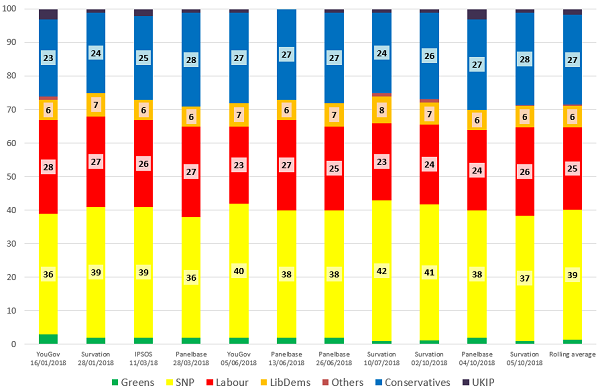
Public opinion is a strange beast indeed. When you least expect it, and when all recent events should lead to the exact opposite, polls show an unmistakeable Conservative surge. And one that goes beyond the Labour surgelet we had in July. Unbelievable as it may seem, Tories would do better in a snap election held this week than they did in 2017.


Trends definitely show it. The Conservatives are back in the lead and with a higher margin than last year. Even the LibDems surge that could have damaged Conservatives' prospects seems to be now dead in its tracks, though they would still do a wee smitch better than at the last GE. And the SNP is no longer on an upward trend, though also still doing better than last year. Full Scottish polls fielded in October show it as I already discussed in my last Scottish Westminster update.


So it seems we reached this twilight zone where democracy ceases to be an educated choice and morphs into a cross between delusion and idiocy. Which by the way you can blame on the Little England voters only as they still are the ones most likely to fall for Tory propaganda.

Sitting on a Barbed Wire Fence


The oddest part of this polling is that 'None Of The Above' is still the preferred next PM if polls are to be believed. But once this is taken out, Theresa May still wins over Jeremy Corbyn. Though with like 40% of respondents sitting on the fence this one is still far from a resounding vote of confidence. But May saved her ass for now in front of the 1922 Committee so she might not in such a precarious position as she was a few weeks ago, whatever polls say.


But of course the most important part is current voting intentions. My updated super-sample includes six polls fielded between 11 October and 30 October, all after the Conference Season and enough to get a fairly good idea of its fallout. Sample size is 8,288 with a 1.04% MOE. And here is what it says:


Saying that the Labour Conference failed to make the desired effect would be the understatement of the year. A 4% Conservative lead is more than we've seen for months and more than in 2017. Don't ask me what went wrong. Ask Jeremy Corbyn. And now their muddled stance on tax thresholds certainly won't help either especially after 20 Labour MPs defied the whip and voted against Hammond's last batch of artistically crafted tax cuts for the wealthiest.

Changing of the Guards


On these numbers here is the House of Commons we would get. Nothing like a major upset. More like taking us back just a few years as it would look quite similar to the 2015 House.


This wouldn't be a realigning election like 1945, 1979 or 1997. More like a readjustment election like most GEs are. Tories would just get a small but sufficient majority just as in 2015 and the upside for them would be not needing the DUP crutch anymore and all the bribing and blackmailing that goes with it.

Now you might notice that Tories would get 333 seats. Which is exactly half of 666. Just make the hell what you want of that πŸ‘ΏπŸ˜Ž. And Labour would get 237, which is the number of the haunted room in Stanley Kubrick's version of Stephen King's The Shining. But again don't read too much into this either.

It's All Over Now, Baby Blue


What current polling predicts is 31 seats changing hands, quite low by usual GE standards. Only 1951, 1955, October 1974 and 2001 saw a lower number of changes. And that low number of changes delivered a new majority only once in 1951. So we would be very far from an earthquake election even though the Conservatives would feel in a festive mood after gaining back a majority. Guess that the SNP and the Liberal Democrats would be more relieved than festive after such results as it could have ended up far worse for both.


There would be nothing too sensational in the list of MPs losing their seats. Though some of the changes might not happen depending on who is actually selected. I can't see Labour reselecting Woodcock or O'Mara so that might be a way to save both seats in spite of the math. Then Labour has de facto made reselection mandatory, and of course some deselected MPs might choose to stand as independents, which would totally reshuffle the deck. And certainly switch the seats because of split votes.
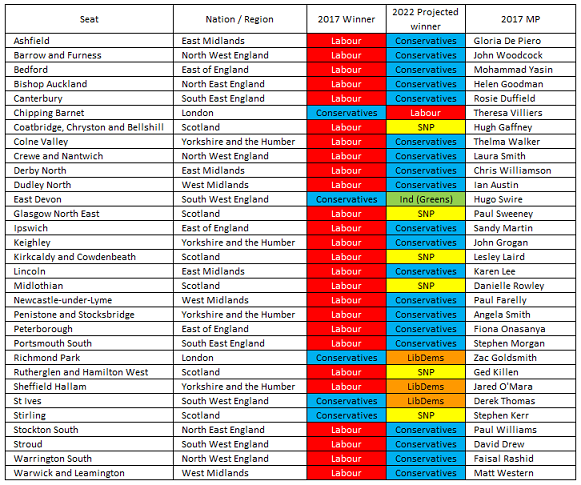

So no real Balls Moments to be expected here. Labour would lose just two members of the Shadow Cabinet: Lesley Laird and Paul Sweeney. And I guess Labour HQ would shrug it off anyway as acceptable collateral damage as both definitely failed to make a lasting impression either on their party or on Scottish public opinion.

Simple Twist of Fate


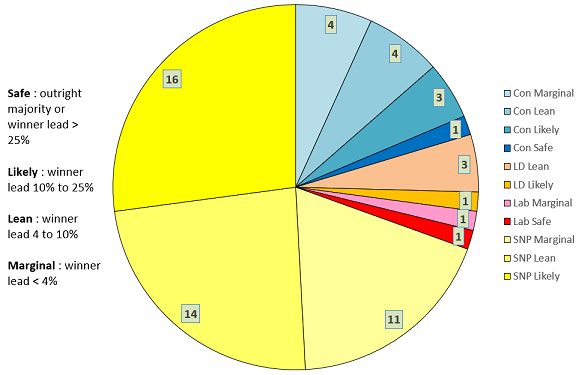
Then we would have 49 marginal seats overall where the winner's margin is within MOE. With an uncomfortably high proportion in Scotland and relatively few in England. Blame that on the number of safe seats the last GE delivered for both Conservatives and Labour.


Under the proper local circumstances Labour might still find a way to unseat Iain Duncan Smith in London or Stephen Crabb in Wales. But Boris Johnson's seat is definitely out of reach and now even Anna Soubry and Amber Rudd are squarely out of the danger zone. That is until polls take another unexpected turn, which might still happen sooner than later.

Don't Think Twice, It's All Right


Alternate scenarios after reallocating the marginals to the runner-up don't really change the big picture. Worst case scenario for the Conservatives would basically be a repeat 2017 which, except for the DUP thorn in their side, would be almost just as good as a repeat 2015, considering. Guess Theresa May's spad team could spin even the status quo as a victory.
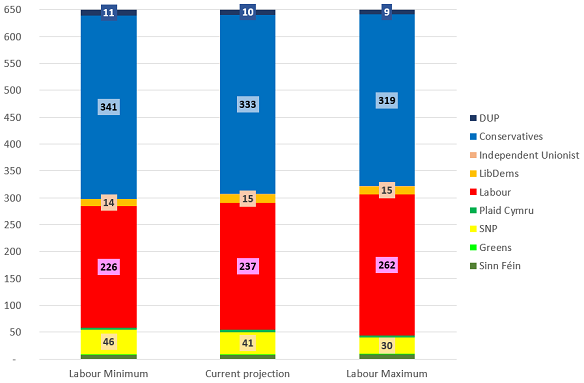

Even the Conservatives' best case scenario would not be a Titanic disaster for Labour as it would not be much worse than a repeat 2015. At least nothing they can't recover from with the right strategies. Which might include taking a real and united stand on major issues and voting accordingly. Including not abstaining. But maybe I'm asking for too much here. By the way stopping obsessing over Scotland and starting concentrating on England might be a good idea too. Juist sayin.

Union Sundown


Much has already been said about Brexit increasing the likelihood of Scottish Independence and Irish Reunification. Time will tell. But already current polling confirms the deep geographical divide between the nations and also a deepening rift within England itself.


Don't be flabbergasted by the massive Tory lead in England. Just remember that in 2017 Tories won England by 4% overall, and by 7% with London taken out. So it's more like history repeating itself with just a swing to the worse for Labour in some English regions. The slightly better LibDem result certainly doesn't help either in competitive seats. UKIP's surge too is not such good news for Labour as we already know they're likely to take as many votes from Labour as from the Conservatives especially in Labour-Leave constituencies.


Current polling confirms widely different patterns from one English region to the other. Voting intentions did not move in the exact same directions since last year but the North-South divide is still here. And possibly stronger with Midlands having moved slightly towards Labour. What the future may bring is hard to tell. Only that England falling apart is not as far fetched a scenario as might have been a few years ago. Minimal devolution within England has already started and you can only expect more demand for it. Until the Union sundown turns into a full Union breakdown.

Just think twenty years ahead. Independent Scotland. Independent Wales. Reunited Ireland. And a Federal England with maximum devolution to all its nine constituent regions. Don't tell me it wouldn't work. That's the way the United States have worked since 1776 and Germany since 1949. Only Little Englander spirits could stop that from happening. And alas probably would.

But one can dream. Or can't he?

Going, Going, Gone


Not so long ago the question was: when will May be gone? Now it seems to have become: will she go at all? It's common knowledge the Mogglodytes already have the 48 signatures needed to trigger a leadership contest. Only they have chosen not to forward them to the 1922 Committee for now. Because you never know how it could end. Again it's all about Tory factions and not the best interests of the UK.

Soubrynistas don't have the numbers to trigger a leadership contest and probably wouldn't if they had them, as the winner would be Johnson or Rees-Mogg and they don't want either as the next PM. Johnsonites and Mogglodytes might feel trigger-happy at times but then the leader of the other faction might win and that's reason enough to take a step back and think it through before blowing the place up.

Then May might get help from where you least expect it (or do you?): Labour. 'Westminster grapevine' has it that some 45 Labour MPs would defy the whip and back the PM on Chequers or whatever other variant of the 'no-deal deal' she tables for a Commons vote some time in November. And on top of that you'd probably have like a dozen Labour abstainers. Which might be just enough to counterbalance the Mogglodytes' and Soubrynistas' defections and grant May the get-out-of-jail-free card she needs.

If May wins the Brexitocalypse 'no-deal deal' vote even by only a handful of votes, she can easily spin it into a major success. No matter where the votes came from and why, that would make her immune to a leadership challenge for at least some months. So don't hold your breath. May might very well be in a position to hold a snap election at a date of her choosing. Or not hold it at all.


But as usual expect the unexpected. And stay tuned for further updates.


Wha daur meddle wi' me


01/11/2018

Scottish Westminster projection - October 2018 Revisited

Background: yet another new Scottish poll


Contrary to my expectations, we have a fourth full Scottish poll this month. First batch are still here: Survation for the Sunday Post (fielded 28 September to 2 October), Panelbase for the Sunday Times (fielded 28 September to 4 October) and Survation for the SNP (fielded 3 to 5 October). And now the new one: Survation for the Daily Record (fielded 18 to 21 October).

Here is what the four individual polls say and their weighted average. We've seen better results for the SNP recently. Especially the most recent poll, fielded after the SNP Conference, is clearly worrying. But bear in mind the weighted rolling average still remains better for the SNP than the 2017 results.


And here are the seat projections each poll delivers and what the rolling average says. Rolling average based on a super-sample of 4,090 with 1.49% MOE.


'Good' news is that even the worst recent poll would return basically a remake of the 2017 election. The SNP would lose North East Fife to LibDems but gain back Stirling from Conservatives. Bad news is that it also means SNP could end up with a net loss of seats if the actual vote is down to the lower edge of MOE.

But who's gonna be my MP now?


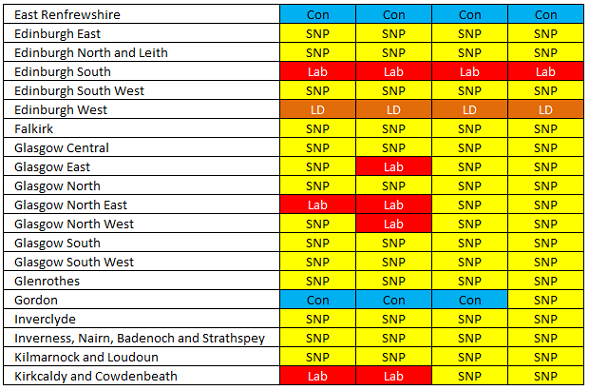
Here is what these four October polls would deliver. Seats by SLLM rating first and then the summary.


Just like with early October polling six seats would change hands. Five from Labour to the SNP and one from the Conservatives to the SNP. But the last poll also adds more uncertainty into the mix so nothing should be taken for granted, now less than ever.


Ending up six seats up from the last GE is obviously an excellent result for the SNP at face value. But, as usual, there are other sides to the story. Darker ones.

So what could go wrong?


On this updated polling 16 Scottish seats qualify as marginals. Including all six projected SNP gains. And this time five sitting SNP MPs are in the danger zone instead of just one in my last projection. David Linden, Chris Stephens, Angela Crawley, Stephen Gethins and Pete Wishart might find the next GE a tougher fight than expected.


This is of course still better than the 2017 result when 14 SNP seats were marginals, but definitely a more precarious situation than was projected from earlier 2018 polls. The frontier between marginals and safer seats has moved back into SNP territory but five Unionist seats are still endangered besides the six already projected to switch to the SNP.

After reallocating the marginals here are the possible ranges of seats current polling delivers for each party. Not as good for the SNP as previous projections as the worst case scenario would see them losing seats. Current odds are it wouldn't get that bad and the SNP would gain some seats anyway but the most recent poll should also ring an alarm.


And finally the full breakdown of seats, as usual from the worst to the best projected results for the SNP.


What to expect now?


As I said in my previous projection, we all know how quickly a seemingly favourable situation might take a turn for the worse. Which is just what the most recent poll confirmed. I certainly don't want to be overly alarming but the polls' trends are not what they used to be. The SNP steadily did better from the beginning of the year until summer. But now there's definitely a slump. And one that for once benefits both Conservatives and Labour, not just Labour as it did in the past. Reason enough to be more prepared than ever for any further upset.


So the two major steps I mentioned last time remain valid: massive GOTV effort and keep the GE campaign focused on the relevant issues. The SNP obviously can't afford to be dragged down to 30 seats as might be possible under today's worstest case scenario. Technically it would still be a majority of Scottish seats. But obviously the immediate Unionist reaction would be that getting barely 51% of the seats annuls the triple-lock mandate on holding a second Independence referendum.

Strong campaigning and a strong media presence are just as necessary as ever. Or else we might want to brace ourselves for more unpleasant news. More on this when we have some more full Scottish polls available.

So as always stay tuned for further broadcasts.


Cha togar m' fhearg gun dìoladh


13/10/2018

Scottish Westminster update - October 2018

Background: a new batch of Scottish polls


For this update on Scottish Westminster voting intentions and seat projections I will rely on the same three October polls I used for my Holyrood update. As a reminder they're here: Survation for the Sunday Post (fielded 28 September to 2 October), Panelbase for the Sunday Times (fielded 28 September to 4 October) and Survation for the SNP (fielded 3 to 5 October). 

Here is what the three individual polls say and their weighted average. The result is slightly less good for the SNP than what we had in June-July but again better than the 2017 results.


Bear in mind all three polls were in the field between the Labour Conference and the SNP Conference. So they tell us nothing about a possible post-Conference bounce for the SNP but they tell a lot about the Magic Dick Effect for Labour. Which is a 2% swing from Labour to the SNP compared to the 2017 results. So much for Richard Leonard being the Next Scottish Wonder and Killing Off The Nats.

Then this only confirms the trend we have seen all along in 2018 polls: the SNP always the first party and Scottish Labour always unable to do really better than their 2017 performance. Surely some polls have been better for the SNP than what we have now. But being 2% up from 2017 is still better than being 2% down. Or isn't it, Richard?


So now might be a good time for the Scottish Branch Office of the English Labour Party to reassess their priorities for good. What does Scottish Labour actually stand for when bedding with the Tories in Scottish Councils? And shouldn't they tone down the 'SNP Bad' rhetoric when 31% of their own voters support Scottish Independence according to the last two Survation polls?

Turns out Scottish Labour have only themselves to blame for making themselves irrelevant. So now Scotland has turned into a Tory-SNP one-on-one. Which is exactly what the SNP should wish for.

But who's gonna be my MP now?


Here is what these three October polls would deliver. Seats by SLLM rating first and then the summary.


On this polling six seats would change hands. Five from Labour to the SNP and one from the Conservatives to the SNP. Again these results show that Conservative and LibDem MPs prove harder to unseat than Labour ones. But also that some of the projected SNP gains are quite fragile.


For the record here is the seat projection each 2018 poll would have delivered individually. Some far better for the SNP than current polling and some far worse. But in the end the big picture points to a SNP surge which was certainly not a done deal when facing all the recent anti-SNP propaganda.


Ending up six seats up from the last GE is obviously an excellent result for the SNP though we have seen better not too long ago. But as always the SNP need a fair assessment of which of their seats are actually in the danger zone and which opposition seats are ready to fall, and how this should dictate the allocation of resources and manpower in the next campaign.

So what could go wrong?


Right now 12 Scottish seats qualify as marginals. Noticeably down from the 2017 result when we had 20 such. And with only one sitting SNP MP in the danger zone but then he always was.


Oddly current polling being less favourable for the SNP than the June-July polls has also moved the frontier between marginals and safer seats deeper into Unionist territory. Seven Unionist seats are now endangered, including two LibDem seats that looked safe last time aboot. You never know what can happen in marginals.

After reallocating the marginals here are the possible ranges of seats current polling delivers for each party. Good again for the SNP as even the worst case scenario has them up from 2017. And as always nothing should be taken for granted, especially seats that might shift on some hundred votes.


And finally the full breakdown of seats, as usual from the worst to the best projected results for the SNP.


What to expect now?


Probably no more fresh Scottish polls for a long time, unless we finally get a late November snap GE. Which I don't think of as the most likely scenario right now. Then current good polling should not get the SNP into the false comfort of over-confidence. We all know how quickly a seemingly favourable situation might take a turn for the worse. So the SNP have to be ready for any upset and get prepared accordingly.

First and probably most important step is a massive GOTV effort by the SNP. Never forget that turnout dropped by 261k between 2015 and 2017 and there is every reason to believe these missing voters were massively SNP-leaning. If these voters had showed up the SNP would likely have cut their losses by half. And we also have repeatedly seen how differential turnout can hurt the SNP in Council by-elections, even in seats that on paper looked like a done deal.

Second point is to make sure the next GE campaign stays focused on the proper issues. It will not be about how the SNP do in Edinburgh but solely how Tories do in London. So let's not repeat 2017 and get cornered into discussing the Scottish Government's performance on devolved matters. The SNP has to be on the offensive on reserved matters, most prominently how their awful handling by the English Government also deeply hurts Scotland. 

And as always stay tuned for further broadcasts.


Cha togar m' fhearg gun dìoladh

© Calum Macdonald, Rory Macdonald 1987

12/10/2018

Holyrood projection - October 2018 update

More Scottish polling at last


Seems there has been quite a frenzy to feel Scotland's pulse again recently as we had three new polls in quick succession. Oddly all were fielded before the SNP Conference so we will have to wait for further polling to know if there's any Conference bounce, or not. Interestingly all three follow the 'poll till you boak' pattern that Survation already used, with detailed data on the Westminster vote, the Holyrood vote and the Second Independence Referendum including Brexit options.

For full results and crosstabs just click on the links: Survation for the Sunday Post (fielded 28 September to 2 October), Panelbase for the Sunday Times (fielded 28 September to 4 October) and Survation for the SNP (fielded 3 to 5 October). Don't worry too much about the sometimes significant discrepancies between the three as I will be using weighted averages which are designed to iron out the outliers.

So with three different and equally meaningful issues being addressed in these three polls I had to choose which one to start with. And that will be the Holyrood voting intentions because I have this hunch they're the ones that currently matter most.

So what do Holyrood voting intentions tell us?


First and foremost that the Early Autumn polling is pretty close to the Early Summer polling. Like all the shiteslinging that happened since just left no trace, be it 'Salmondgate' or the truckloads of lies and insults hurled at the SNP by the various Unionist factions and their friends in MSM.

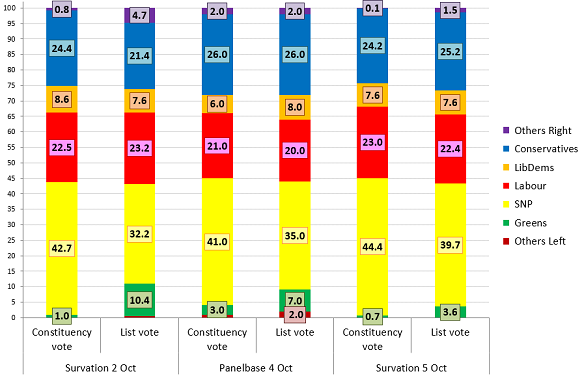
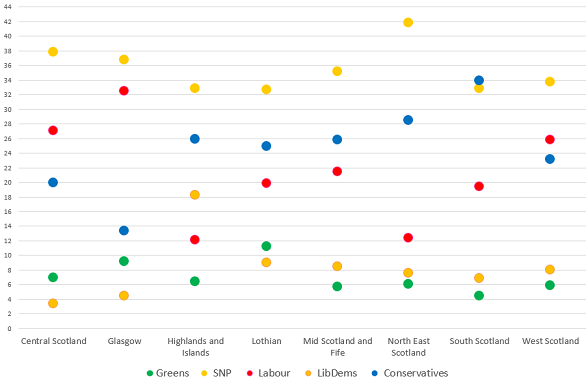
Here is what the three individual polls say. As always there are some discrepancies like on the list vote for the Greens. Also Survation insist on publishing their result with one decimal pace, which is quite irrelevant when you have like 3% MOE on any given poll, but I always oblige them.


With all these caveats, here are the weighted averages we now have:


Not as good aw we could hope for the SNP as they are down on both votes from 2016. But still good enough for promising results as we shall see later. Even the breakdown of the list vote by region has barely moved and South Scotland remains the odd one out with Tories in the lead as on the Early Summer polling, again for the first time since 2003.


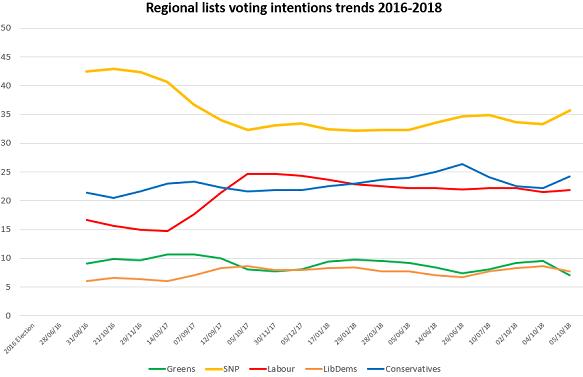
Finally the trends on both votes show that, despite ups and downs, the Scottish electorate are still happy enough with the SNP to grant them sizeable and improving leads. Though of course the SNP should never take anything for granted, especially votes when the highest factor might very well be the differential turnout again.


The constituency results


On this polling here is how the 73 constituencies project on SLLM rating.


Only one seat would change hands: Perthshire South and Kinross-shire (Roseanna Cunningham) switching from the SNP to the Conservatives. Guess this one would offer the BBC some Portillo Moment re-enactment but it would be only a marginal Tory gain, so not a given if the SNP hear the warning and campaign hard enough in that seat. Then we would also have seven marginal seats that might go either way.


Raw math says that John Swinney and Richard Lochhead, among others, might also have a harder time holding their seats than expected. But the upside could also be unseating Trident-lover Jackie Baillie. You never know what might happen in marginals.

The regional lists results


As usual the bizarre workings of AMS would trigger more changes on the list seats. Here are the results we get by region on current polling. This time the Liberal Democrats and the Greens would come out as the winners with respectively three and two gains and no losses.


For the other parties there would again be some sort of musical chairs with seven seats overall changing hands. Right now the list MSPs notionally losing there seats would be Maree Todd, Paul Wheelhouse (SNP), David Stewart (Labour), Alison Harris, Dean Lockhart, Tom Mason and Maurice Corry (Conservatives).


The big picture


Finally here is what the next Scottish Parliament would look like on this polling, and how the parties would perform in terms of net gains and losses. The Liberal Democrats and Greens would score only gains, the SNP only losses, while Labour and the Conservatives would have a mix of both.


These results are generally good for both the SNP and the Yes movement. The SNP is still the only party able to form a government and the pro-Independence majority gained one seat from where we were on June-July polling, just one seat short of the 2016 result. And we have further confirmation that the SNP are on an upward trend, at least as far as Scottish Parliament elections are concerned, and no longer the downward trend we saw in 2017.

Full breakdown of seats by region


The usual stuff. Not much to add here.


Just note that some surprises may happen with the seventh list seats as five of them would be won by less than 1,000 votes. Surprisingly the shakiest would be the LibDems' seventh in Highlands and Islands, won by just 100 votes in a region where they otherwise do quite well.

And now what next?


You might remember that a month ago, the conclusion of my last Holyrood projection was that I did not expect 'Salmondgate' or the various 'SNP Bad' made-up controversies to have any effect. And that's exactly what happened, with the SNP even slightly up on both votes.

Not that the SNP should lapse into complacency because this batch of polls is good. The next one might not be so. And we all remember how well "We don't take anything for granted…. except your votes" worked in 2016 and especially 2017. So let's just avoid that next time.

More than ever stay tuned for further broadcasts.


Nemo Me Impune Lacessit


The Smile Signals Emptiness

I hear the approaching thunder that, one day, will destroy us too. I feel the suffering of millions. And yet, when I look up at the sky, I s...