14/07/2018

Westminster projection - 13.07.2018 update

I'm not in the habit of posting updates every other day. But now seems the right time to do just that as things are moving fast this week. As in 'one poll a day' since the botched 'Chequers Deal'. Funniest is what happened to YouGov. The Times commissioned an extra poll ahead of the weekly regular probably to assess the instant fallout of the ongoing Tory debacle. YouGov had that one in the field on 8-9 July. The Times certainly didn't like the results as they showed a tie between the Conservatives and Labour. But the regular weekly poll that was in the field on the heels of the special on 10-11 July was even 'worse' with Labour leading by 2%.

As I said things are moving fast. Remember that two weeks ago that very same YouGov weekly had the Conservatives leading by 5%. Of course this is part of the post-Davis/Johnson frenzy and the influx of new polls will soon slow down. But what they show right now is worrying for the Conservatives and possibly an incentive for the Government NOT to hold a snap GE in September, in the hope of long-term recovery. I think I remember Gordon Brown believed that too some ten years ago.

The big picture:


Out of the six most recent UK-wide polls you can find here, four have been in the field after the Chequers fiasco including two partly and one entirely after the Davis-Johnson walkout. And their weighted average shows Labour closing in on the Conservatives.


This is not the result of Labour doing better as they too are down from 2017. But the Conservatives are doing even worse with a number of voters switching to both UKIP and the LibDems. Current super-sample size is 9,018 with a 1.0% MOE.

With this polling we might either have four outliers in a row or a turning point. Since the former is statistically highly unlikely then it has to be the latter.

Where does that take us?


Updated seat projection is pretty impressive.


For the first time in ages Conservatives would be below 300 seats and Labour would gain significantly more seats outside Scotland than they lose in Scotland. Downside of course is that no party could even dream of forming a viable government coalition and so it's the recipe for yet another snap election. Fancy this: the only time in history when the House of Commons votes to dissolve itself on the same day as the State Opening of Parliament. Would be truly grand for once.

And now the summary of projected gains and losses and the full list of seats projected to change hands. With a handful of Balls moments (what used to be called Portillo moments in the last century).


With only 27 seats changing hands this would by no means be an 'earthquake election'. That would actually be a record-low number of changes since 2001. But the alternate scenarios sound more promising.

Alternate scenarios:


See what happens when I switch to 'Labour minimum' and then 'Labour maximum'. For a reminder of how these work go back to my previous article here.
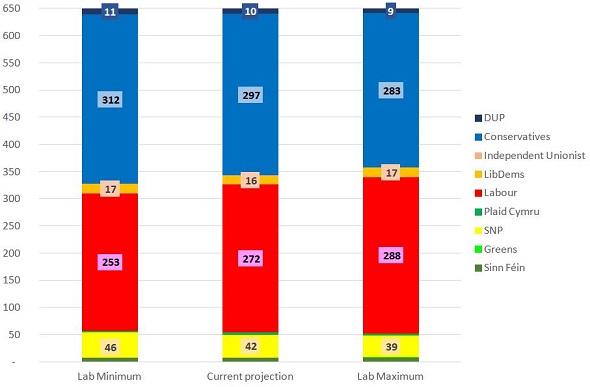


'Labour minimum' has now become the status quo scenario with Conservatives staying in power only thanks to the DUP, though now that would be just a two-seat majority. 'Labour maximum' is trickier. Even with Labour becoming the first party they would have to risk a 'grand coalition' with the Liberal Democrats, the Greens and Plaid Cymru. And even if that worked it would still be a minority government on at most 310 seats overall. Unless of course….. But this time you won't get me started about that SNP confidence and supply deal….

So these projections show that we have already come a long way from where we were after the 2017 GE. But there's still a long way to go before 'PM Jeremy' (not me, the other one). Labour should know by now what they have to do: go for the jugular all over England, because their weaknesses are still there somewhere Doon Sooth even in the 'Labour maximum' scenario.

An aside about Scotland.


Rumour has it some SNP MPs are worried at the prospect of a September snap GE because they held their seats with only small margins last year. Their concern is about a Tory-Labour one-on-one all over the rest of the UK possibly triggering a Labour surge in Scotland too. So let's get down to basics: last year vote shares were SNP 36.9% and Labour 27.1%. Current Scottish polling says SNP 39.5% and Labour 24.5%. That's a 2.6% swing from Labour to the SNP with Labour losing five seats. And I will stick with that until further polling says otherwise.

So before the Scottish Branch Office of the Labour Party can credibly consider aiming at any gain they first have to get back these 70k-odd voters and these five potentially lost seats. Which is far from a done deal in my opinion. Of course future polls might take an unexpected twist and the SNP should not take anything for granted. For once. But honestly I don't think there's too much to worry about. For now.

Stay tuned for more updates and upsets.

Saor Alba gu bràth


11/07/2018

Westminster Flash Update - 11.07.2018

Just a short update to my Westminster projection. Two days ago I wondered 'is a change gonna come?'. Today with three more polls in there's definitely something in the air.


Today's super-sample is 7,940 (1.07% MOE) based on the six most recent UK-wide polls. Three fielded before the botched 'Chequers deal' and three after. Two of them were out in the field in part after Davis' and Johnson's resignations. Updated polling average:


Conservatives down to a 1% lead is in itself an upset. Factoring in MOE this basically amounts to a tie. Updated seat projection is pretty interesting too:


Even with DUP support Conservatives would still be 10 seats short of a majority. The summary of gains and losses and the list of seats projected to change hands confirm these have really been bad days for the Conservatives. A handful of Portillo moments in there.


Of course this is just a snapshot and we have to wait for more polls to see if this is just a momentary response to recent events or the beginning of a downward spiral for the Conservatives. You never know.

Stay tuned for further updates.

Saor Alba gu bràth


09/07/2018

Westminster projection - 09.07.2018 update

The big picture:


I have not updated my Westminster projection for a while simply because recent polling was like Groundhog Day Déjà Vu All Over Again Rerun. Poll after poll after poll sent the same message: Conservatives leading by 2-3% and seat projection almost a repeat of 2017. Then Survation released a new poll on Saturday that has Labour in the lead for the first time in a month.

Of course it might be just an outlier and we definitely need more polls to assess the impact of recent developments (the half-boiled 'Chequers Deal', the shockwave of Boris Johnson's and David Davis' resignations and how all this will wreak havoc within the Conservative Party). But it might also be the first hint of a real change in voting intentions. We'll see…. Anyway weighted average of last six UK-wide polls now says this:


Super-sample size is 8,354 (1.04% MOE). Labour and Conservatives are both slightly down, with Conservative leading by 1.9% (down from 2.4% at 2017 GE). Updated polling also confirms SNP surge that I already discussed in a previous post.

Where does that take us?


On these numbers projected House of Commons (HofC) would look like this:


Obviously this is not an upset but it would put Theresa May in a very uncomfortable position anyway, with Conservative-DUP coalition one seat short of a majority. Such a result would undoubtedly add momentum to any ongoing backbenchers' revolt within the Conservative Party. Also for the first time in weeks Labour would almost make up for their losses in Scotland with a handful of gains in England. 

Now bear with me for a second and do the math. A 'Magic Rainbow' coalition of Labour + Greens + LibDems + Plaid Cymru + SNP would also get 321 seats. Leaving Sylvia Hermon to decide who becomes the next PM. Well one can dream. Or can't he?

Back in the real world, here's the summary of projected gains and losses and the list of seats projected to change hands:


With only 12 seats (1.85% of HofC) changing hands this would be an all-time low in reliably recorded parliamentary history. Only previous GE that came as close to a status quo as this is December 1910 when only 13 seats changed hands. Coincidentally that election too delivered an awkward result for the government of the day (Liberals) and they too had to seek support in Ireland (though from a wholly different side).

Alternate scenarios


I have two basic alternate scenarios: 'Labour minimum' and 'Labour maximum'. The method is simple: just swing the Labour vote to the lower edge of MOE or the higher edge of MOE respectively, with the Conservative vote swung in the other direction and see what happens. The only exception (as always) is Scotland. I input data from my 'SNP max' scenario into 'Labour minimum' and data from my 'SNP min' scenario into 'Labour maximum'. For a reminder of what's behind 'SNP min' and 'SNP max' see my previous Scottish Westminster projection post.

So here are the statistically possible ranges of seats under current polling and the summary of projected gains and losses under the two 'extreme' scenarios:


Note that even the two 'extreme' scenarios would have only a relatively low number of seats changing hands (24 or 33). 24 would be a record-low since 2001 when only 27 seats changed hands. Wee smitch of useless trivia: in 1951 too only 27 seats changed hands and it's the only time such a record-low number of changes brought on a change of government.

Finally the kind of coalition we might get under my three scenarios:


It's pretty clear for me that Conservatives have run out of options. The only one they have left is further life-support from the DUP. If I were Arlene Foster I would not let Tories get away with a one-shot £1bn bribe. I would go for a yearly £1bn donation for the duration of the term.

Meanwhile Labour have a lot of options open, if only they were bold enough to go all the way. Meaning a truce with the SNP in return for confidence and supply. Even if that means eating their collective hat and disavowing everything the Scottish Branch Office has stood for in the last six years. Throwing Richard Leonard under the bus would be a small price to pay to get Jeremy Corbyn to Number 10.

Breakdown by nation/region:


The projected breakdown of seats by nation/region confirms what we already knew. Labour's weaknesses are in England outside London. They were 98 seats behind Conservatives there in 2017 and are still projected to be 95 seats behind on current polling.

So that's where the battleground is, not in Scotland. It is also quite clear that most Conservatives seats in the South West, South East and Anglia are uphill battles for Labour. Their best gain opportunities are somewhere between the Severn-Wash line and Hadrian's Wall. Surely Labour should prioritize marginals in this area when they allocate campaign resources.

And where do we go from here?


I wish I knew. Next batch of polls will tell us.

After Conservatives' 'septimana horribila' I wouldn't be surprised to see them down a couple of points again. With polling average a tie or even a tiny Labour lead.

Time will tell.

Stay tuned for further updates.

Saor Alba gu bràth


04/07/2018

Holyrood projection - June 2018 update

The big picture:


As I said in my previous post, someone was really eager to feel Scotland's pulse in real time last month amidst all the political turmoil. Just like we had three Scottish Westminster polls in June, we also had three Holyrood polls (one of them polling only the constituency vote). See them here. For the record there had been only 13 Holyrood polls in two years before that.

Super-sample on constituency vote is 3,114 (1.7% MOE). On regional list vote it's 2,096 (2.1% MOE). And here are the voting intentions the weighted average delivers:


At face value you might think 'good for the SNP' as their projected Holyrood constituency vote is higher than their projected Westminster vote. But it's not. Actually it's a pretty bad result for the SNP.

Current polling says SNP is down 5.8% from the 2016 Scottish Parliament election on constituencies. And down 7.8% on the regional lists. 

While Conservatives are up 5.3% on constituencies and up 3.1% on regional lists. 

Labour level on constituencies and up 2.9% on regional lists. 

Liberal Democrats down 1.8% on constituencies and up 1.2% on regional lists. 

Scottish Greens up 1.4% on regional lists, the only vote that really matters for them.

What it delivers:


Constituencies by SLLM rating. List seats by region. And the full result.


So projected result on current polling is SNP down eight seats, Conservatives and Labour both up three and Scottish Greens up two from 2016 election. Bottom line: pro-independence parties down to 63 seats, two short of a majority.

What happens in the constituencies:


The SNP is projected to lose six constituencies, all to the Conservatives:


Surely some of these projected SNP losses are shockers. Who can imagine Richard Lochhead, John Swinney, Roseanna Cunningham and Maureen Watt losing their seats? Let that sink in and then rewind to 2017.

Shocking upsets happened at 2017 GE though they were 'politically unlikely'. Most of them unexpected. And most of them in the same area from Moray to Perthshire. So I'm not ruling out upsets at 2021 Holyrood election either. However 'politically unlikely' it may seem I go with the math: SNP six constituencies down.

But of course there are some marginal constituencies that might tilt either way and influence the outcome. Though with the weird Additional Member System (AMS) we have in Scotland you never know. Anyway here are the five marginal constituencies we have on current polling, including four of the six projected Conservative gains:


And here we just stumbled upon on of AMS' oddities: sometimes a gain is not a gain. Meaning a change in constituency results can, under the proper circumstances, be 'compensated' by a change in the other direction in list results. We have two such cases here.

If the SNP hold Moray, then they lose their one projected list seat in Highlands and Islands. And if they lose Angus South, they gain one list seat in North East Scotland where they're currently projected to have none. In both cases the overall result is unchanged.

The other three seats tell a different story. Under current polling the SNP are projected to win no list seats in Mid Scotland and Fife or in North East Scotland. So if the SNP manage to hold the three marginal projected Conservative gains there (Perthshire North, Aberdeen South and North Kincardine, Angus North and Mearns), there can't be any 'compensation' by a list seat loss. Then the overall result would change to:


In this 'best case scenario' for the SNP, pro-independence parties hold their majority by ONE seat. As fragile a mandate as can be.

Back to the big picture:


Finally here is the complete seat breakdown by region.


As with my Scottish Westminster projection, next update will be next time we get further Holyrood polling.

Might be next week. Might be two months from now.

Saor Alba gu bràth


01/07/2018

Scottish Westminster projection - June 2018 update

Before I start, a quick reminder. For these projections I use only full Scottish polls, that is ones fielded in Scotland only and with a credible sample size (> 1,000). I don't use subsamples from UK-wide polls as they have too big a margin of error (MOE) and also deliver highly volatile results.

Of course there are far fewer Scottish polls than UK-wide polls for the next General Election. Only twelve so far since the 2017 GE. Then all of a sudden we get three in June which will be my super-sample for this projection, see details here.

I think it's far from a coincidence these three polls were fielded in quick succession last month in the middle of political turmoil (SNP walkout, 'power grab' controversy). Surely someone wanted to feel Scotland's pulse on a more regular basis.

The weighted average of these three polls results in these voting intentions (super-sample size 3,114, MOE 1.7%):


That means SNP up 1.8%, Conservatives down 1.6% and Labour down 2.1% from the 2017 GE. Only caveat is that Scottish Greens' and UKIP's voting intentions are based on the premise that both would field candidates in every constituency. If 2017 is any indication this will not happen and these theoretical votes will switch to other candidates. My best estimate is that the tiny UKIP vote will switch to Conservatives. And the Green vote will split roughly 2-1 between the SNP and Labour.

And now the seat projection (detail by SLLM rating and summary):


It's not as spectacular a shift as 2015 or 2017. But 10% of seats changing hands is already quite an achievement when current UK-wide polling predicts next to no change at next GE in the rest of the UK. Below are the six seats projected to change hands. One from Conservatives to SNP. Five from Labour to SNP.


Remember that in 2017 Labour's average margin in the six seats they gained was only 2.14%. So they're highly vulnerable even to small swings in voting intentions. Conservatives' average margin in the twelve seats they gained was 9.04% so gaining them back is quite an uphill battle for the SNP in most cases.


Then of course there remains some uncertainty because of the 1.7% MOE we have with current polling average. The way I see it eight seats are in some sort of 'danger zone'. Meaning a swing roughly equal to the current MOE might tilt them either way and change the outcome. Here they are: 


Remarkably only two of the SNP's projected gains are within the danger zone. The swing from 2017 in current polling is enough to make the other four 'Lean SNP' rather than marginals. And only one of the seats currently held by the SNP appears vulnerable (North East Fife) as it was held by only two votes last year.

So here are the possible ranges of seats once we factor in MOE. Remarkably even in my 'SNP min' scenario the SNP would still bag a net gain of three seats. Liberal Democrats also do well as their average margin in the three seats they gained in 2017 was 7.53%. So it would take more than current swing for the SNP to gain any back.


And finally the projected seats breakdown from 'SNP Min' to 'SNP Max' scenario, compared to 2017 results:


Next update will be next time we get further Scottish Westminster polling.

Might be next week. Might be two months from now.

Saor Alba gu bràth

The Smile Signals Emptiness

I hear the approaching thunder that, one day, will destroy us too. I feel the suffering of millions. And yet, when I look up at the sky, I s...