03/12/2018

Westminster projection - 03.12.2018 update


Battle For Britain


General Election polls never cease to amaze me. Or, more exactly, the mood swings of the English electorate do. They make up 84% of the overall electorate so they hold the key to any GE and should take 84% of the blame if the end result is unmitigated disaster. After a long period of Tory lead which would have given them an outright majority, we're now back to alternating Labour and Tory leads. We have been down that road before and already know it's a dead end street leading to a deadlock.


Trends definitely show Labour closing in on Tories but at slower pace than the last time it happened. Recent YouGov polls, as usual rather Tory-friendly, might explain this in part. But there also some mixed messages in there. Like some LibDem voters switching back to Tories to keep Corbyn out while some others switch to Labour perhaps mistakenly believing that somehow Labour could mitigate the fallout of Brexitocalypse, which they obviously can't.
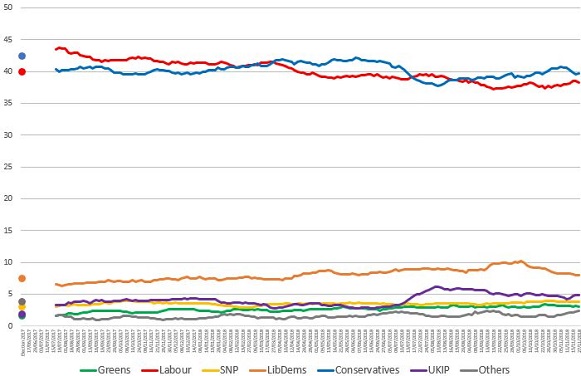

UKIP are still trending around 5% which will gain them nothing except the dubious pleasure of jeopardizing Tories' chances in a few marginal seats. Finally the SNP are still doing well which strengthens their position both as Scotland's dominant party and as the ones with a mandate for Independence.

Where Are We Now?


My current super-sample includes the last six polls, fielded between 2 November and 27 November. Super-sample size is 9,784 with a 0.96% MOE and it delivers an almost perfect tie between Labour and the Conservatives. Which is where problems begin.


Because of course nothing says 'Trouble Ahead' better than the two main parties both losing votes from the last GE and the number of potentially wasted votes increasing.


The Next Day


As expected crappy voting intentions deliver a crappy seat projection. Full speed ahead into a deadlock with Conservatives bagging 45% of the seats and Labour 43%. As usual different voting patterns translate into a bonus for Conservatives on similar vote shares. But more to the point neither of the two main parties is in a position to form a strong and stable government no matter what combination you try.

The aftermath of such and outcome would be interesting to watch as it is one of these rare situations where both major parties actually lose the election. Guess that both Jeremy Corbyn and the then Tory leader, whoever that might be, would be handed their P45s in no time for failing to deliver. Which of course would do nothing to solve the problem. But there's nothing here that another snap election couldn't cure. Or not. Depending on which way it goes: 1910ish into another dead end that would require extreme solutions (like that deal John McDonnell pledges will never happen) or 1974ish into the narrowest of majorities.

Ashes To Ashes


On this projection the body count would be 37. Labour would get their PortiBalls Moment unseating Amber Rudd. Which is why her chances in a leadership election are close to absolute zero. Tories just wouldn't choose a leader who held her seat by just 346 votes and is at the top of Labour's hit list. Or would they? Second-tier trophies would two Ministers of State (Eustice and Lancaster). Third tier would be three whips (Whittaker, Pursglove, Stephenson) and four PUSS (Smith, Andrew, Doyle-Price, Harrington). And yes you might want to look up the last one before getting any naughty ideas about what it really is.


But the overall balance of gains and losses is far from stellar for Labour. A net gain of just 16 seats is far from the 60 they need for a majority. I fully expect them to blame it on Scotland and I will just stress that current polling has them 49 seats behind Tories in England outside London. A 50-50 split of seats down there would do the trick and it requires 'only' a 3-4% additional swing to Labour. They've done better than this in 2017 so what can possibly be the problem?


Incidentally doing better in London than current polling predicts (down 6% and two seats) would also help Labour, at least symbolically, even if it would possibly switch only a handful of seats. Losing their two unexpected and highly symbolic 2017 gains (Battersea and Kensington) would be a blow to Corbyn in his own backyard. Guess London Labour would put up a serious fight to at least hold these two even if they fail to make further inroads into Tory territory there.

Quicksand


Current polling would deliver 43 marginal seats within MOE, down from 66 in 2017. With only 22 of them in England outside London. Voting patterns Doon Sooth would make a large number of seats more competitive but 313 of the 460 Little England seats (68%) remain safe including 147 current Labour seats and 162 current Conservative seats. Which makes a 1997ish landslide unlikely for the time being unless the cumulative effect of Mayxit, a leadership free-for-all and Brexit triggers some sort of collective Tory meltdown even in their heartlands.


Even without a full Tory meltdown Labour still have two high profile targets worth putting up a fight to turn them into first-tier trophies. Solicitor General for England and Wales Robert Buckland in South Swindon, a Labour seat from 1997 to 2010 and considered a bellwether. Minister of State for Employment Alok Sharma, Amber Rudd's right-hand man at DWP, in charge of Universal Credit and sanctions, which should make him a first priority target. Just like South Swindon, his Reading West seat was held by Labour from 1997 to 2010 and is also considered a bellwether.

Wild Is The Wind


Even after reallocating marginals to the runner-ups, this batch of polls would deliver a quite chaotic situation. At one end of the spectrum Conservatives would be 20 seats short of a majority. I think a resurrection of the Con-DUP deal is highly unlikely as the whole Brexit bùrach has left many open wounds, especially the backstop fiasco. Unless of course DUP can be appeased by another bribe, say £2bn this time. At the other end, even the unlikely Lab-Lib coalition would be 12 seats short of a majority and could probably deliver no better than a short term caretaker government until the second 2019 snap GE. Unless of course Corbyn chooses to boldly go where no Labour PM has gone before….
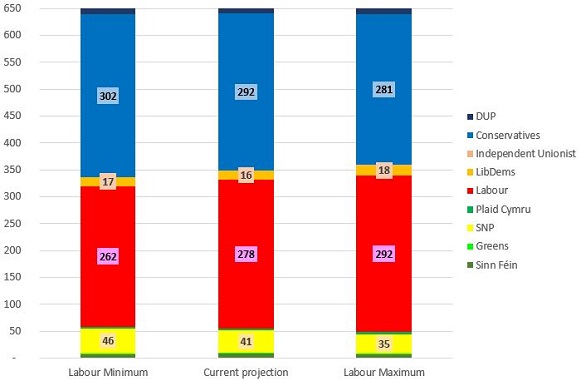

…. and at last have some adult conversation with the SNP. Right now Labour seem confused about this. Emily Thornberry is ready for a deal to pass an alternate Brexit plan. John McDonnell rules it our for fear it would imply granting a Section 30 order. But his point might be moot anyway as a strong legal case can be made that the Claim of Right, as agreed by Commons last July, gives Scottish Government full authority to call a referendum without a Section 30 order. Would be interesting to try it and see what the Supreme Court has to say.

As an aside I compared my projection with the results you get when using the two projection models currently available online (Electoral Calculus and Election Polling) as I did earlier with the Scottish Parliament projections. As expected the differences between the three models are minimal. Nothing here that can't be explained by the slight differences between the algorithms when moving from pure UNS (Election Polling) to slightly tweaked UNS (Electoral Calculus) to UNS-PNS mix (my model).
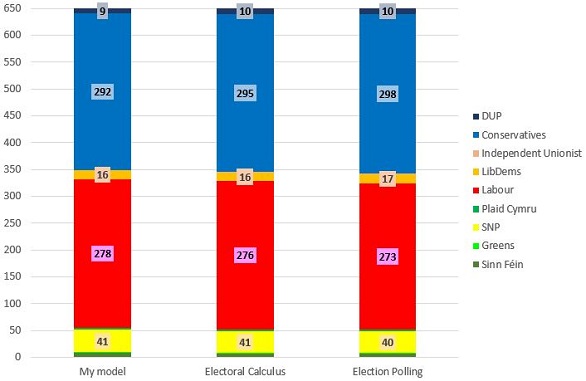

A difference of 5-6 seats does not change the conclusions with the current batch of polls. It would become relevant if we had something like 'Labour projected 4 seats shy of majority'. But of course such a result would revive the old debate about Scotland holding the key to Number 10, which is a wholly different story.

Sense Of Doubt


Early last month Survation released a Jumbo Poll (20k sample) soon followed by its breakdown by nation and region. Polls with such a huge sample don't happen often and regular polls usually have 1k-2k samples. Such a huge poll would definitely act as a black hole warping the time-space continuum if it was included in a 'poll of polls'. Whatever other polls fielded over the same period say the Jumbo Poll would dominate and swing the weighted averages to values almost identical to its own results.

When the Survation Jumbo was released I had more than reasonable doubt as it showed Labour leading by 1% while earlier polls had the Conservatives leading for over a month. Which begged the obvious question: what if the Jumbo Poll is the outlier and will totally distort any results and conclusions? Which is the reason why I postponed any update of my projections until I had at least another six polls fielded later that would help assessing the actual trends.

As it turned out the Survation Jumbo was not an outlier but an advance warning of a shift that was broadly confirmed by later polls. Here is the seat projection it would have delivered combined with its regional sub-polls (samples are big enough to not call them just 'subsamples').


This projection is quite close to the one based on my current super-sample. Only noticeable difference is in Northern Ireland where Survation sees SDLP and UUP coming back with two seats each. Which might or might not happen. There haven't been any full scale polls of Northern Ireland since the last GE and the Survation sample is only 555 and down to 394 when undecideds and refusers are removed, not enough to draw conclusions. So for the moment I will discount it and wait until further NI polling reliably shows massive changes from 2017.

So now we are back to the 'business as usual' reasonable doubt about the reliability of all polls. Which I can address only with the alternate scenarios moving the swingometer to the outer limits of MOE. Might be enough or might not, only actual election results will tell.

Something In The Air


From my days in France I remember an expression that always made my day: la niche est tombée sur le chien. Of course a lot is lost in translation as 'the kennel fell on the dog' is certainly less dramatic than 'the walls came tumbling down'. Then this week in Theresa May's life really made me think the kennel had fallen on her and this might very well be just the Prelude To Mayxit. 

Next week will undoubtedly be even worse as the English Government is headed to a massive defeat in Commons. Last Government talking point is that 'under the Brexit deal we have agreed to strike an ambitious new flexible and scalable relationship that allows us to combine resources worldwide for maximum impact' (Steve Barclays's own words). Which doesn't mean fuck all in plain English and certainly won't help clarify what's really in the 585-page agreement.

May winning the vote on 11 December would be a major upset. But odds are heavily against her. Below is my take on what the vote might deliver, and how Guardian sees it as of 3/12, might still change before the vote. I have reallocated all 'independents' (withdrawn the whip mostly) to their original parties and left some room for abstentions as some MPs might actually have last minute second thoughts. But the verdict is clear: FAIL.


Unfortunately what the oppositions have to offer just doesn't cut it. In their own words Labour "respect the referendum result but don't respect the Tories' botched Brexit negotiations". Their alternative is a 'comprehensive and permanent Customs Union' coupled with a 'strong Single Market relationship'. That would be some sort of 'Norway Option' while the SNP's proposal as described some days ago by Ian Blackford would be 'Norway Plus'. Problem is that both are but a pipe dream as EU has made it abundantly clear there will be no further negotiation and it's now decision time. Donald Tusk put it bluntly: if the May Deal is voted down then it's either No Deal or No Brexit. Though the latter sounds to me like way outside the bounds of plausibility as it would require revoking Article 50 and nobody has the weest clue how to get it done clean and quick.

I have a hunch the Tory vote of no confidence in May will then become irrelevant as she will resign (even if Guardian says otherwise) rather than face another predictable and humiliating defeat. Her successor, whoever it might be (and my guts say it won't be Johnson) will then have little choice but to at last call the Long Awaited Snap GE, which technically can still happen before Brexit Day. Some Tories have already expressed concern that it might be a 1997ish debacle, but I'm sure some others secretly with they lose it so that Labour will have to clean up their mess. Time will tell.

If the snap GE happens, looks to me like the SNP's manifesto is already written for them: seek a mandate for Independence while hammering home what a disaster the Labour-assisted Tory Brexitocalypse is for Scotland. And stay on course. Don't let Labour drag you into a debate on how ScotGov could mitigate the impact of Tory policies Labour helped pass. Don't let Tories get away with their betrayal of Scotland and how they lied even to their core electorate. Get the message home at all hustings, especially in areas likely to suffer most from Brexit and where seats lost in 2017 can be taken back this time. Think Moray, Gordon, Banff and Buchan, Dumfries and Galloway, Aberdeen South and be bold. Juist sayin….


And as usual stay tuned for further upsets and updates.


Saor Alba Gu Bràth


28/11/2018

Scottish Westminster projection - November 2018


The road so far


Once again Somebody Doon South seems eager to feel Scotland's pulse in almost real time so we got three Scottish Westminster polls this month: Survation for Channel 4 (fielded 30 Oct to 2 November), Panelbase for Constitutional Commission (fielded 2 to 7 November) and Survation for Scotland In Union (fielded 9 to 13 November). The SNP's Westminster voting intentions here are quite close to the Holyrood constituency voting intentions in recent polls which definitely sends a mixed message as it means Westminster vote is up while Holyrood vote is down. Good news though is that the last three Westminster polls show a slight SNP surge from earlier polling.


Here are the voting intentions these three polls predict when taken individually and their weighted average. Current super-sample is 3,336 with 1.64% MOE.


Interestingly the most recent trend again shows a slight swing from Labour to the SNP. As usual this will project into devastating results for Labour, quite predictable when looking at the change in vote shares from 2017.


The main swing is from Labour to the SNP with LibDems too snatching some votes from Labour. Greens and UKIP are also doing better but I think this will not materialize in the actual election. Polls implicitly assume all parties would stand in all constituencies which was far from true in past elections. So I guess Greens and UKIP will actually not do better than in 2017 as they again will field candidates in only a small number of constituencies. The Conservatives will benefit from the lack of UKIP candidates and might get roughly the same vote share as in 2017. The SNP mostly and Labour to a lesser extent will benefit from the absence of Green candidates though I think the 2% swing from Labour to SNP will stay.

And where does that take us?


The SNP nearly 2% up and Labour 3% down is bound to trigger some significant changes. Remember 20 Scottish seats were marginals in 2017 including 14 decided by less than 2%. Labour's lead in the six seats they gained in 2017 was barely 2% while the Conservatives led by 9% in the twelve seats they gained. So again the SNP would do well against Labour on current voting intentions while Tory MPs would prove harder to unseat. For now.

Here are the seat projections for the three polls individually and on their weighted average. Illustrating the Scottish electoral paradox: 39% at a Westminster election is a success and gains seats while 39% at a Holyrood election is a setback and loses seats.


Weighted average says the SNP would take back five seats from Labour (Coatbridge, Chryston and Bellshill, Glasgow North East, Kirkcaldy and Cowdenbeath, Midlothian, Rutherglen and Hamilton West)  and one from the Conservatives (Stirling). Then the distribution of the 59 seats by SLLM rating is also pretty good for the SNP with 35 seats held or gained with a margin larger than the polls' MOE.


But of course the SNP should devote special attention to the marginal seats which might deliver either good news or bad news depending on which way the wind blows.

What might possibly go wrong?


Right now polls suggest we would have eleven marginals, down from twenty in 2017. Good news is that only three of the six projected SNP gains are in the danger zone. Bad news is that three seats currently held by the SNP are too.


Pete Wishart and Stephen Gethins might be in trouble which comes as no surprise as their seats were the two closest in 2017. Angela Crawley too as her seat was the closest three-way marginal in the whole UK last year. But as usual a lot will depend on whom stands against them. For example Murdo Fraser standing in Perth and North Perthshire would undoubtedly improve Pete Wishart's chances. And Tories might even be daft enough to actually select him.

Below are the ranges of seats that can be expected when moving the swingometer to the outer limits of MOE. These results confirm that Labour is in worse shape now than last year as they would lose at least three seats no matter what. And that Conservatives remain the clearest and presentest danger for the SNP though we can't rule out a Brexitocalypse backlash that would seriously weaken them especially in the North East. And possibly spell doom for The Rosses, aye this one (especially if Angus Robertson is willing to try a rematch) and that one.


And finally the fully seat breakdown as usual from worst to best for the SNP.

What to expect next?


Interestingly the most recent poll was fielded after 7 November, the SNP's dies horribilis in Holyrood and shows an improvement over the previous one fielded just before 7 November. So maybe I was mistaken in my assessment of that day's fallout or more probably public opinion make a clear distinction between Westminster elections and Holyrood elections and what matters most in each case. Doesn't mean the SNP shouldn't be vigilant about the state of mind of public opinion and act accordingly. Listen and explain, which does not mean bowing to public pressure. Clue: watch Macron and do the opposite.

With less than stellar results expected at the next Holyrood election, an indisputable victory at the next GE is more necessary than ever. The SNP have to focus their campaign on two major issues: Independence and Brexit fallout. Don't make the same mistakes as in 2017. Don't let yourselves be dragged into debating P1 tests, planning, potholes, bin collections or whatever outside reserved matters. This is a GE not a Scottish Parliament election or Council elections.

Stick to what makes the best case for Scotland and hurts Tories the most. Like reminding public opinion that Tories sold out Scottish fishing industry to get a better deal for Gibraltar only to get that deal vetoed by Spain and Spain de facto getting shared custody of Gibraltar. Then never fail to highlight Labour's never ending hypocrisy. Like when they voted against Full Fiscal Autonomy and devolving social security schemes and now urge the SNP to cure the fallout of Tory austerity Labour supported or abstained on. Make it the main talking point that both the Brexit bùrach and the Universal Credit disaster are the shared responsibility of Tories and Labour. And don't worry too much about LibDems as they will make the case for their own irrelevancy.

Above all make Indy a major campaign issue so that the first lock in the triple-lock mandate is not just renewed but strengthened by an increased number of seats. After all Thatcher herself made that point.

And as usual stay tuned for further upsets and broadcasts.


Cha togar m' fhearg gun dìoladh


20/11/2018

Holyrood projection - November 2018 update


More Scottish Parliament polling again


Five Holyrood polls were fielded in October and November, including two after the SNP conference: Survation for the Sunday Post (fielded 28 September to 2 October), Panelbase for the Sunday Times (fielded 28 September to 4 October), Survation for the SNP (fielded 3 to 5 October), Survation for the Daily Record (fielded 18 to 21 October) and Panelbase for the Constitutional Convention (fielded 2 to 7 November). As always there are noticeable discrepancies between their results so each taken individually might lead to different conclusions. So first here are the voting intentions from all five:


I will not draw hasty conclusions from just one poll as John Curtice did in The Daily Record based on the 21 October poll only. As always we must take a step back and look at the bigger picture. Though the SNP should be worried that the two polls fielded after the conference are also the ones with their lowest voting intentions. Current super-sample is 5,136 with 1.33% MOE. So, with all the usual caveats, here are the current weighted averages:


This is a clear warning for the SNP. Being 5% down on the constituency vote and 7% down on the list vote from the previous election means bad news. But bear in mind the SNP won 53 of their 59 constituency seats with double-digit margins in 2016 so most seats remain likely or safe holds. Then we all know the list results are largely pre-determined by the constituency results. So the odd ways AMS works make a 7% loss on the list vote less of a threat that you might think at face value. But the combination of both is a giant step into the danger zone.

The constituency results


On this polling here is how the 73 constituencies project on SLLM rating.


On current polling six seats would change hands, all from the SNP to the Conservatives: Angus North and Mearns (Mairi Gougeon), Aberdeen South and North Kincardine (Maureen Watt), Edinburgh Pentlands (Gordon MacDonald), Moray (Richard Lochhead), Perthshire North (John Swinney), Perthshire South and Kinross-shire (Roseanna Cunningham). The first five would be marginal gains with less than 2% lead so odds are the SNP could in fact hold them with strong campaigning. Perthshire South would be trickier as the projected Tory margin would be almost 6%. Then we would also have six marginal seats that might go either way, including five of the projected Tory gains.


Raw math says that Graeme Dey might have a harder time holding his seat than expected though a Tory gain remains a remote possibility. The drop in SNP vote also puts the current Labour seats out of the danger zone though Labour would still be unable to gain any extra one.

The regional lists results


As usual the bizarre workings of AMS would trigger more changes on the list seats. Here are the results we get by region on current polling. This time the Liberal Democrats and Labour would come out as the winners with three gains and two gains respectively and no losses.


For the other parties there would again be some sort of musical chairs with nine seats overall changing hands. Right now the list MSPs notionally losing there seats would be Ross Greer (Greens), Maree Todd, Paul Wheelhouse (SNP), Alison Harris, Jeremy Balfour, Alexander Stewart, Dean Lockhart, Peter Chapman and Tom Mason (Conservatives).


Interestingly five of the potentially defeated Tory list MSPs (Balfour, Stewart, Lockhart, Chapman, Mason) might even keep their day job if they're lucky enough to be selected in one of the constituencies Tories are projected to gain in their respective regions. Though one of them would have to throw Murdo Fraser under the bus to get selected in Perthshire North. And two of the potentially defeated SNP constituency MSPs (MacDonald, Gougeon or Watt) might be just as lucky if they top the list in their regions. The 'compensatory seats for FPTP losers' part of AMS.

The big picture


Finally here is what the next Scottish Parliament would look like on this polling, and how the parties would perform in terms of net gains and losses. The Liberal Democrats and Labour would score only gains, while the other parties would have a mix of gains and losses. And the end result is quite distressing.


These results would be an unmitigated disaster for both the SNP and the Yes Movement as a whole. Switching from a nine-seat pro-Independence majority to a one-seat Unionist majority would blow up two of the locks in the triple-lock mandate to seek Independence. Now just picture the electoral schedule if no snap GE happens in the meantime: Holyrood elections in 2021 and 2026, Westminster elections in 2022 and 2027. Provided the pro-Independence majority comes back in 2026, the first realistic window of opportunity for another Section 30 order would be 2028. Meaning independence pushed back to 2030 at best, if ever. Let that sink in and you will realize why the SNP definitely need to up their game and do it quick (more on this below). Of course that also means SNP voters need to get their asses out of the couch and get the fuck out to vote. With all due respect.

But as usual there is more here that meets the eye at first glance. So I tried to determine which alternate scenarios are possible under current polling. It's quite easy to figure out which constituency seats are marginals but a wee smitch trickier for marginal list seats. I simply added a feature to my model that swings the list vote shares to the outer limits of MOE, uniformly across all regions. It's admittedly a rather crude approach but it delivers a rough estimate of what could happen with both the FPTP and the list vote moving to the edges of MOE:


The pro-Independence parties could now be anywhere between 60 and 68 seats. Which doesn't mean a pro-Independence majority could be held that easily. Odds are more like 3-to-2 in favour of a Unionist majority. Labour and the SNP are the two most impacted by small swings and for the exact opposite reasons. Labour because they rely almost exclusively on list seats and the SNP because they rely almost exclusively on FPTP seats, so both are more sensitive to even small swings in either category. Conservatives have a more balanced representation so fall in the grey zone where changes in FPTP seats are roughly compensated by changes in the other direction in list seats.

Finally the usual breakdown of seats by region.


Just remember that some surprises may happen with the seventh list seats as some would be allocated with less than 1% margin. AMS delivers marginal list seats just like FPTP delivers marginal constituencies. For example Ross Greer would lose his West Scotland seat by barely 2k votes out of an estimated 300k turnout, while Greens would miss a seat in South Scotland by about 800 votes and hold one in Mid Scotland and Fife by about 700 votes. And the surprise SNP seats in Lothian and North East would be gained by 300 and 700 votes respectively.

Can election projection models be trusted?


Questions are often asked about the reliability of projection models and the results they deliver. All legitimate questions as the seat projections often make headlines and undoubtedly influence the parties' campaign strategies. Besides my own model I know of two sites who currently offer a prediction tool for Scottish Parliament: Scotland Votes and Election Polling. I have explained in a previous post how my own model works. I don't know the exact algorithms used by the other two models but the results they deliver give strong hints about how they work.

So here is what my model projects from the five polls taken individually and their weighted average:


Same using Scotland Votes:


Same using Election Polling:


Finally how the three models allocate constituency and list seats, based on the weighted average:


The results from all three models are quite similar as might be expected. The differences in constituency seats come from the relative weight of Uniform National Swing (UNS) versus Proportional National Swing (PNS) used in the algorithms. The differences between UNS and PNS are explained here. I have done various simulations that show Scotland Votes uses pure PNS and Election Polling uses pure UNS while my own model uses 30% PNS + 70% UNS. UNS is slightly more favourable for the SNP while PNS is slightly more favourable for the Tories.

Differences in the list seats results come from the way the raw data are processed. Both Scotland Votes and Election Polling appear to use full UNS across al regions. I rely instead on regional crosstabs when they exist (Survation) and full UNS only when the pollster does not publish regional crosstabs of the list vote (Panelbase). Then I can only state the obvious again: projections are only as good as the polls they use. And we all know UK polls in general and Scottish polls specifically are not exactly the most reliable in the galaxy.

Of course what really matters is that all three models show an Unionist majority. Whether it's by one seat or three seats is irrelevant. The point is that these results, plus the fact that the most recent polls are also the worst, should raise huge red flags for everyone in the SNP. The next Holyrood election is three-and-a-half years away and already Unionists are on the offensive on all fronts. So should the SNP lest they be doomed to suffer a major setback.

And now what can possibly go wronger?


I am less optimistic right now about the SNP's future prospects than I was a month or two ago. This is not just because of the less than stellar voting intentions in the most recent polls as we don't know yet if this is the start of a real downward trend or not. It has more to do with what happened in Holyrood two weeks ago and how the SNP fumbled it on two major issues. Two major political fuckups, one of which is already a PR disaster and the other a timebomb.

First we had the SNP voting down Labour and Green amendments to the Planning Bill. The story has already been told so I won't repeat it, and all the hard facts are in the Official Committee Report anyway. You could call that one an own goal. When even The National publishes a highly critical article on the issue, you should realize something went wrong. Unless of course if you think pissing off environmentalists and community activists, who otherwise might have felt inclined to support you, while handing out ready-to-use live ammunition to the oppositions is a viable option.

On the afternoon of the same day Scottish Parliament passed the infamous People's Vote amendment, which made an already bad day even worse. This story too has been told repeatedly with all sorts of spin by everyone from Patrick Harvie to Andrew Adonis. As usual all the gory details are duly recorded in the Official Chamber Report. If you read the full motion as amended it is quite obvious that Tavish Scott's amendement is not actually one. Rather it's a rider (non-germane amendment in parliamentary lingo). And quite obviously appending it to Richard Lochhead's motion was a trick to ensure it would pass, as SNP MSP's would find it more important to support the motion than to question the amendment. And it worked though some reportedly have buyer's remorse now. But too late. 


You might remember that I explained why the SNP supporting People's Vote would be very bad idea. That was three months ago. Others on Twitter sent strong warnings too at about the same time, long before the SNP conference. A lot of SNP MPs, former MPs, MSPs and local branches are on Twitter and quite a number of them follow me and other 'concerned Yes tweeps' who addressed the issue back then. So it's not like the SNP can pretend they haven't been warned. As much as I hate going into 'I told you so' mode, I guess that's just the thing to do this time. 

Then we had Pete Wishart and Angus MacNeil voicing concern about how support to People's Vote could harm the second Independence referendum. When both the 'cautious path to Indy' guy and the 'bold path to Indy' guy raise the same objections, it should flash a massive red light and give reason to think it through. Especially when you remember that Wishart tweeted early in August that he was 'open to the idea' of supporting People's Vote and then obviously fully assessed the downside. That all of this did not set off an alarm invites the obvious question: what are Sturgeon's ulterior motives here?

Because of course nothing beats pissing off SNP-Leave voters and Yes-Leave voters in a single blow. Except possibly drawing flak from your own parliamentarians while going squarely against public opinion who don't support the SNP's stand here. The National had an online poll on the very issue after the ScotParl vote and here is what it says:

I see a disturbing similarity with the 2010 coalition deal here. Just like Nicola Sturgeon with People's Vote, Nick Clegg had made up his mind beforehand to ram the coalition deal down his party's throat not matter what. And it did not exactly end well for the Liberal Democrats and Clegg himself. Let's just hope the similarity will not go that far for the SNP.

More than ever stay tuned for further upsets and further broadcasts.


Saor Alba Gu Bràth


The Smile Signals Emptiness

I hear the approaching thunder that, one day, will destroy us too. I feel the suffering of millions. And yet, when I look up at the sky, I s...